





Featuring the soulful vocals of NANDI alongside Laura’s instantly recognisable horns, “Juna” has taken an extraordinary route to the dancefloor. Originally conceived in 2020, an uncleared Oumou Sangaré sample left the track in limbo before a chance encounter at Ibiza Airport eventually connected the pair with NANDI and provided the missing piece. Now finally released and already proving its power at Pikes and 528, the single encapsulates the instinct, persistence and Ibiza spirit at the heart of Laura & Santiago’s music.
We caught up with the pair to uncover the full story behind “Juna”, discuss their creative rebirth and the freedom afforded by Creature Mode and explore how marriage, music and Ibiza continue to shape their journey together.
Ibiza is deeply woven into your story, both personally and musically. With residencies at Pikes and Café Mambo alongside your 528 shows this summer, does the island continue to influence the music you’re making or has your relationship with Ibiza changed as you’ve evolved as artists playing internationally?
Ibiza is at the core of everything we do in the studio, and it influences us in so many ways. Inspiration can come from listening to other DJs here, being on the dancefloor and feeling what connects, but also from seeing for ourselves what gets the biggest reactions when we’re playing. At the risk of sounding pretentious, Ibiza has a certain feeling or energy, and if we get it right, we somehow manage to capture a little bit of that spirit and translate it into our music.
You’ve previously talked about the unusual dynamic of essentially living and working together 24 hours a day. Have you had to learn where the relationship ends and the work begins?
To be honest, we still very much struggle with getting the work/life balance right. I guess it’s the same for most people who work for themselves, but we’re especially bad at it! So, if anything, it’s the other way round, we need to learn where the work ends and the relationship begins!
Big time! That’s exactly what it is. The name change is something we’d thought about for a very long time, but it always felt too risky. There’s nothing like a health scare to make you re-evaluate things and, dare I say it, a bit of bravery emerged from that difficult period that helped us overcome any concerns about changing things up.
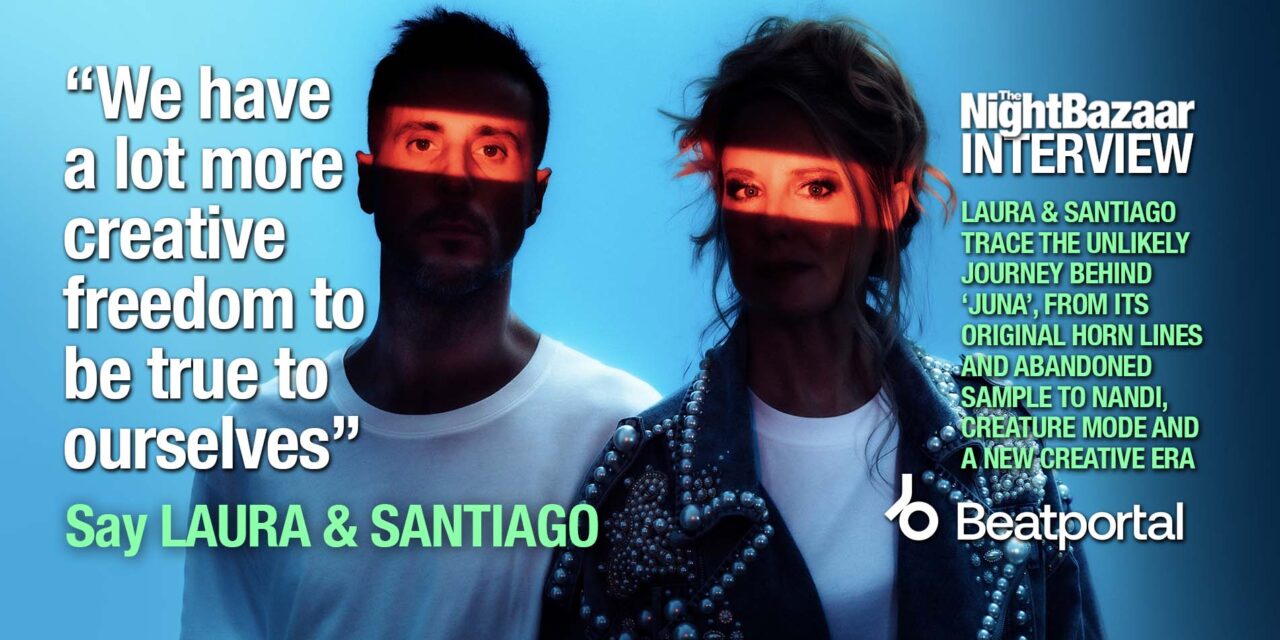
Probably the biggest thing that’s come from the name change is that we’ve let go of any worries about meeting expectations. Instead, we feel we have a lot more creative freedom to be true to ourselves. The music we’ve got coming up will totally reflect that, and we’re also working on an album that isn’t being made with the dancefloor in mind. Watch this space!

Laura & Santiago – Laura
New single “Juna” was originally recorded back in 2020, so this record has effectively travelled with you for six years. Take us back to the beginning, what was the original idea, and how different was that first version from the track we’re hearing today?
OK, we’ll share the full story with you, which we haven’t done before. Here goes…
It all started with the two horn lines that you can still hear in the version we’ve just released. It needed some vocals, and we stumbled across an African record called Mali Niale by Oumou Sangaré.
We ripped the vocals, put them on the track, and were jumping for joy at how it sounded. In our complete and utter ignorance, we thought we’d just discovered some unknown artist, had been handed an epiphany from the gods, and could clear the sample without any issues.
Turns out Oumou Sangaré is one of the most important African musicians of all time. She helped bring Wassoulou music to an international audience and has even won a Grammy. That brought us crashing back down to earth. But we still had a record we believed in… one we couldn’t release. So what do we do now?
One of us gave up hope on the record and abandoned it, but the other completely believed in it and just couldn’t let it go. I think that’s one of the great things about being a duo, you take turns encouraging each other through those moments when you know something is special and worth fighting for.

Laura & Santiago – Santiago
The eventual connection with NANDI came from a chance meeting at Ibiza airport. Can you tell us the full story of that encounter and how it ultimately led to her becoming the voice of “Juna”?
We bumped into another artist who had just been on a writing camp here in Ibiza. We got chatting and, somehow, African vocals came up in conversation. We mentioned we had a track that needed an African vocalist, and she introduced us to Nandi. The rest is history! Pure Ibiza magic at work.
Ben, you’ve said the hairs stood up on your arms when you first heard NANDI’s vocals. What was it about her performance that immediately made you realise you’d finally found the missing piece of the record?
Just the way they slotted in. There’s a real-life phenomenon called “demoitis”, where you get so used to hearing a demo a certain way that you become overly attached to it, so any change just sounds wrong. It’s a genuine struggle that producers come up against all the time. But when I first heard Nandi’s vocals on the track and the way they sat with the horn line, it completely blew any demoitis and attachment to the original version out of the water. I couldn’t believe how right it sounded, especially given how used I was to hearing the old vocals. I’ve never experienced that before, which says so much about Nandi’s talent and just how perfectly she nailed it.
Laura & Santiago
NANDI sings primarily in Ndebele, with elements of Zulu and the lyric translates as “I carry my burden / I’ll be on my way.” What does that sentiment mean to you and did understanding the words change the way you approached the finished production?
To be honest, the lyrics and their meaning didn’t really change anything. We’d already fallen in love with the emotion in Nandi’s performance before we knew exactly what she was singing. Once we found out the meaning, it just felt like another beautiful layer to the record rather than something that changed the way we approached it.
There’s an interesting contrast within “Juna”: the lyric carries a sense of burden and moving forward, yet musically the record feels incredibly joyful and uplifting. Was that emotional duality something you consciously wanted to preserve?
Not at all. It wasn’t a conscious decision – it’s just the way the record evolved. It felt right, and ultimately that’s all that matters.
Laura, your saxophone topline is one of the elements that immediately identifies “Juna” as a Laura & Santiago record. When you’re working on new music, at what point does the live instrumentation enter the process, are you writing melodies specifically for saxophone or responding instinctively to what Santiago has built?
We don’t really have a particular process or way of approaching things. In the case of Juna, the horn lines were actually the very first thing we wrote, even before the drums. On other records, though, the sax has been the very last thing we’ve added, sometimes after we’ve already got the full arrangement down. More than anything, our focus whenever we’re making music is to lose ourselves in the process and let the ideas evolve naturally. We don’t really have a set point where we think, “Right, let’s get the sax out.” It just happens whenever it feels right.
After returning to “Juna” you freshened up the drums and changed the bassline. Having lived with a record for so long, how do you modernise it without losing the character and emotion that made you fall in love with the original idea?
To be honest, we were never really happy with the old bassline anyway. It was more of a placeholder that filled out the low end than something that added any groove or melody. We just kept playing around with ideas until something jumped out and felt right.
“Juna” follows “O Ma” as only the second release on your own Creature Mode label. Why did this record feel right for this early stage of the label and what are you hoping Creature Mode will allow you to do creatively that perhaps wasn’t possible before?
The timing just fell into place. The label was due its second release at exactly the same time this updated version of Juna was finished, and it felt like a really natural follow-up to O Ma. Everything just seemed to line up. As for what we hope Creature Mode will allow us to do… simply release what we want, when we want! I think that’s one of the reasons you’re seeing so many independent labels emerge now. Artists finally have the tools and opportunities to release music on their own terms, and it’s really exciting to see the creativity that freedom is producing.

Laura & Santiago
You’ve spent years building an identity around the interaction between DJing and live saxophone, but records like “Juna”, “O Ma”, “Real Love” and “Cinnamon Flower” increasingly establish you as recording artists in your own right. Has creating Creature Mode given you a clearer idea of what a Laura & Santiago record should sound like?
Not really. I think that’s come more from gradually building confidence in ourselves and releasing music that we genuinely love, rather than worrying about meeting expectations. It’s taken us a long time to get to that place, probably longer than it should have! I imagine lots of artists go through something similar, but for whatever reason it took us a while to really find our feet. That said, horns have definitely become part of our sound. Cinnamon Flower and Juna both feature horn sections playing the main hooks, whereas Real Love centres around a sax solo that was really just one of those magical moments in the studio. Laura played it in a single take and, when we sent it to Marco Lys, he loved the whole performance so much that he kept it in its entirety.
“Juna” has already been tested at places including Pikes and 528. What have those early dancefloor reactions taught you about the record, particularly when you’re able to perform it live rather than simply play it in a DJ set?
That it goes off! It’s always an amazing feeling when a record you’ve made gets such a strong reaction, and seeing Juna connect so well with people on the dancefloor has really given us confidence in it. Those moments remind you to trust your instincts.
Laura & Santiago ‘Juna’ is out now on Creature Mode. Grab it on Beatport HERE.
Read the full interview with Laura & Santiago on The Night Bazaar HERE.