






In 1995, Ken Ishii’s Jelly Tones arrived as a message from a future that felt both global and intensely personal. Released on R&S Records at a time when techno’s axis still ran firmly through Detroit and Europe, the album quickly propelled the Sapporo-born producer into international view.
Three decades later, as a 30-year anniversary vinyl reissue returns the record to circulation, Ishii looks back on the mindset that shaped a work many now consider a cornerstone of Japanese electronic music’s global breakthrough.
Looking back three decades later, what do you remember about the mindset and creative environment that led to “Jelly Tones”? Was the futuristic tone intentional at the time or just how things sounded in your studio then?
Since I was aware that I was one of the first known Asian techno artists actually coming out of Asia, I wanted my music to sound different from the techno made by Western artists. I concentrated on using digital sounds with digital synthesizers during the production of the ‘Jelly Tones’ album. I didn’t have any of the standard gear techno artists commonly used at that time, such as the 909, 808, 303, or Akai sampler. The synth I mainly used for the album was Roland JD-800, which is 100% digital with PCM waves. The other gear was KORG M1, secondhand KORG DDD-1 and a thin Roland S-330 sampler. I guess this is why the album sounds like that to you. Also, there wasn’t really a techno scene in Japan back then, and I wasn’t influenced or taught how to make music by anyone. I made music entirely in my own way, which is one reason why my music sounded different.
“Jelly Tones” is often described as sitting between Detroit’s machine soul and unmistakably Japanese melodic sensibilities. How conscious were you of those cultural touchpoints as a young artist?
Yes, I was deeply influenced by early Detroit techno and it provided the ground foundation for my work as a music producer. However, from the beginning, I felt it was more meaningful and interesting to add my own elements to the music rather than being a follower of the Detroit sound. Many people say my music sounds “Japanese” or “Oriental”, although it wasn’t intentional. I never studied traditional music and I would never use typical Asian gimmicks in my tracks. It was just a matter of the notes and phrases that naturally came out of my brain and hands.

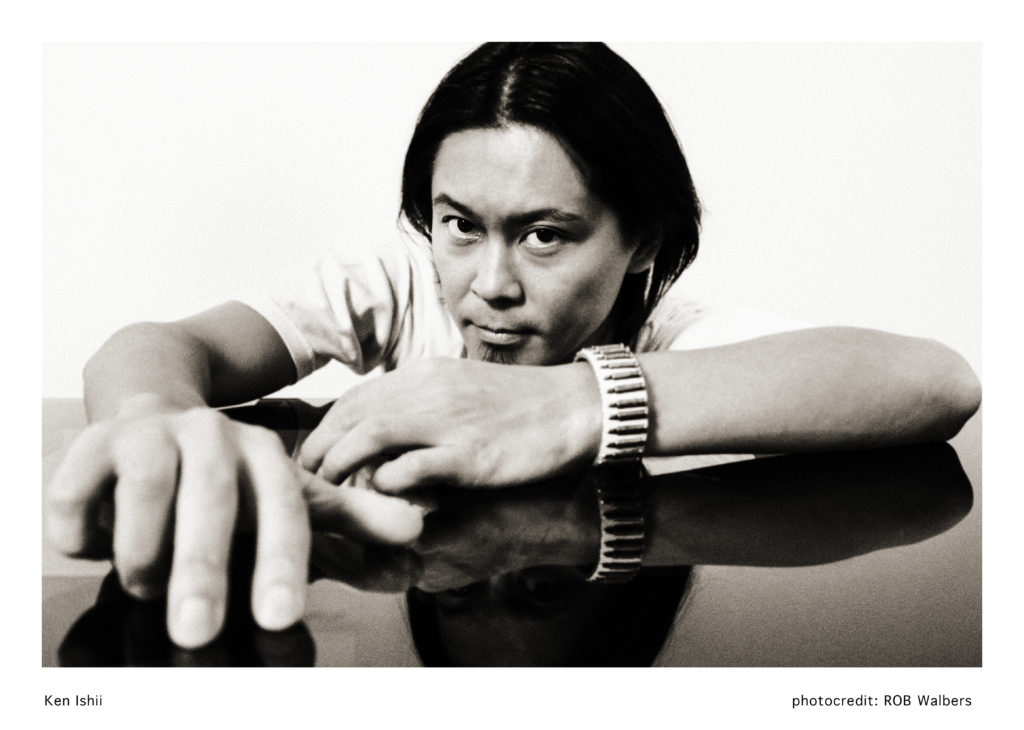
Ken Ishii
What about “Jelly Tones” still feels timeless to you and what feels like it belongs to 1995?
It was ages ago and I was in my early 20’s when I made it, so it’s naturally a part of my past. However, it’s something that made me widely known internationally, so I still appreciate the album. People still talk about it after 30 years, like this Q&A, and I still see many people who bring this album to my gigs for me for an autograph in any country I visit.
The animation world embraced “Extra” early on, especially with Koji Morimoto’s video. How did that collaboration influence the way electronic music could interact with visual culture?
One day, my A&R in Japan at that time, Hiro Hiroishi, told me a rumour that the anime guys who created the epoch-making ‘AKIRA’ seemed to like techno and often went to techno parties. We visited their studio to spoke with them and the rumour turned out to be true – I saw lots of techno CDs on Koji Morimoto’s desk. They were totally up for making a video for my track. There wasn’t really a relationship between electronic music and anime back then, so I can tell it started as a personal collaboration between us. It became the beginning of the tide, “anime and electronic music”.

Ken Ishii – Jelly Tones
For many Western artists, Japanese electronic music seemed ‘futuristic by default.’ Do you think that perception came from technology, urban life, philosophy or something else?
Maybe yes. Japan is no longer “one and only” futuristic country, but until the end of the 90s technology was our trademark and we were proud of it. At the same time, we knew we hadn’t invented the original popular music styles like classical, jazz, rock, funk, reggae etc. So we used technology and futuristic visions as our own “weapon” to compete with Western cultures, I guess.
When you revisit a 30-year-old album, do you hear the work as Ken Ishii the artist, or Ken Ishii the young student discovering techno?
30% artist, 70% techno kid. For the first two years after my professional debut and before ‘Jelly Tones’, I didn’t think about my crowd or listeners at all. I was just enjoying making music and doing gigs. My mentality was shifting
bit by bit towards something more professional though. ‘Extra’ was the first track I specifically aimed to make people dance and shout in my live set. So, ‘Jelly Tones’ was produced during that transition period. 30% was produced for the listeners, and the other 70% was still for myself.
Your work often dances between cerebral listening and physical dancefloor energy. How did you develop that duality without compromising either space?
I simply like going both ways. I still love DJing and travelling to see the crowd enjoying my music, which keeps me young and motivated to make energetic music. But I also still love to make music at home and I get happy like a kid when I create something I have never heard before. Yes, I’m lucky to enjoy both sides of music!
What was the most futuristic element of your studio setup in 1995 and what were the limitations?
The JD-800, as mentioned above, and the first Nord Lead synthesizer. The limitations were my studio itself. It was just my bedroom in a tiny apartment in Tokyo, and I couldn’t get the acoustics right. My engineering techniques were poor as well.
Do you feel the Japanese techno scene today produces its own ‘Detroit moment,’ or is it still connected to external cultural hubs?
I don’t think it’s been Detroit oriented for many years now, although some older generations show love for what they were originally into. I feel the scene is more aligned with Europe now.

Ken Ishii
When young producers tell you they discovered Detroit through Japan, how does that feel?
It makes me smile!
In 1995 techno was forward-looking; today it sometimes appears nostalgic. What should futurism sound like now?
Difficult question. Perhaps it’s no longer about technology, but something that needs human power and passion.
What still excites you in electronic music, technologically or creatively in 2026?
It’s not a specific musical style, as dance/electronic music tends to move in cycles, but there is a constant progress in music production and engineering techniques. I get happy whenever I find a new sound or a new tricks of mixdown. Everything is easy now in terms of making and playing music, but you really have to try hard to make something truly new and different from everyone else. I think you should seek to do what nobody else can do. That would be a real excitement for you.

Ken Ishii
What aspects of your current studio practice feel completely different from the era of “Jelly Tones”? And what has stayed the same?
Now, everything is computer based and I use almost no hardware for standard production, which is a major change. However, my attitude, or curiosity, to seek new and unheard sounds is still the same. It’s pure passion. I still enjoy messing around with plugins when I have time, just like I used to do with hardware when I was a student.
Are there new sonic territories or genres you’re intentionally exploring right now that might surprise your longtime fans?
I have been working on a collaboration album with a Japanese jazz pianist for the last two years. It will be a blend of funky, melodic, experimental and techno elements. It always feels fresh to do something I haven’t done before.
You’ve always balanced dancefloor functionality with musical sophistication. How does that balance manifest in your most recent projects?
I’m happy you see my music that way. When I make an album I can balance those elements across the whole project. To make straightforward DJ music, it’s not easy to find a 50/50 balance of those two things in a single track. My releases last year were mostly dancefloor material, so I concentrated on polishing the basic dance elements, but I tried to include a new sound or a new arrangement idea in every track to make it sound like me as much as possible.
Is there a piece of modern music technology that has changed the way you write or perform in the last few years?
Not really. I check out new plugins all the time though. My DJ style and gear have remained the same as well.
Do AI or generative tools play any role in your creative process today and if so, how do you use them without losing your artistic DNA?
A few months ago, I was really surprised to see for the first time how much AI music generators can do, especially for pop or mainstream type of music. However, my impression is, they are not good enough for our kind of music yet. Our music is freer and more creative and they can’t quite follow that yet. So, I don’t use them for my music.
Do you feel pressure to innovate or do you enjoy the freedom of having already carved out your place in techno history?
It’s not pressure, it’s just pure joy for me if I can make music that I find innovative. That’s why I still spend much time on making music. Music is a lifelong pursuit and I will be trying to make something better for the rest of my life.
What motivates you creatively in 2026 that didn’t motivate you in 1995?
Young producers’ music, maybe? They have so much talent as well as many more tools than we had in 1995!
What are you working on at the moment?
There is a bit more work needed for the collab album with the jazz pianist as I mentioned. I’m also currently finishing EPs for Sway and Mind Medizin. More EPs to follow this year. Plus, I will be working on a remix for Hiroshi Watanabe in the coming weeks.
Ken Ishii – Jelly Tones 30th Anniversary vinyl reissue is out now on R&S Records HERE. Grab it on Beatport HERE.
Browse our archive of interviews HERE and visit our Beatportal page HERE.