




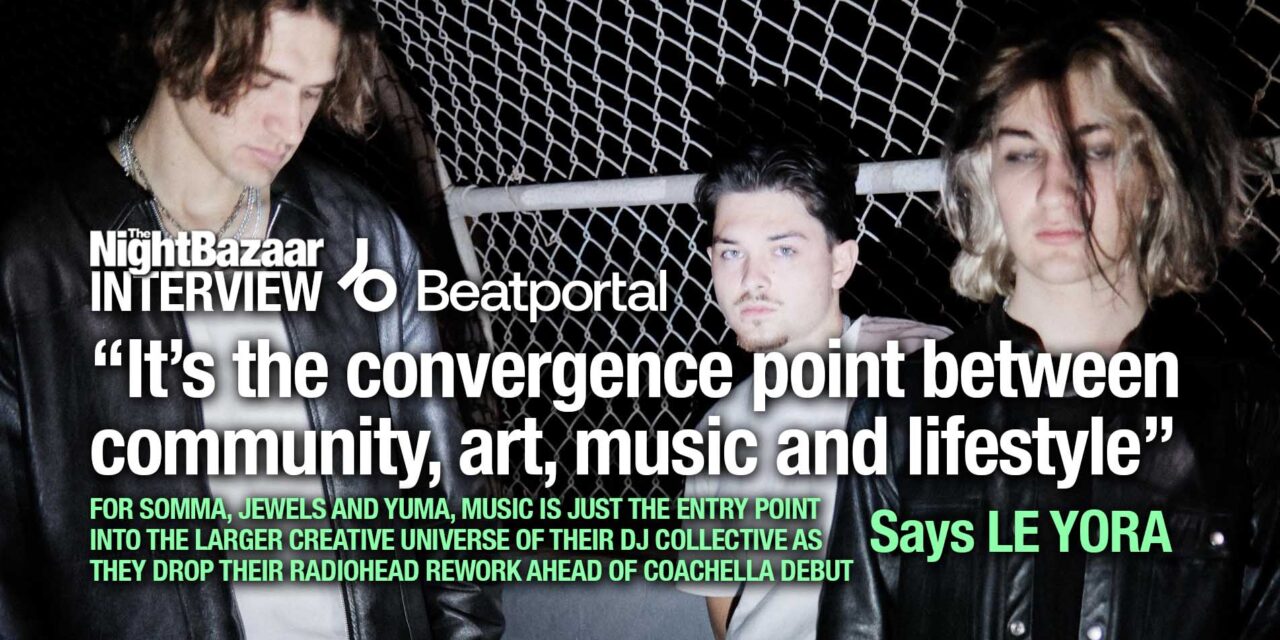
Ahead of their Coachella 2026 debut, LE YORA are moving with the kind of momentum that’s both hard-earned and carefully constructed.
The trio, SOMMA, JEWELS, and YUMA have spent the past few years building their project deliberately outside the traditional underground label circuit, shaping it into something they describe as more than a DJ-producer outfit. For LE YORA, the music is the lifeblood, but it exists inside a larger creative ecosystem spanning visual art, fashion, design and live experience.
That philosophy comes into sharper focus with their reimagining of Radiohead’s EVERYTHING IN IT’S RIGHT PLACE, a track they’ve been quietly developing for nearly three years. With early support from artists like Diplo, Adriatique, Richie Hawtin, and The Blaze and a milestone slot AT Coachella on the horizon, 2026 is shaping up to be a defining chapter.
We caught up with LE YORA to talk about building a self-contained creative world, why they avoided the standard label route, how they approached covering such an iconic record and what stepping onto the Coachella stage really represents for the collective.
You describe LE YORA as more than a DJ-producer project, as a self-contained creative world spanning music, fashion, design and visual art. When did it become clear that this would be a full universe rather than just a musical collaboration?
For us, music is about energy. We draw on a variety of influences and there’s a big emphasis on experience as a larger concept – it’s the convergence point between community, art, music, lifestyle, and more. You can just distill it down to “vibe” too. We feel this is retroactively true for a lot of projects, especially those outside of dance and elec tronic music, but we wanted to be proactive in how we present our experience and energy. It doesn’t matter that everyone experiences what we’re presenting in the same way, but it should be felt that there are layers to what we want to build.
The three of you come from distinct backgrounds. How do the differences show in the studio when you’re making a track together?
We all play off each other’s energy and ideas. Often one of us will sketch the initial idea and then the others layer in production and different elements. Creatively, we like to work with analog tools and instruments; the best ideas come from real moments. Although all of our music lends itself to the shared world, there is a distinct difference between the records that we all significantly contribute on; records where LE YORA is tagged first represent our larger, more ambitious ideas; records that begin with a solo project (SOMMA, YUMA, or JEWELS) are individual ideas that maybe we worked on together but are not fully reflective of the bigger project’s vision. We contextualize our solo releases as DJ tracks and collective releases as main-stage moments.
You first connected through Discord and built momentum organically outside the traditional underground label route. Why was it important to build LE YORA as its own ecosystem instead of plugging into an existing scene?
We have a lot of love for the underground scene and traditional DJ-label ecosystem. As a DJ, releasing on tastemaker and artist/party-driven labels is probably the most popular way to educate your audience on your genre and style. People also clearly understand and anticipate live experience from new artists through the lens of the existing dance music system, which is great, but we wanted to lay the foundation of our project a bit more independently. It’s a longer learning-curve for listeners and promoters but it’s essential to us that when we go into the studio we don’t have any idea or pre-conceived notion of what things “should” sound like or how they’ll be digested or supported by DJ’s. Truthfully, we didn’t want to be DJ’s until we understood that the music we were making needed to be presented that way. For that reason, we’ve decided to work with partners outside of the DJ-scene who lean ahead of what’s trending in dance music to give us more creative autonomy.
Le Yora – EVERYTHING IN IT’S RIGHT PLACE
Your aesthetic draws from rock, hip-hop, club culture and fashion simultaneously. Do you start with sound and build visuals around it, or does the visual identity sometimes lead the music?
It always starts with the music. It’s true that the overall vibe and look and energy help inform certain choices in our process but the music comes first no matter what. When it comes to live elements and larger shows, we definitely think more in terms of sound-design and will create specific tracks based on what’s happening production-wise, otherwise the visual storytelling is all just to give extra attention to what’s happening sonically. Honestly, we just like this stuff anyway. Maybe it’s all a long-winded way to justify paying for Rick Owens.
You’re heavily hands-on with everything, directing videos, designing magazines, developing a clothing line. How do you keep that level of control without it slowing down the music output?
It definitely does slow down music output. The more hands on we are and involved across the full creative suite the less time we have to make music. It’s important that at the ground-level we are extremely intentional with our choices and oversight on all things creative. What you see us doing is probably more apt for a full team to cover, which again is what we feel happens with a lot of larger artists eventually, but we wanted to do something comprehensive yet DIY from day one.
Part of the thesis around LE YORA is to build a creative world and collective, and in time that will include our party series, clothing, inviting fellow artists to our world, and more, and that means bringing other creatives whose art and vision compliment and gels into our own. It just doesn’t make sense to open things up like that yet. We’re each passionate about different things around the project and passion should guide how the collective spends its time. We expect this to be fluid and change as we grow and the project expands too.
EVERYTHING IN IT’S RIGHT PLACE is such an iconic Radiohead track. What made you feel now was the right moment to reinterpret it?
We’re not sure it’s ever the “right” moment to do a cover or re-work like this, especially such a classic. It’s also obviously the first remix or cover of this song. This was an idea that started nearly three years ago and has since grown and developed with us. A lot has changed for these past three years and the project has evolved in many ways. This track was something that we all slowly worked on together for a long time. When it finally reached a point where we all felt like it could come out, which was not something that was planned for or targeted, we started moving towards finishing the idea. This all coincided with some larger, exciting moments for us that feel like real milestones, so why not celebrate with a release like this?
Covers can be tricky, especially with something so beloved. How did you approach reworking it for the dancefloor while preserving the original’s emotional weight?
We always trust the fundamentals. Keep the original elements, like hook, melody, and instrumentation, in one solid piece so you can recreate them in an authentic way, then infuse that core with your own artistry and arrangement. The key parts of Radiohead’s original are immediately recognizable but the idea diverges as the energy builds. Our version is not an “update” or a “dance-floor rework”, it’s just different and our tribute to a critical influence.
You reunited with MAGNUS for this version. What does he bring to the LE YORA universe vocally and creatively that made him the right collaborator for this release?
MAGNUS is an essential part of LE YORA’s DNA. He’s a gifted writer, producer, and singer and was the melodic core of the project in its early days. MAGNUS fulfills the role of an entire room of people when we work together. Though our commitments around our projects have changed, he’s still a key collaborator and we have an open door policy with the creative relationship and flow, and, most importantly, he was still part of the collective when we started this record, so it had to be finished the same way.
You’ve described your sound in terms of “atmosphere, scale, and gravity.” How do those concepts guide your production choices in a practical sense?
There are many elements of layered sound design beyond the core melodic arrangement that are necessary to create that sense of scale and space in our music. We’re heavily inspired by film scores; composers like Hans Zimmer, Howard Shore, and John Williams; as well as the rawness and overall mood of many rock and alternative bands from the past. These are all key influences., We want to pursue similarly emotive and anthemic productions. Practically, this means making a lot of choices and embracing the right inspiration as you layer in elements. Never lose sight of the core of the idea but maintain a healthy appetite for continually exploring different complimentary sounds.
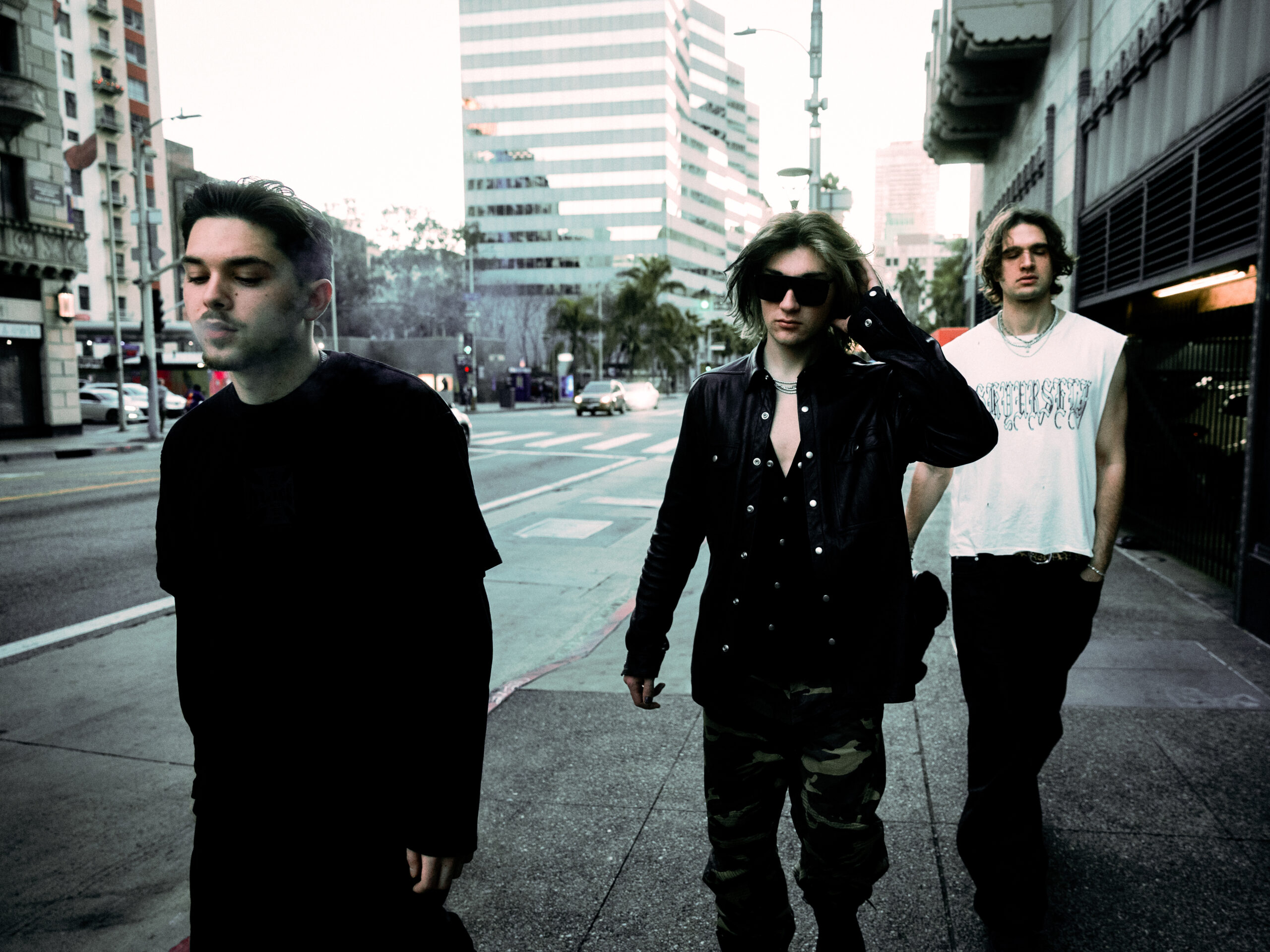
LE YORA – Picture: Rachel Blackman
Diplo played the track by the Ganges before release and you’ve had support from artists like Adriatique, Richie Hawtin and The Blaze. How does that early backing shape your expectations for 2026?
We’re very lucky that our work frequently resonates with other, larger artists. It’s hugely helpful in getting the word out and introducing people to our music. A big part of the DJ-game is receiving this kind of support, and as a DJ it’s important to be ahead of the curve of trends and spend time in discovery mode. That said, we don’t have any presuppositions about where our project will go in 2026. We’re very grateful for the moments coming this year. Our dream as artists is to be able to make music and then share that art with others- just doing more of what brings us closer to this is what we care about. Everything else will come in time.
You’ve got Coachella 2026 on the calendar already. What does that moment represent for LE YORA, validation, exposure, or just another step in building the world you’re creating?
The validation and exposure are amazing. We’re very much still developing and extremely grateful to the tastemakers behind the scenes (shout-out Kobi Danan and the whole team at Framework) for giving us a chance to experiment with our project in real time and share the music on larger stages. The truth is it’s another step in the world we’re building and a huge chapter in the story but we’re just getting started. In some ways, this feels like the real beginning for us.
Your live shows span everything from underground club rooms to major festivals. How does the LE YORA experience change depending on the setting?
Playing to the room is at least half the job of being a DJ. Is it a hard ticket moment for LE YORA or a soft ticket club show? Is it a festival? What time of day and indoor vs outdoor? Are we setting the tone or riding the wave? These factors and many others are all considered intuitively when preparing for and playing a show. While we see ourselves as artists, we understand the mission when we get booked to be DJ’s. Sonically, the LE YORA project is fairly dynamic, evolving and combines multiple influences, however we always stay true to its core identity. Especially if we know people are coming to see us then we play mostly originals.
Because you treat music, visuals, and fashion as one language, do you see LE YORA more as a band, a brand or an art collective?
We see it primarily as a ‘DJ collective.’ LE YORA is the group project between us three solo artists for now, but in time we want the brand itself to also evolve and include other creatives. Outside of our group efforts, we each have our own sound and vision too. It’s not exactly all the same, which is what makes it special.
You’ve avoided the “standard underground label circuit.” Do you think more artists will start building self-contained creative worlds instead of fitting into existing industry structures?
I think it depends on vision and alignment. We appreciate the underground label circuit and we’d love to release on certain labels in those ecosystems, but it’s difficult to make the music we want to make and have that also make sense for someone else’s taste. We want our work to be free of the sonic rubric that comes with trying to sign records to taste-maker labels.
As to whether or not other artists will lean into building their own labels and creative worlds vs signing music to existing systems, we feel it completely depends on the artist. To be clear, we all met because we used to originally release on an underground label together; we started there too. And when what we wanted to do began changing we had to pivot to our own thing because it didn’t feel like anyone else was doing it yet. The most important thing is to just build your own world if you can’t find one that feels right.
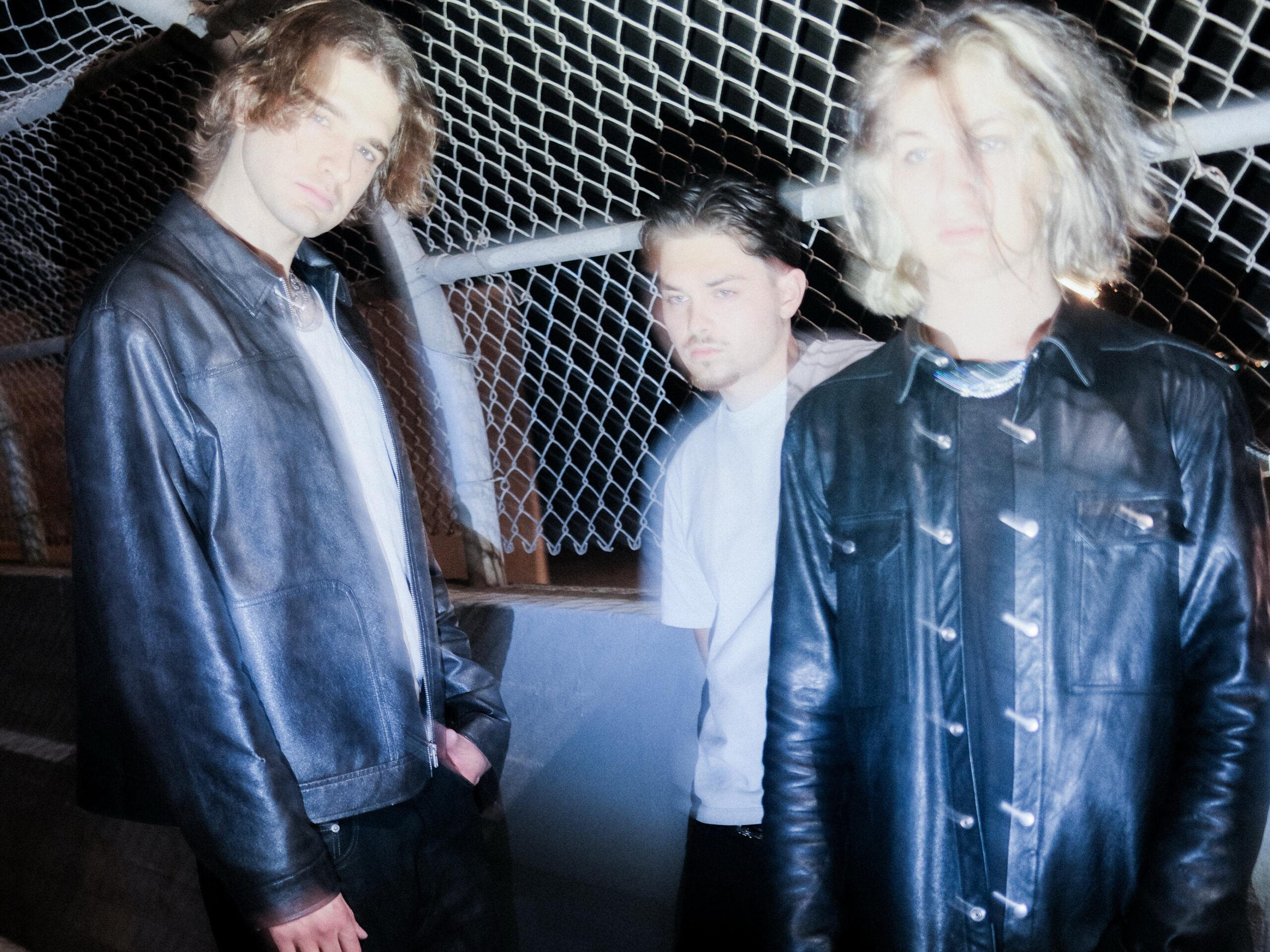
LE YORA – Picture: Lee Oster
The idea of a “lived-in” project comes up a lot when people talk about LE YORA. What does that mean to you in practice, day-to-day?
We think that comes from the fact that we’ve been doing this for a while. If you go back to our early releases, creative direction, etc., everything has evolved and changed. Evolution is the most interesting part of what we’re doing. We’re big believers in immersions and eras; a project should expand over time. It’s important to never lose sight of your roots and core identity, but why do the exact same thing forever? This is a journey and experience we get to share. In practice, this means risking going off the beaten path at times and weaving in new influences that are out of genre or unfamiliar to dance music fans. Honestly, the goal is not to just capture the attention of the dance music community, it’s also to be the entry-point for fans of other genres into dance music.
With the clothing line and other visual projects in development, how do you decide what belongs inside the LE YORA universe versus what should stay separate?
It’s actually pretty intuitive. We all agree or we don’t. The creative decisions are our easiest choices. We just know when it fits and when it doesn’t. Same with our solo releases and remixes at times.
Looking back to forming in 2021 through Discord, what’s surprised you most about how far the project has come?
We’ve experienced success and setbacks in waves. When it rains it pours, both good and bad. We’ve had a series of breakthrough moments that are crucial to our success and understanding of how to move the ball forward and do more of what we love. What’s most surprising is that we truly never know what’s going to connect or be most meaningful to others. That’s why we just make everything for ourselves.
What does 2026 look like beyond this release and Coachella?
We’re planning to continue working on our sophomore album in 2026 and are excited to get back in the studio. We have a number of other shows around the world in places we haven’t been that we’re excited to explore too. This year is critical in continuing to lay the foundation for what we want to do in the future and beyond.
Browse our archive of interviews HERE and visit our Beatportal page HERE.