




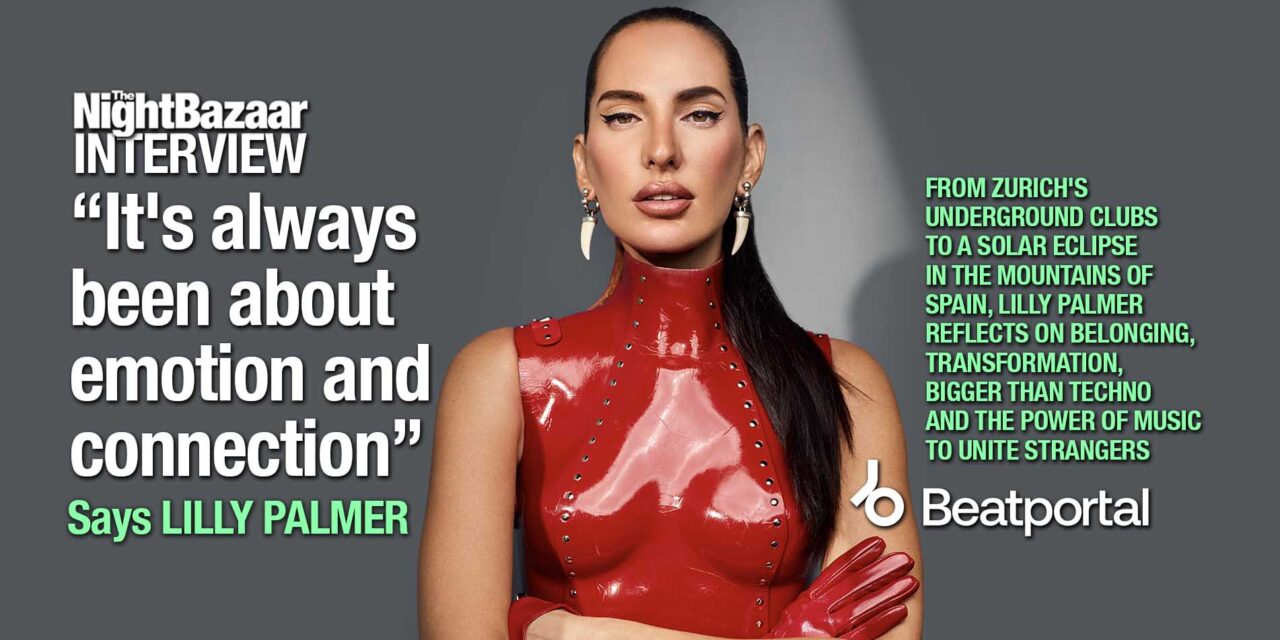
Lilly Palmer’s rise from Zurich’s underground club circuit to the upper ranks of global techno has been built on a simple philosophy: emotion comes first. Whether she’s delivering high-energy festival sets, pushing genre boundaries in the studio or exploring the expansive soundscape of her debut album Bigger Than Techno, connection remains at the heart of everything she does.
Ahead of her appearance at Astral Plane, the unique festival built around Europe’s first total solar eclipse of the century, Lilly sat down with The Night Bazaar to discuss her musical evolution, underground roots, the meaning behind Bigger Than Techno and why techno continues to be a transformative force both on and off the dancefloor.
Your rise over the last few years has been massive, when you look back at the small club gigs in Zurich, what do you think has stayed constant about you as an artist?
Honestly, the core of what drives me has never changed, it’s always been about emotion and connection. When I was playing small clubs in Zurich to maybe a hundred people, I was trying to take them somewhere, to create a moment where everyone in the room felt the same thing at the same time. That’s still what I’m doing on a festival mainstage. The scale changes, the production changes, but that hunger to genuinely move people? That’s never wavered. I grew up feeling like an outsider, and techno was the first space where I truly felt like I belonged, where nobody cared about who you were outside of those walls. I carry that feeling into every single set.
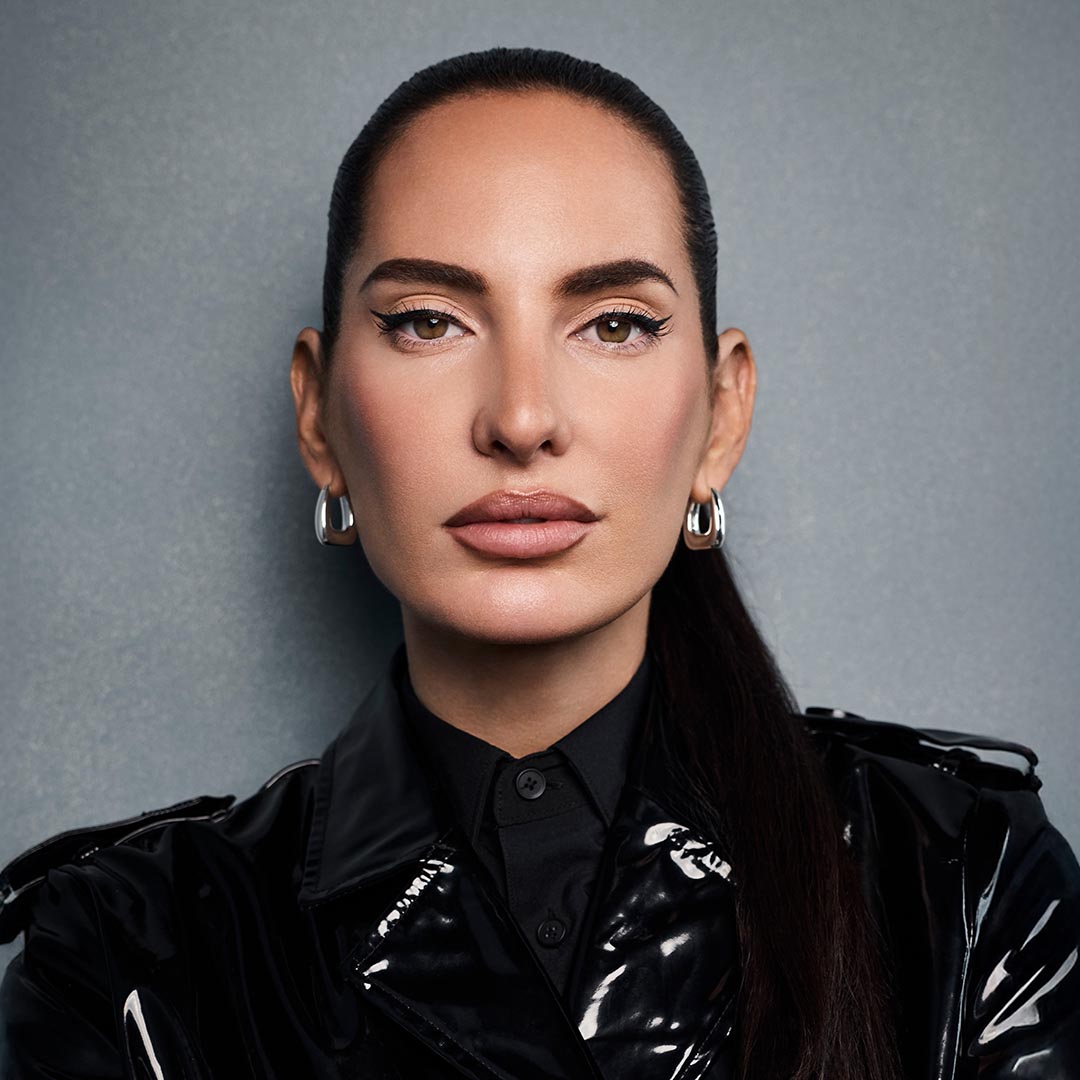
Lilly Palmer
What does techno give you emotionally that other genres never did?
For me, music has always meant freedom, the freedom to express, process, and transform emotions. What techno does that nothing else quite manages is that it gives you all of it at once: the joy, the catharsis, the relief from anger or pain, the melancholy, the pure physical release. When I say ‘bigger than techno,’ I’m speaking about this indescribable feeling that takes over completely in those moments. Those moments when strangers become family, when the pain becomes colour, when time seems to stand still and the beat carries you upward into something almost spiritual. Techno has saved me, genuinely, and I see it save people in the crowd every single night.
Your sets balance aggression, melody, trance and emotion. Do you consciously think about storytelling when building a set or is it very much spur of the moment decisions reacting to the crowd in front of you?
It’s both, always both. I go into every set with a kind of emotional arc in mind, I know the journey I want to take people on, from the first beat to the last. But the crowd tells you everything in real time. Their energy, their body language, you feel it back as clearly as they feel what you’re putting out. My sets grew from a more melodic deep house foundation in Zurich, and that DNA never fully left. Even at 150 BPM, I’m always looking for that melodic moment that cuts through the intensity and makes someone close their eyes. The aggression and the tenderness have to live together. That tension is actually where the magic is.
You’re now playing huge festival stages worldwide, has success changed your relationship with the underground side of techno at all?
I think about this a lot. My roots are in the underground and I’m fiercely protective of what that means, the rawness, the community, the lack of compromise. What I’ve come to believe is that you can carry those values onto any stage. The underground isn’t just a physical space, it’s an attitude. It’s about authenticity and genuine connection, not spectacle. When I play a huge festival, I’m not trying to water anything down for a bigger audience, I’m trying to bring the underground to them. I founded Spannung Records precisely to protect that ethos and champion a sound that doesn’t bend to commercial pressure. The size of the stage doesn’t change what I believe in.
The title of your album Bigger Than Techno feels like a statement. What does that phrase mean to you personally?
People sometimes read it as an ego statement, like I think I’m bigger than techno. It’s actually the complete opposite. Bigger Than Techno is about techno itself being bigger than anything. Bigger than a genre label, bigger than a scene, bigger than any boundary you could put around it. Techno creates transformative experiences, it builds communities, it inspires people on a level that goes far beyond the dancefloor into the very fabric of human experience. For me the album is a heartfelt declaration of that. It’s me saying: look at everything this music can hold trance, psytrance, hard dance, raw emotion, spiritual depth. This is sacred space. This is where authentic self-expression flourishes without colour or constraint.
The album moves across techno, trance, psytrance and hard dance influences. Was the goal to break genre boundaries intentionally?
The genre boundaries were never really my starting point, the emotion was. I produce most of my music with my husband Egbert in our home studio, and when we’re in that space it’s completely organic. You follow what feels true rather than what fits a box. I’ve always had that restlessness in me, I went from musicals as a kid, to death metal as a teenager, to deep house, to peak-time techno. Genre was never really the point. When I brought in psytrance with Vini Vici and Shanti People on ‘Gaana Modam’, or trance with Armin on ‘Ayi Giri’, it wasn’t a calculated crossover move. Those influences were already living inside me. The album just let them all exist at the same time, honestly, without apology.
You collaborated with artists like Armin van Buuren, Maddix and Vini Vici on the project. What did those collaborations bring out in you creatively?
Each one opened a different door. Working with Armin on ‘Ayi Giri’ was extraordinary, he has this nostalgic, euphoric trance energy that connects with something very deep in me, because my emotional roots in music go back to those big cinematic soundtrack moments.
What worked was that we didn’t try to split the difference between his world and mine, we fused them, and you can hear both of us clearly. With Maddix on ‘Late At Night’ it was a different kind of intensity. And ‘Gaana Modam’ with Vini Vici and Shanti People was genuinely spiritual, those mantric vocals from Shanti People sit right at the heart of what I believe techno can be: transcendent. Every collaboration pushed me somewhere I wouldn’t have gone alone.
If Bigger Than Techno captures who Lilly Palmer is today, what do you think the next evolution sounds like?
I genuinely don’t know yet, and I think that’s the right answer. The album was such an honest document of where I am right now, it’s the result of years of absorbing influences, processing emotions, travelling the world, connecting with different cultures and scenes.
Whatever comes next will be equally honest, equally personal. What I can say is that I’ll never stop pushing. I’m still learning every day in the studio, still being surprised by what the music wants to be. I think the next chapter goes even deeper emotionally, maybe quieter in some places, louder in others. I just know it will be true.
You’ve become known for extremely high-energy sets around the 150 BPM mark. What’s the secret to sustaining that intensity for hours?
Ha! I think part of it is that it doesn’t actually feel like intensity to me anymore, it feels like home. I discovered that tempo because the crowd in Zurich told me that’s where they wanted to go. My sets were more melodic at 125 BPM and I kept pushing higher and higher and felt the energy multiply. The key to sustaining it over hours is the arc, you can’t play at absolute peak the entire time, you have to breathe, pull back slightly, create contrast, so that when the peak comes again it hits harder. And honestly, it’s the crowd that carries me. When the energy feeds back from them it becomes a loop, they push me, I push them. The horse helps too. Time with animals, nature, getting grounded again, that’s what lets me go back into the storm.
Techno has become increasingly mainstream in recent years. Is that exciting for you, or do you worry about the genre losing something along the way?
Both feelings are real and I hold them at the same time. It’s genuinely exciting that more people are experiencing what this music can do, every person who comes to techno for the first time through a festival mainstage and feels that transformation for the first time, that’s beautiful. But I do think there’s a responsibility that comes with the platform. You have to stay honest. You have to keep the rawness alive even when everything around you is getting more polished and more commercial. The underground ethos, the idea that this music is for everybody but belongs to no one, that it thrives through genuine community, that has to be protected. I try to carry it with me everywhere I go.
As a female artist in a still male-dominated scene, have things improved since you started or do you still feel you have to prove yourself more than others?
Things have genuinely improved and I want to acknowledge that, there are more women headlining, more conversations happening, more space being made. But the doubts that get thrown at female producers didn’t disappear overnight. I’ve had people question whether I actually make my own music. My response was never to get angry, it was to show my work, to post my process, to let the music speak for itself. That’s the same integrity I’d expect of any artist. What I will say is that coming from the outside, being adopted, feeling like an outsider at school, finding my tribe eventually with the death metal kids, gave me a resilience that I now consider one of my greatest assets. I’ve never needed everyone’s approval. I need to be true to what I create.
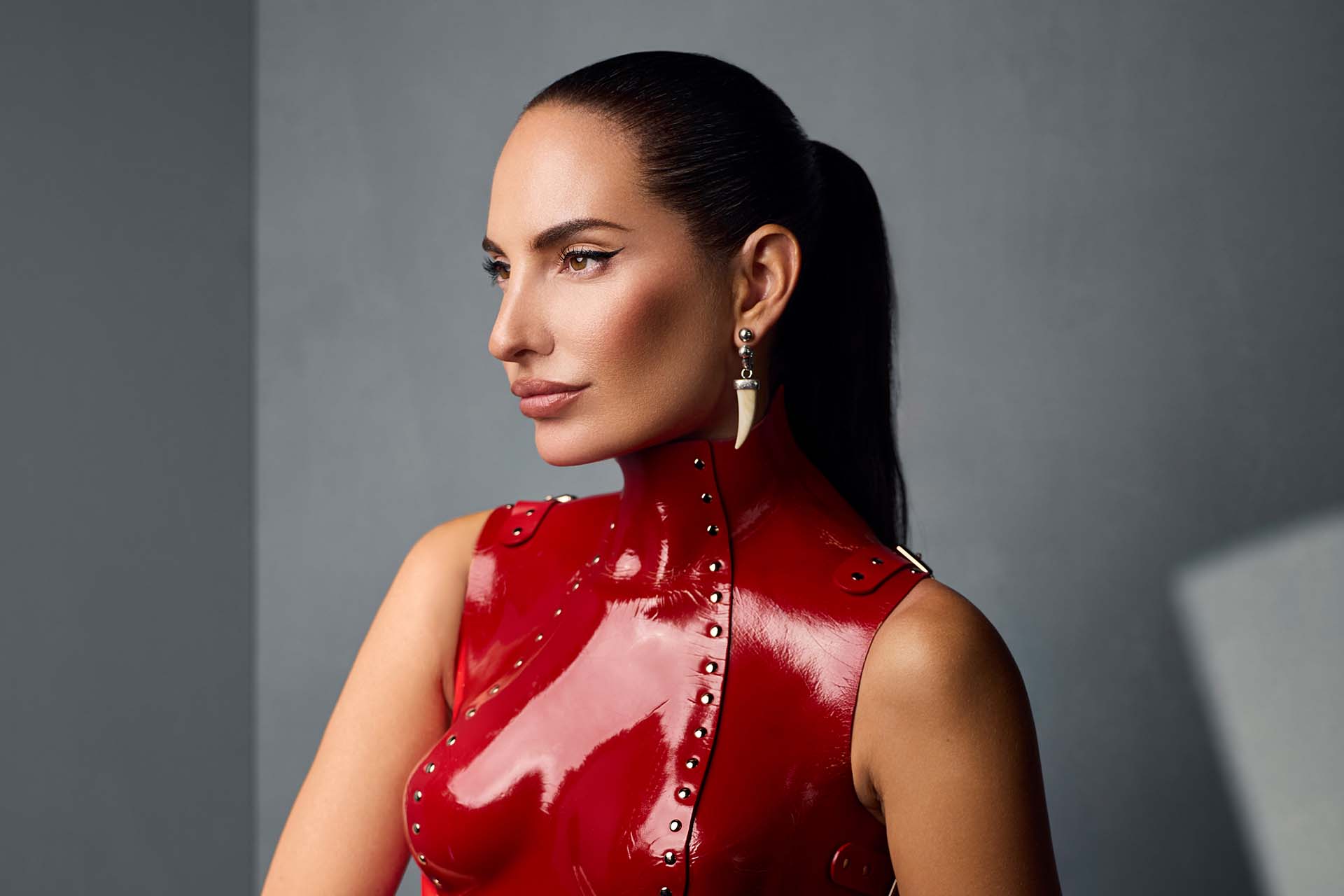
Lilly Palmer
Astral Plane isn’t just another festival, it’s built around a once-in-a-generation total solar eclipse. What was your first reaction when you were invited to be part of something this unique?
Immediate, full-body excitement. A total solar eclipse crossing Europe for the first time this century, day literally becoming night, stars appearing in a summer sky, the sun’s corona visible to the naked eye and there will be music underneath all of it. That’s not just a festival, that’s a ritual. I’ve always felt that techno operates on a frequency that goes beyond the ordinary and here’s an event that literally bends the physics of the day to create something extraordinary. Being part of that alongside legends like Kevin Saunderson, Ellen Allien, Luke Slater, in the mountains of Segovia, is something I genuinely couldn’t have dreamed up.
Festivals often talk about “energy,” but Astral Plane seems to take that idea literally, cosmic energy, nature, collective emotion. Does that resonate with the way you experience techno?
Completely and deeply. Like Nietzsche’s idea of the Dionysian, that intoxication, that losing yourself in something greater, techno at its best is exactly that. It’s a modern sanctuary where genuine thriving happens through music and community. I believe we reclaim our capacity for connection in an increasingly isolated world every time a dance floor comes together with true shared intention. An eclipse set in a mountain range at 1500 metres, day turning to night, 10,000 people unified by the same cosmic moment and the same music, that’s not metaphor. That’s the literal version of what I try to create every time I play. I cannot wait.
Astral Plane Total Eclipse Festival takes places August 10th, 11th and 12th in Segovia, Spain. Get more information HERE.