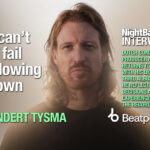





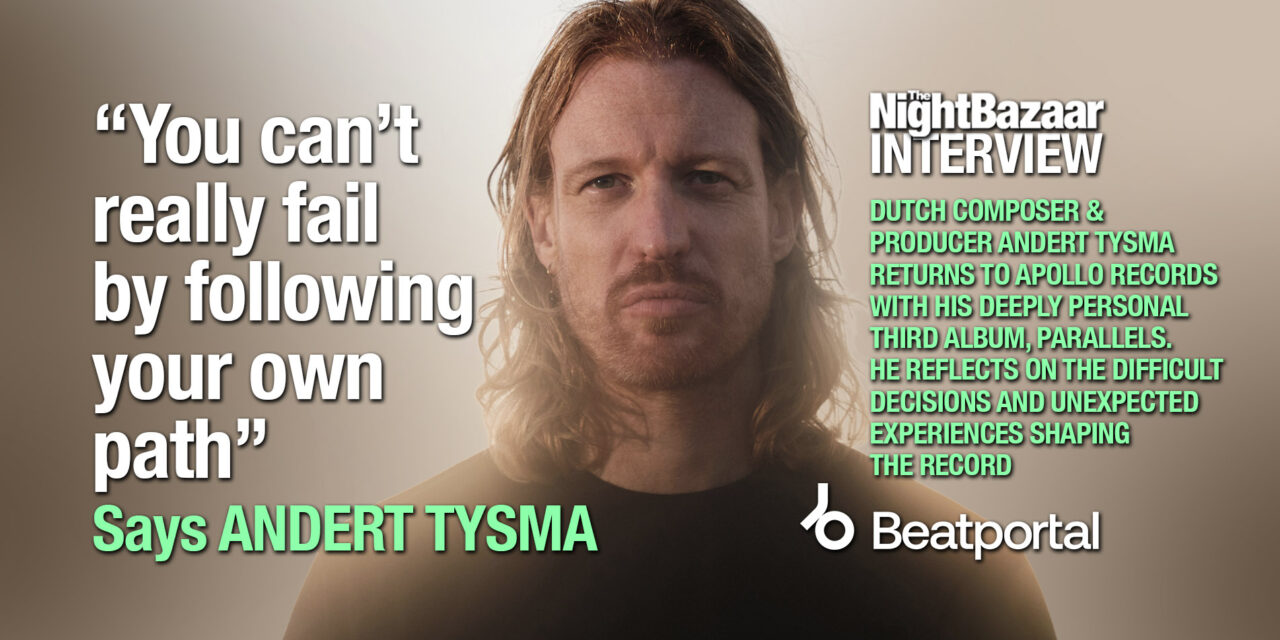
Dutch composer and producer Andert Tysma returns to Apollo Records with Parallels, his deeply personal third album, exploring life’s defining choices, vulnerability and the paths left untaken.
Blending contemporary classical composition with ambient electronics and cinematic textures, the album reflects a period of profound personal change.
He talks to The Night Bazaar about the experiences behind the record, his parallel careers in music and medicine, the influence of his surroundings and his enduring relationship with the legendary R&S Records subsidiary.
Your third album, Parallels, explores the choices we make in life and the alternative paths we leave behind. Can you tell us where this concept originated and why it became such an important theme for you to explore musically?
For two reasons. I was having difficulty finishing my tracks. I didn’t want to finish them because that meant having to deal with the possible consequences of going in a certain direction and having to live with those decisions. At the same time, while making the album, I had to make similar choices in an interpersonal relationship. As I was making those choices, I kept thinking about the alternative scenarios: what if I did this or that? These are just scenarios, of course, but I realised that you constantly make these micro-decisions that have consequences.
You’ve described Parallels as your most personal work to date. What was happening in your life during its creation and how did those experiences shape the emotional direction of the record?
A long relationship ended, and I was also having some health issues with my heart. That made me feel very vulnerable. Looking back, I realise I felt miserable for quite a long time. But the urge to create was very strong, and working in the studio really felt like my safe space. I felt the urge to make things small and intimate, perhaps a bit contained as well.
There’s something particularly fascinating about the idea that the paths we don’t take continue to influence who we become. Looking back on your own life, are there particular decisions or turning points that you find yourself revisiting and how have these found expression in the music?
Very much so. I remember a friend of mine giving a piano concert, which inspired me to pick up the piano again myself. That was about seven years ago, and a whole solo career kind of evolved around that decision. Of course, it wasn’t just that, but it was a big part of it.
The album was written across several locations, including Amsterdam, Berlin and the former home of Dutch composer Simeon ten Holt. How did these different environments influence the compositions, and to what extent do you believe physical surroundings become embedded in the music we create?
I think it’s an important part of the process. On a deep level, we’re always influenced by our surroundings. Just listen to the music and look at the art being made all over the world. It’s a form of communication or conversation between humans and their surroundings. For me, that really became clear when I did the residency at Simeon ten Holt’s house. His grand piano was still there (and took up half the space), and it had a great impact on the tracks I wrote there.
One particularly intriguing story concerns a composition written near the former Theresienstadt concentration camp, without you initially being aware of its proximity. Can you tell us about that experience and how discovering the history of the location subsequently changed your relationship with the piece?
Well, yes, this is another good example of how strong the influence of our surroundings can be. When I wrote the piece, I was a bit surprised by how dark it was. But I thought: this is something that’s inside me and apparently needs to come out. After visiting the concentration camp, I was able to place the piece a little better.
Your music occupies an interesting space between contemporary classical composition, ambient electronics and cinematic sound design. How has your approach to bringing these different disciplines together evolved, particularly across your three albums?
My initial plan was to make film music. It came quite naturally, and I enjoyed doing it. Then it evolved into my first album. Through releasing that album, I discovered many other artists working in a similar realm. That inspired me a lot and changed the direction my music was taking. In a way, the albums I’ve released so far have been a journey of exploration, discovering what’s possible with composition and instruments.
Piano remains central to your work, but modular synthesis and electronic processing have become increasingly important elements of your sound. Can you walk us through your creative process when developing a composition and how you decide which instruments and textures best communicate a particular emotion or idea?
There’s never really a preconceived or fixed plan for how to start. It usually begins with an idea, and then new ideas and textures emerge. To me, composing is very similar to cooking: adding flavours to your taste and responding to what the composition (the dish) needs.
You have a background in jazz, while your music also draws on minimalism and contemporary classical traditions. Which composers, musicians or electronic producers have had the greatest influence on your musical identity, and are there particular influences that became more prominent during the making of Parallels?
That’s difficult to answer because I think what you’re hearing on the album is the accumulation of all my influences, processed by my own processor (i.e. my brain). That being said, Simeon ten Holt, Steve Reich, Tim Hecker and The Black Dog were definitely important influences on this album.
You spent time composing in the former home of Simeon ten Holt, an important figure in Dutch minimalist music. What did that residency mean to you personally and creatively, and did working in that environment change your understanding of repetition, space and musical structure?
It was a very inspiring time, surprisingly enough, because I had just broken up with my partner at the time. The atmosphere in the house was very tranquil, and I was able to focus on creating new tracks. It also made me realise how important these kinds of residencies can be. Not necessarily in this exact form, but simply having the opportunity to empty your head and have as few distractions as possible.
One of the most unusual aspects of your story is that you work as both a composer and a practising doctor. After initially studying at the conservatory, you chose to pursue medicine. What prompted that decision and did you ever imagine that these two seemingly different careers would eventually coexist?
Your work as a doctor brings you into contact with people during some of the most vulnerable moments of their lives. Has that experience changed the way you understand human emotion and do those encounters influence the sensitivity and emotional depth of your compositions?
To answer the second question first: yes, I think so. In a way, working as a doctor has motivated me to make more music, to do things that resonate with my heart as much as possible, and especially to do them now, rather than putting them off until the future. My work as a doctor has also made me realise that I need to have something for myself. Not just helping others all the time, but also making time for myself.
As a kid, I used to play with Lego all the time. Composing is that for me: playtime. And it’s all reciprocal: when I take care of myself in the way I’ve just described, it has a positive influence on my work as a doctor as well.
Music is frequently described as having healing qualities, something that seems particularly relevant given your professional background. Do you see a meaningful connection between the therapeutic…
I do. Just look at what music can do! You don’t necessarily have to experience it in a therapeutic setting. For example, I think going dancing regularly can sometimes be more beneficial for stress and anxiety than the average medication I prescribe.
You’ve developed an ongoing relationship with Apollo Records, an imprint whose history includes groundbreaking releases from Aphex Twin, Biosphere and Locust. What initially attracted you to the label and what does it mean to have your music associated with such an influential catalogue of electronic and ambient music?
Full transparency: when I finished my first album, I only knew Aphex Twin’s album. I did a Google search to find out which labels might be interesting for my music because I had no idea what the scene looked like. Before embarking on this path, I played pop music as a bass player.
But what I always felt about my music was that it resonated with me personally, and that gave me a certain bluntness when it came to showing it to the world. I think Renaat (founder of R&S and Apollo) connected with that, and that was the reason we decided to sign and work together.
Your previous album Hana was partly recorded at Berlin’s Funkhaus, with contributions from musicians associated with the Berlin Philharmonic. How important have collaborations with other musicians been to your development and has your approach to working with others changed on Parallels?
I think Parallels is a bit more minimalist and less bombastic. For Hana, I used many layers of strings, whereas for Parallels I wanted to dive deeper into one or a few instruments. To focus even more on the textures.
I think collaborations are a beautiful thing. It’s about the musical knowledge of someone else and how they respond to your own ideas. The collaborations on Parallels really lifted the whole album to another level.
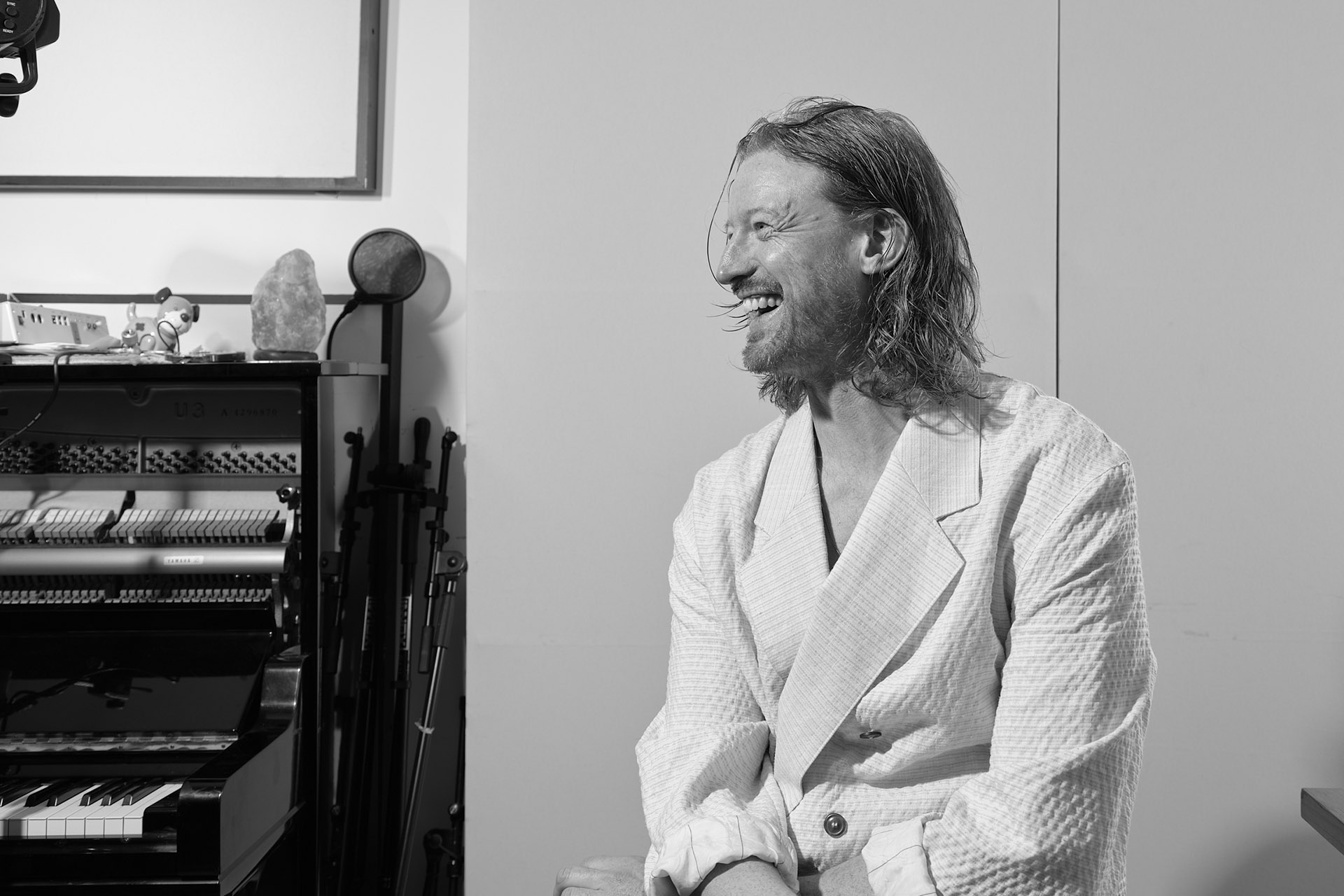
Andert Tysma
You’ve performed internationally and shared stages with artists including Yann Tiersen, notably at London’s Barbican Centre. How have those experiences influenced your approach to presenting your own compositions live, particularly when translating intimate studio recordings into something that connects with a larger audience?
That’s an ongoing process and a field of exploration. I still feel very green when it comes to translating my compositions into a live setting. But at the Barbican, for the first time in my solo career, I really felt that things clicked live. The studio and the live environment are definitely two different entities.
You presented Parallels during Amsterdam Dance Event with a special performance at the ARTIS Planetarium, accompanied by visuals from Julius Horsthuis. How did this collaboration come about and how do you envision the relationship between the music, imagery and physical environment enhancing the audience’s experience?
I was a bit nervous about the ADE performance. I had never worked with Julius before, and although we had discussed the show, I wasn’t sure whether it would actually work on stage. But it did! Better than I expected, to be honest. It was a beautiful dance between the visuals and the music, with both improvising and responding to each other.
In a previous interview, you discussed your admiration for Steve Reich and your ambition to explore larger live ensembles and multiple pianists. Is that still something you’re hoping to develop, and how might that approach expand the possibilities of your music beyond the studio?
Very much so! My dream is to perform my tracks with all the instruments featured on the album, in the big room at Funkhaus (Saal 1). With some adjustments for the live setting, of course.
Finally, Parallels is fundamentally concerned with the different directions our lives can take. Having reached this point in your journey, both as a musician and as a person, what have you learned about following your own path?
That you can’t really fail by following your own path. It’s not easy to do. It takes courage, and it can be very painful at times. But it’s also very beautiful and rewarding, and nobody can take that away from you.
Andert Tysma – Parallels is out now on Apollo Records. Grab it on Beatport HERE.
Read more interviews from The Night Bazaar on Beatportal HERE.