



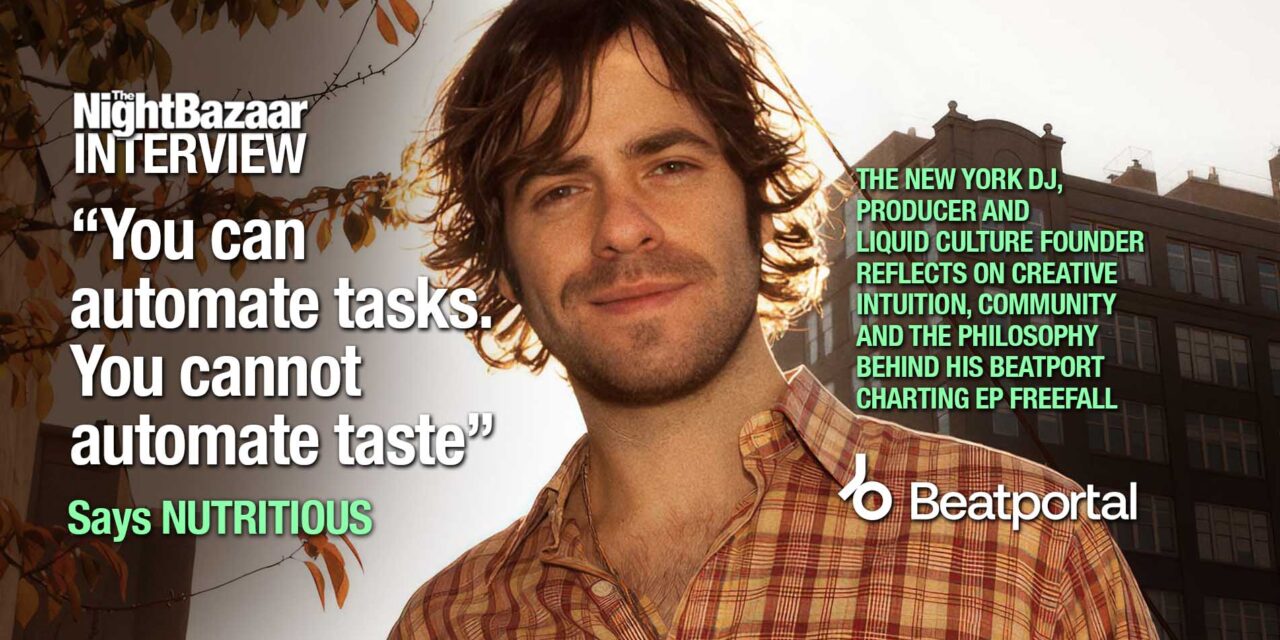
Long before streaming algorithms and digital waveforms became the norm, Nutritious was learning the language of music through cassette tapes, vinyl records and New York City’s thriving underground culture. Decades later, that analogue foundation still informs his approach as a DJ, producer and label founder, shaping a career built on intuition, community and an unwavering commitment to the craft.
From immersive performances that blur the line between DJ set and experience to the curation of his Liquid Culture imprint, Nutritious has remained guided by the idea that music is about more than what comes through the speakers. It is a philosophy that runs through Freefall, his recent Beatport-charting EP, which explores themes of trust, surrender and living fully in the moment.
In this conversation with Night Bazaar, Nutritious reflects on New York’s influence, the lessons of analogue culture, the importance of building genuine communities and why human connection remains the most valuable currency in dance music.
Your performances combine turntablism, outboard effects, live instrumentation, visuals and lighting into a single experience. At what point did you realise you wanted your shows to be more than a traditional DJ set?
Cielo was a turning point. I played there regularly, and that room had the right ingredients: incredible sound, a sunken dancefloor, a booth designed by a phenomenal DJ, and a crowd that came ready for the experience. Meatpacking during its club heyday was a truly special place.
We could take things further there with performers, visuals, and lighting techs who were spiritual DJs themselves. It was never just aesthetics. It was part of the frequency in that space.
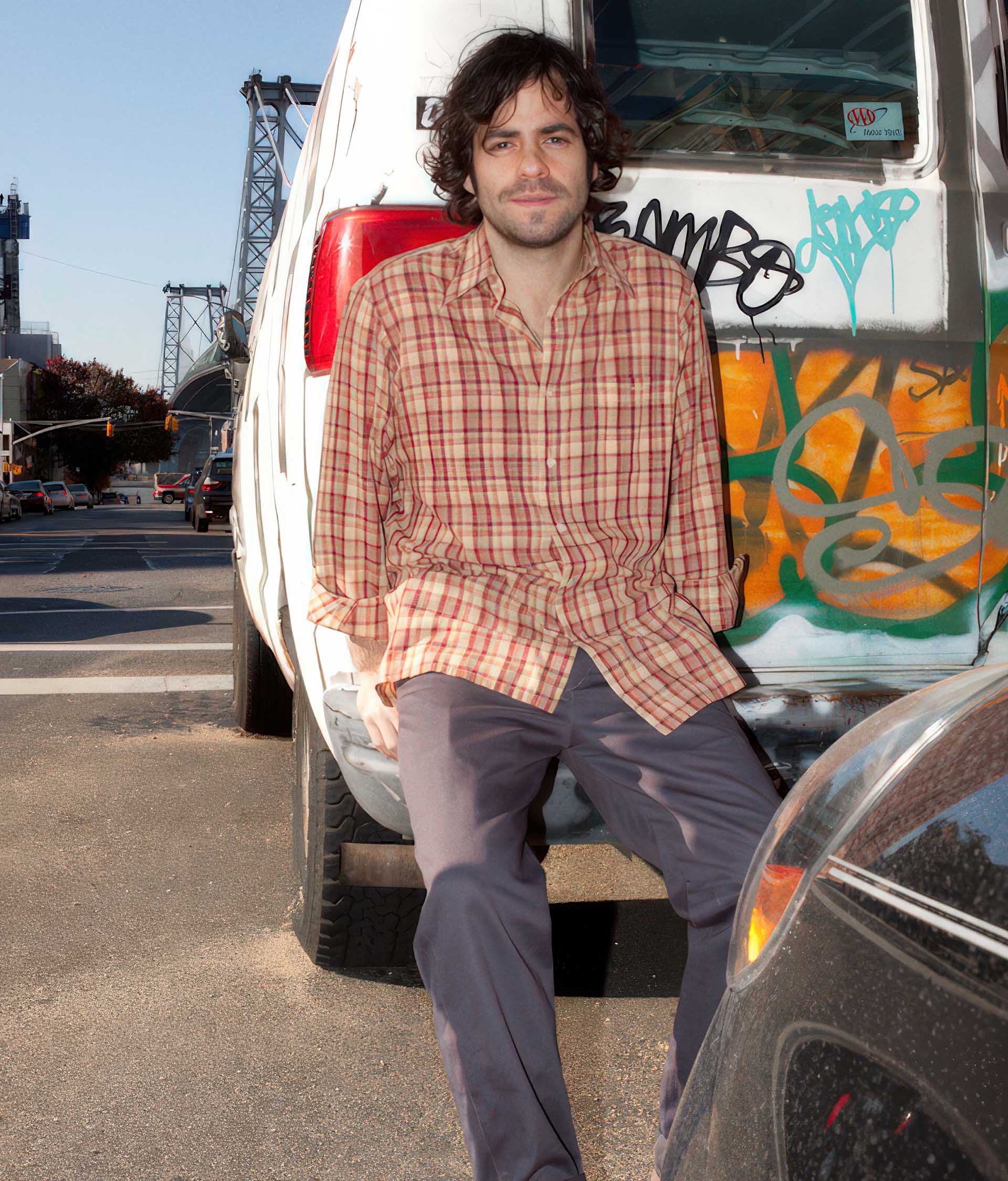
That instinct was honed from hundreds of nights we threw at Bembe, next to Brooklyn Bowl, where we held Brooklyn Shakedown and touring musicians would roll through and improvise with us. A great DJ set does not need anything added to it. A great DJ with great records is still one of the most powerful things on earth. But when the room, the records, the people, and the timing align, a night can become something people remember in their souls. The aim is simple: give people the experience of their lives. Every time.
You learned your craft through cassette and vinyl culture before embracing modern production tools. How has that analogue foundation shaped the way you approach music today?
Analog trained my ear. With cassette and vinyl, everything is touch, timing, and listening. No screen is giving you the answer. You learn how a record drifts, how warm low-end hits, how two sounds can blend by tone instead of waveform readouts.
BPM and key are useful, but they are not the whole story. Keys, modes, and the twelve-note system are maps. The full spectrum of frequency is the terrain. Analog taught me that music lives in the space between notes as much as the notes themselves. That shapes everything I do.
Many artists eventually settle into a particular lane, but your sound moves between cosmic disco, deep house, nu-disco, indie dance, techno, funk and soul. What connects all those genres for you?
Taste. Discretion. Feeling. I constantly remind myself that much of my performance as a DJ is what I don’t play. That is true in the studio too. A song is often defined by what you decide doesn’t fit. I can move through disco, house, funk, soul, techno, psychedelic music, whatever feels alive in the moment.
You’ve described your music as organic and emotive while still being dancefloor-focused. How do you balance emotional depth with the energy needed to move a crowd?
The body understands subtlety. Emotion does not have to sit on top of a dance record. It can live inside the rhythm itself. Small shifts in swing can change the perceived tempo and emotion of a song. A clap that lands a touch late. A bassline that sits behind the beat. A groove that pushes and pulls without feeling locked to a grid. Those details create feeling while keeping the dancefloor alive.
New York City has always been a melting pot of musical influences. How has living and performing there shaped your artistic perspective?
The beautiful city that raised me. In New York, life is an artform. Creativity is how the populous processes close proximity. I began performing shows at places like CBGB when I was sixteen. I’ve played Tompkins Square Park for Dance Parade with thousands of skilled dancers ecstatic in the sunshine. I’ve fully appreciated access to MoMA, the Whitney, New York Fashion Week, private tours, underground rooms, world-class chefs, designers, dancers, musicians, the greatest artisans everywhere you look.
There are nights where I’ve played three or four shows on a Friday, then day parties through the weekend. I experienced the strength of clubs uniting cultures after 9/11. During Hurricane Sandy, my Ace Hotel residency became part of a space where displaced people found refuge.
We kept the party going at Hotel on Rivington with some of the greatest DJ/producers working today. I had an underground studio on the corner where the Paul’s Boutique cover was photographed. The abandoned church across from my apartment became an underground rave institution. This is such a small sample set. This is New York. Art is not something you visit. It is New York’s soul.

Nutritious
Through your label Liquid Culture, you’ve become not only an artist but also a curator and community builder. What inspired you to start the label and what role do you see it playing in today’s electronic music landscape?
Liquid Culture is an incubator for artists, songs, events, ideas, and the conditions that let music become more than a file on a platform. The art comes first. Always. But the environment around the art matters.
A song lands differently when the context has care. The room, the artwork, the sound system, the people, the timing, the way it is introduced. All of that makes the experience what it is. I am interested in curating art, events, and music infused with a devotion to the heavens. I’m not interested in only surface level ambition.
The underground scene can be challenging to sustain. What have you learned about building a loyal community around music rather than simply chasing trends?
Trends are information, not instruction. Community comes from consistency, care, and shared experience over time. We’ve produced hundreds of parties, many free, because love is what house is. It’s about legacy and essence. People can feel when something is real. The rest is noise. Chasing trends is capitalist. Timeless form is magic.
You’ve played everywhere from intimate all-night sessions to major venues and festivals. How does your mindset change when performing for a small, dedicated crowd versus a large festival audience?
A small room is more detailed. You can hear people listening. You can feel small changes in attention. The exchange is intimate.
A festival is more expansive. The sound has to travel farther. You are working with scale, weather, distance, echo, production, and the whole environment. The choices need to translate across a much larger field. The environment changes but the mindset is consistent: listen to what is actually in front of you and engage it fully.
Your sets are known for threading together rare vinyl edits, deep cuts, and future-leaning selections. What makes a record stand out enough to earn a place in a Nutritious set?
It has to be incredibly well produced, unique and timeless. A lot of records work for a weekend. I’m looking for the ones that still have electricity decades later.
In an era of increasingly automated DJ technology, what still excites you about the art of mixing and digging for music?
You can automate tasks. You cannot automate taste. Finding the record no one expected. Hearing why two things belong together before the logic is obvious. Feeling the room ignite because of one small move on the console. Digging is not just collecting music. It trains your inner compass.
Your recent Beatport success with Freefall introduced your sound to a wider audience. Did that recognition change your confidence or your approach in the studio?
Each release that connects confirms the same thing: resonance is the point. While I’ve been fortunate to have songs resonate, resonance does not make me want to repeat myself. It gives me faith in the next idea. In the creative process, if I am forcing a song to be something, I am making it smaller. If I am listening, the song shows me exactly where it wants to go.
Your productions often feel both nostalgic and forward-thinking. Are there specific artists, eras or scenes that consistently inspire you?
There are tens of thousands of artists, plus many eras and scenes that inspire, so we would barely scratch the surface here. What connects the music that stays with me is life-force. Late 60s and 70s psychedelia, soul, funk, jazz, disco, 80s, hip-hop, house, techno, rock, experimental music, classical music, music from all over the world.
I know people want names, so here are a few: Led Zeppelin channeled enormous electricity in the studio. Their records are massive. Hendrix was supernatural. Prince may be the most complete artist to ever live. Bill Evans is like a glass of soul spilling over the keys. After Billie Holiday, Norah Jones, Sophie Barker, and Sia each redefined what it means to record a great vocal take. Talking Heads, Missy Elliott, Theo Parrish, Moodymann, Air, Beck, Sly Stone, Parliament, Satoshi Tomiie, Morgan Geist, Lindstrom, Seth Troxler and Phil Moffa as Lost Souls of Saturn, Sault, Disclosure, Peggy Gou, Kaskade, Khruangbin, Mildlife, Yin Yin, Dylan and Buck Meek. All different worlds, same standard.
Nutritious
How do you know when a song is finished, especially when you’re someone who clearly enjoys experimentation?
When it is in my head the next morning, I’m close. If I am humming it without playing it, that’s signal. I’m a relentless listener. Sometimes one finishing touch can take days. I will sit with a sound, a placement, a small detail, and try to understand if it belongs. Eventually it either locks the song into place or the song rejects it. Finishing is not only adding the right thing. Often, it is removing what is no longer needed. Mostly, it is accepting that the song knows when it is complete. When you take your time, the muse tells you.
What sparked the idea behind this new release and what story or feeling were you hoping to communicate through it?
Living fully. Surfing, skydiving, falling in love, playing music, meditation. Everything is moving. The thrill is total. The only way through is to let go and trust. That’s Freefall. You commit to the moment without knowing where it lands. Passion, love, faith. Three songs.
Electronic music is constantly evolving. What developments in the scene are inspiring you most at the moment?
People are remembering that the full experience matters. Sound systems matter. Rooms matter. Lighting matters. The way people arrive to a party and the way they leave matters.
I’m also interested in more balance around the culture, not in a forced way. I don’t think every club needs a meditation room. But if there’s a weekend of parties, maybe one of them happens in the sun. Maybe people put their bare feet in the grass or the sand. Maybe there’s fresh coconut water instead of only another drink ticket. That’s not about sanitizing music culture. It’s about making it more alive, more sustainable, and more human. The best scenes leave people with more life, not less.
Looking ahead to the rest of 2026, what goals or creative ambitions are driving you forward?
What we do is handcrafted and human. DIY, not AI. The goal is to keep raising the standard without sacrificing the human element, or our belonging to the natural world. Vinyl survived because it carried the best of its era forward. It kept the soul, the function, the ritual. I want Liquid Culture to do that for the best of this generation. More music, more intentional performances, more worlds around the work. I’m all-in on our divinity.
You’ve played iconic venues, built a respected label and earned recognition from tastemakers across the scene. What still motivates you to keep pushing boundaries after all these years?
Pushing creative boundaries is all I really know how to do.
Nutritious – Freefall is out now. Grab it on Beatport HERE.
Head to Beatportal to read The Night Bazaar exclusive interviews in partnership with Beatport HERE.