




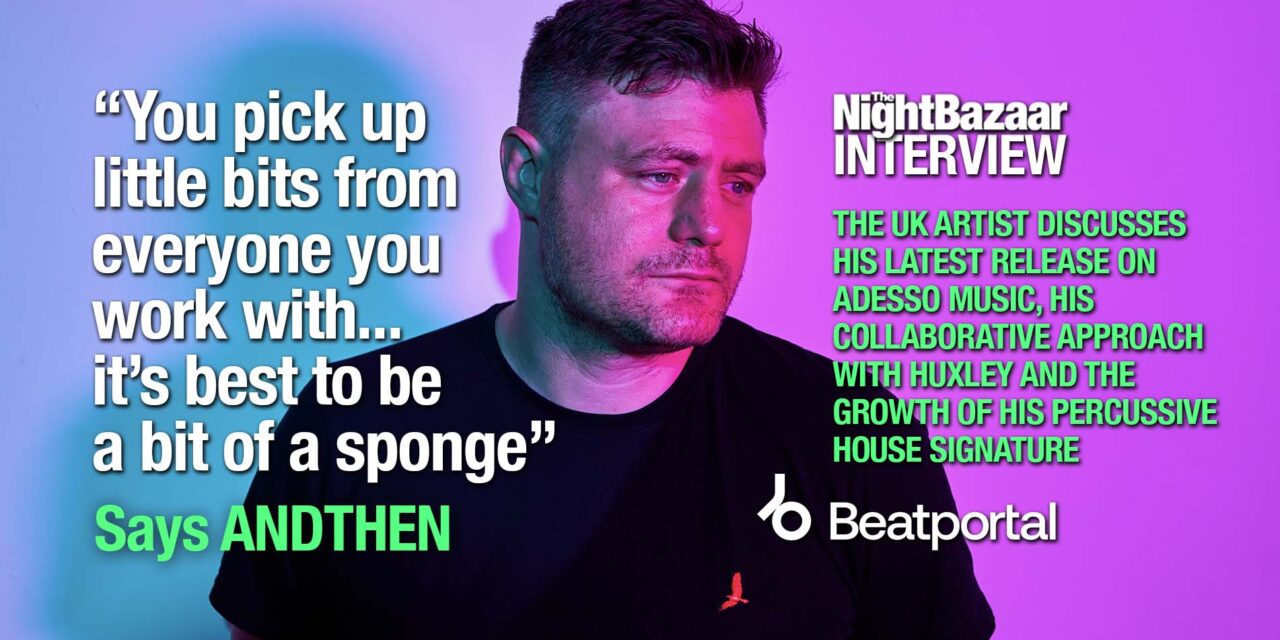
With a sound that fuses house, techno and tribal percussion into groove-led, dancefloor-ready tools, UK producer AndThen has quietly become one of the most interesting names emerging from the percussive end of the underground.
In the past year, his momentum has been impossible to ignore: charting releases on Beatport and Traxsource, support from BBC Radio 1, BBC Introducing and international stations, plus co-signs from heavy hitters across the scene. It’s the kind of steady rise that recently saw him named a “One To Watch” by 6AM and for good reason.
His latest move arrives via Junior Jack’s Adesso Music, teaming up with longtime influence Huxley for Head On, a tension-driven yet emotional club cut that blends soulful vocals with weighty, rolling groove. The collaboration marks a meaningful moment in AndThen’s journey, not only because of Huxley’s stature, but because of what the studio experience unlocked for him creatively.
We caught up with AndThen to talk about how the track came together, what he’s learned from collaborating with established artists, why radio and charts still matter in a fractured streaming era, and where he plans to go next.
Your new collaboration with Huxley, Head On is described as going “straight for the jugular.” When you first started working on the track, what kind of energy or moment were you trying to capture on the dancefloor?
Not quite sure really, is the honest answer. We had the vocal and a bit of a loop going and built it from there. We had just finished a track which was quite high-energy, so we wanted something with a bit more soul and feeling, and this hit the mark for us. Because Huxley is so good in the tudio it gets realty easy to get in the flow and developing the music because it feels right.
AndThen
How did the collaboration with Huxley come about and what did each of you bring to the table creatively during the process?
I have known Michael (Huxley) for a few years. We worked together on an online electronic music platform and also did a retreat together. We stayed in touch, and he now runs Rtrybe with Ramin Rezai and Bakkiss, which is a great community for music producers. I’ve also released music on his label, Dumb Safari, so when he suggested making a track together, I obviously jumped at the chance. I’ve always loved his music and have been a big admirer of his work for a long time.
Huxley has garnered big respect over the years. What did working with someone of his stature teach you, either in the studio or in terms of approach?
I’ve worked with a few big artists now, like Flashmob for example, and you always learn a lot from those who have been there and done it. You pick up little bits from everyone you work with, so it’s best to be a bit of a sponge. Studio-wise, Hux is a genius, so I learned loads about the actual music production, but it was also great chatting with him about his experiences in the industry as well, both the good and the bad.
The track balances tension-heavy grooves with a euphoric, emotional vocal. How intentional was that contrast and why does that combination resonate with you?
As I said, we had a vocal and a groove going, and I think it just moved on from there really. Sometimes you don’t intentionally go anywhere with the music, you just feel what’s right and go with it. When I produce on my own, I tend to use reference tracks to keep things on the right lines. However, Huxley is so experienced that he just goes with the flow, and I’m starting to do more of that now.
AndThen
What made Junior Jack’s Adesso Music the right home for Head On and how does releasing on that label fit into your wider journey?
Adesso is one of the best labels I’ve worked with. They really invest a lot of time in their artists, and I’ve been working with them for the last few years. They are lovely people to work with, very professional, and genuinely support the music. As for my journey, I’d love to grow alongside them as they continue to develop.
You’ve described your sound as a fusion of House and Techno with tribal, percussive undertones. How has growing up alongside the evolution of UK electronic music shaped that identity?
Great question! I’ve had a bit of a journey in electronic music, from hard house, tech house, tribal and techno, so all of that influences my sound now. I love the drummy, tribal sounds of the 2000s, with artists like Tony Thomas, Danny Tenaglia and Peter Presta. I ran a party with some close mates a few years ago called Superchunk, which was based around that sound, and I suppose I’ve clung onto it ever since. With the Latin tech sound being so big right now, and having strong drummy elements too, it all feels like a natural fit.
Artists like Nic Fanciulli, Matthias Tanzmann, and Yousef are cited as big influences on you, what elements of their music do you feel most connected to?
With Nic, we’re a similar age, so having someone your age who you’ve seen grow over the years is a huge influence. I loved the Skylark tracks and everything released on Saved is always a banger (I’d love to release on Saved one day). Matthias and Moon Harbour are similar in that sense too, seeing how they’ve grown over the last 20 years while staying true to their sound. And of course, Yousef. He really supported me by releasing some of the early AndThen material on Circus, and he’s such a nice bloke who still has so much passion for the music. I also love how his sound has become more emotional over the years, his new album I Operate in Purple really shows that side of him.
The past year has been huge for you, high-charting releases, Beatport success and being named a “One To Watch” by 6 AM. Does all of this feel like a turning point?
It definitely feels like a bit of a turning point. It’s nice to see chart support on Beatport. Pretty much the only people buying from Beatport are DJs in one form or another, people who just want to listen will usually head to a streaming service. So getting chart support on Beatport really does mean a lot, as it shows that other DJs are choosing to download and support your music. That’s a really cool feeling, and it also means people will hopefully hear it being played out and dancing to it, which is why we do what we do.
Support from platforms like BBC Radio 1, BBC Introducing and international stations has followed. How important is radio support to you in an era dominated by streaming and social media?
I’m having a hard think about social media at the moment, I am thinking of doing something counter intuitive this year. I think most people who are in it to play records and make music they love struggle with the social media side of things, especially alongside the dominance of streaming as the main way people consume music. That said, there’s no turning back, so you have to deal with the current industry format and make the best of it while still trying to enjoy the process.
On the radio side, I still think it’s important, especially Radio 1. It’s still influential, and the listen-again element of those shows is strong too. Getting support from Arielle Free was amazing, she’s incredibly supportive of new music and helped a couple of my tracks get some traction and has helped develop a track of mine outside of the radio show. She absolutely doesn’t have to do that, especially as she’s such a busy person.
I’ll also admit there’s a certain kudos to getting music played on Radio 1. It’s legendary, isn’t it? That said, things have changed. For example, my mate Loz (Loz Seka) was chatting to Tall Paul recently. I’ve had a few Radio 1 plays this year, as well as national radio plays in Italy and Australia and Loz has had around ten Radio 1 plays this year. Paul was saying that if that had happened 15 years ago, you’d be touring everywhere.
As you say, with how fragmented the industry is now, that’s no longer the case. It’s a mix of formats and platforms.
So, is Radio 1 still important?
Absolutely, of course it is, but you also need to crack the other formats as well.
You’ve recently collaborated with names like Flashmob, Loz Seka, Johan S, and now Huxley. What do you look for in a collaborator before committing to a project?
A few things to consider. The first is whether they’re nice to work with and decent humans, that’s essential if you’re going to work closely with someone and support the track together once it’s released. Another key factor is whether you genuinely love their music, and if you click creatively. I really do love these guys’ music and have done for years.
Do collaborations push you outside your comfort zone creatively, or help sharpen the core of your sound?
I’d say both, really. Collaborations push you outside of your comfort zone creatively, because you’re exposed to different workflows, ideas and ways of thinking about music. That challenge is a good thing, it forces you to approach things differently and not fall into the same habits.
At the same time, they also help sharpen the core of your sound. When you take those experiences back into your solo work, you become much clearer on what you want to keep, what you want to evolve, and what really feels like “you”. So in that sense, collaborations help you grow while also helping you refine your own identity as an artist.
AndThen
Looking ahead to the rest of the year, should fans expect more collaborative projects, or a stronger focus on solo releases?
A bit of both, really. As I said, I’ve got a track that I’m proud of which is currently in the hands of a label, I can’t say which yet, but hopefully I’ll be able to share that soon. Loz and I also have a collaboration to finish off, and I’ve got a few solo tracks that I may release myself.
For the last three years, I’ve really concentrated on getting as much music out there as I can. Lately, I’ve slowed that down a bit and I’m trying not to force things too much, instead focusing on putting out music that really feels right. I also work very closely with Deep Fiktion and Elemental, so there are lots of plans this year around working with them. I’ve got a few tracks sitting with those guys that we’re hopefully looking to release this year as well. And keep an eye out for an even bigger and better Elemental Festival this year
If Head On introduces someone to AndThen for the first time, what do you hope it tells them about who you are as an artist?
If Head On is someone’s first introduction to AndThen, I’d hope it shows that I like to mix things up while keeping a strong groove at the centre of what I do. For me, it always starts with rhythm and feel, but I’m also interested in adding emotion and musicality rather than just making something purely functional.
I think it also reflects how I don’t like to sit in one box. There are different influences in there and I’m comfortable letting those come through if it feels right. Ultimately, I’d want people to hear it and think it sounds natural, honest, and like something made for people to move to, but also to feel something at the same time.
Browse our archive of interviews HERE and visit our Beatportal page HERE.