




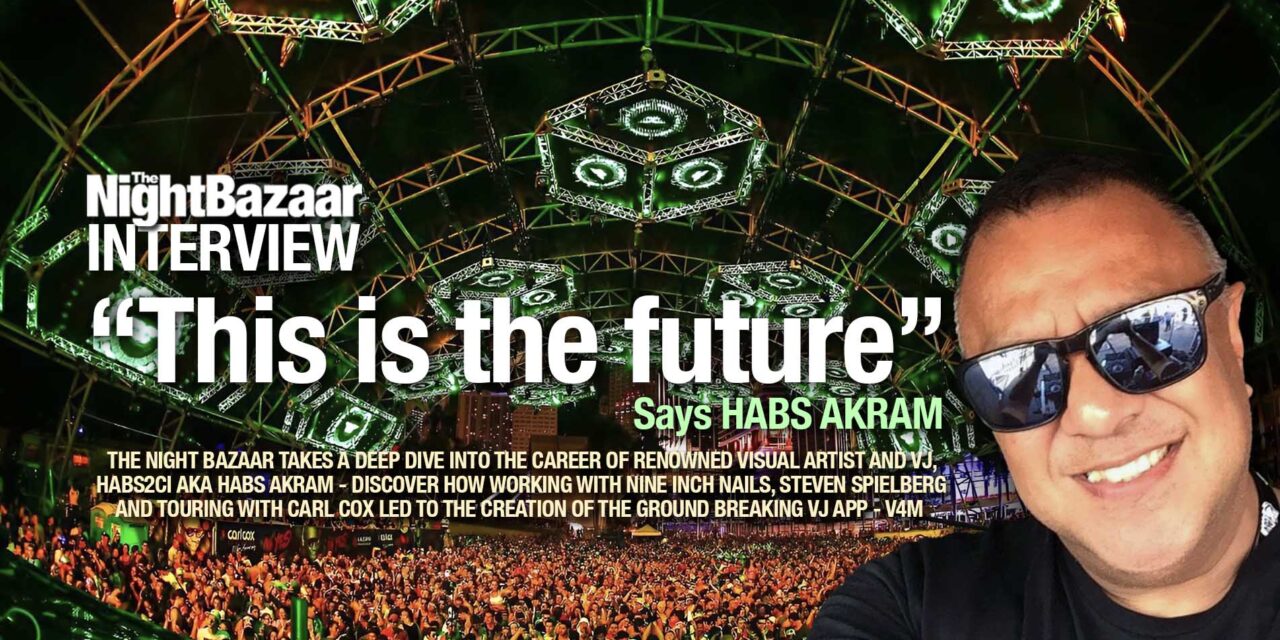
IN the mid-90s, visual artist Habs Akram aka HABS2CI found himself at a turning point that would shape his career as a pioneering VJ.
“In 1996, I was headhunted by a company called Notting Hill, owned by British film censor Andreas Whittam Smith. They were developing a real-time software program called ‘Dancer DNA,’ but the technology was ahead of its time—home computers simply weren’t capable of running it,” he recalls.
Faced with a stalled project, Habs proposed a bold new direction: “I suggested they keep the team, keep the product, and instead use the design team to create content for bands to take on tour.”
The risk paid off, leading to a groundbreaking opportunity. “The first tour we won was the Nine Inch Nails world tour,” he says, a pivotal moment that set him on a path toward redefining live visual mixing.
His connections soon propelled him into even bigger opportunities. “It was through a contact of mine, Mark Brickman—who was the lighting director for Pink Floyd—that we got the Nine Inch Nails gig. He told me, ‘What you guys are doing is perfect for Nine Inch Nails to take on tour.’”
That tour also led to an unforgettable, close encounter. “While I was in New York doing visuals, Steven Spielberg was in the audience—he’s a big Nine Inch Nails fan! He came backstage and told me he really liked the visuals. Then he mentioned a project he was working on which turned out to be the movie, A.I. Artificial Intelligence. To cut a long story short, he invited me to L.A. and offered me the chance to do visuals for a band in the movie.” It was a moment of realization: “That’s when I knew visual mixing had the potential to reach massive audiences.”

Habs Akram and Carl Cox
One of his most legendary partnerships has been with DJ icon Carl Cox. “I was first approached by Carl’s management, and I remember my first gig with him in Paris at Le Zénith,” Akram shares. But their connection went back even further: “I had actually played with him six years prior at a Slinky event at Westpoint Arena in Exeter. He did one of his famous six-hour sets, and I video-mixed for the entire six hours.”
The moment Cox recognised his talent was unforgettable. “After his set, his driver came up and told me Carl wanted to speak with me. I went backstage to his dressing room, and he said, ‘Are you the guy who did the visuals? I just want to tell you—you were f****** amazing!’”
They wouldn’t cross paths again until years later. “Six years later, I walked into his then manager, Lyn Cosgrove’s office, and Carl was there. He looked at me and said, ‘I recognize you.’ When I reminded him of our Slinky gig, he said, ‘You know what? I always wondered what happened to you. Now that you’re here, we’re taking it to the next level.’”
That next level took them to some of the world’s biggest stages including providing the visuals for Carl for most of his tenure at Space Ibiza and he spent ten years as his personal visual artist. He told us: “We also went on to play Stade de France for 80,000 people. It was Carl Cox, Tiësto, and David Guetta – it was actually Guetta’s event, but the production was out of this world!”
One of the most meaningful gigs, however, was in Japan. “After the tsunami, we did a charity event to raise money for the survivors. It was me, Carl, Fatboy Slim, and a few others. We wanted to represent, and it was an amazing event that raised a lot of money.”
Live performances can be unpredictable, but Habs thrives on that challenge. “When I’m visual mixing at events, I’m fully focused on the music and the energy of the artists and crowd,” he explains. His extensive content library gives him the flexibility to match any musical style. “From funky house to high-intensity techno, I can adapt in real time. That’s the magic of live visual mixing.”
Habs’ passion for innovation didn’t stop at live performances. In 2011, while touring Japan with Carl Cox, he had a revelation. “I walked into a phone shop to check out the latest mobile tech, and I had this lightbulb moment: I need to create a real-time visual mixing app,” he recalls. “At the time, mobile technology wasn’t ready, but I never gave up on the dream. Now, V4M—Visuals for Music—is finally here for iOS and Android.”
The app isn’t just for seasoned VJs. “V4M was created for everyone—DJs, bands, even students in schools. They can create their own visual art, import it into the app, and watch it beat-match to any style of music in real time,” Habs explains. “It’s a game-changer in the music industry. Now, DJs can mix music at an event while visual mixing from their mobile device at the same time.”
Habs sees V4M as just the beginning. “The app will always be updated with new features and effects to stay ahead of new technology,” he says. “This is the future—real-time visuals, AI-driven VJing, mixed reality. V4M is setting the stage for what’s next.”
For those looking to elevate their music performances with cutting-edge visuals, V4M is a must-have. Download HERE now and experience the future of visual mixing firsthand.
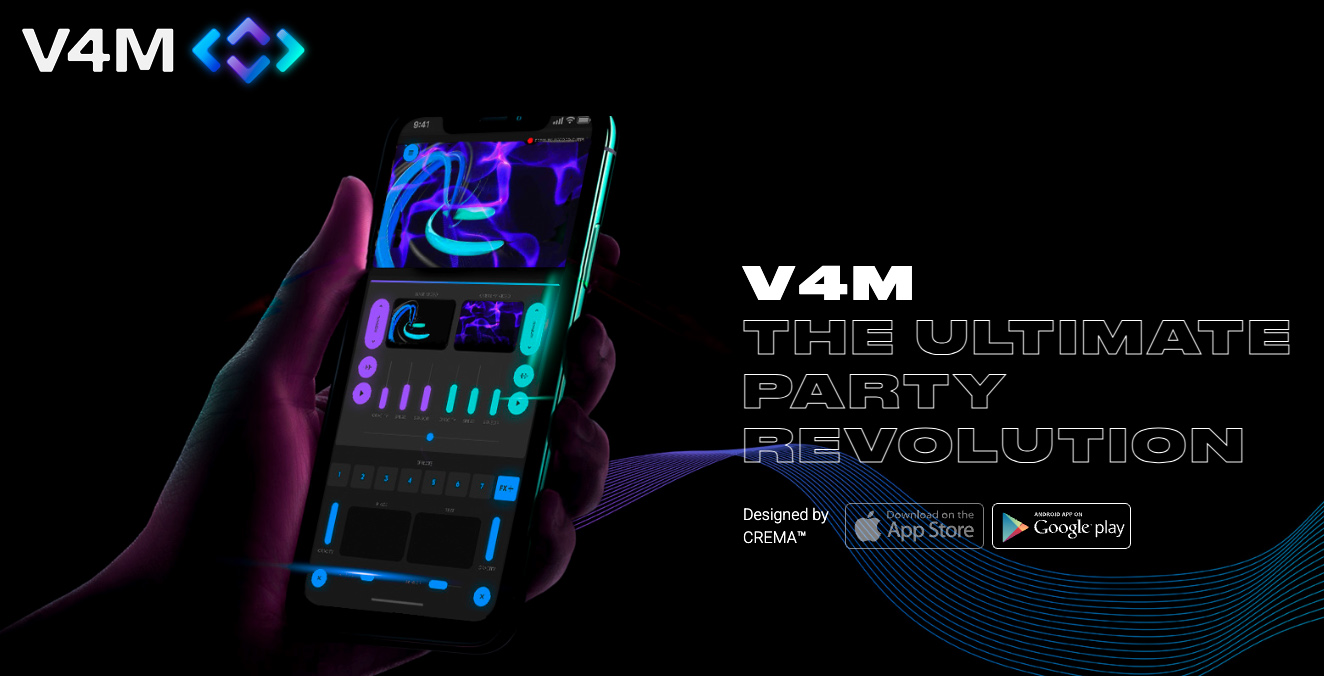
CLICK IMAGE TO DOWNLOAD
Get more electronic dance music news on The Night Bazaar HERE.