




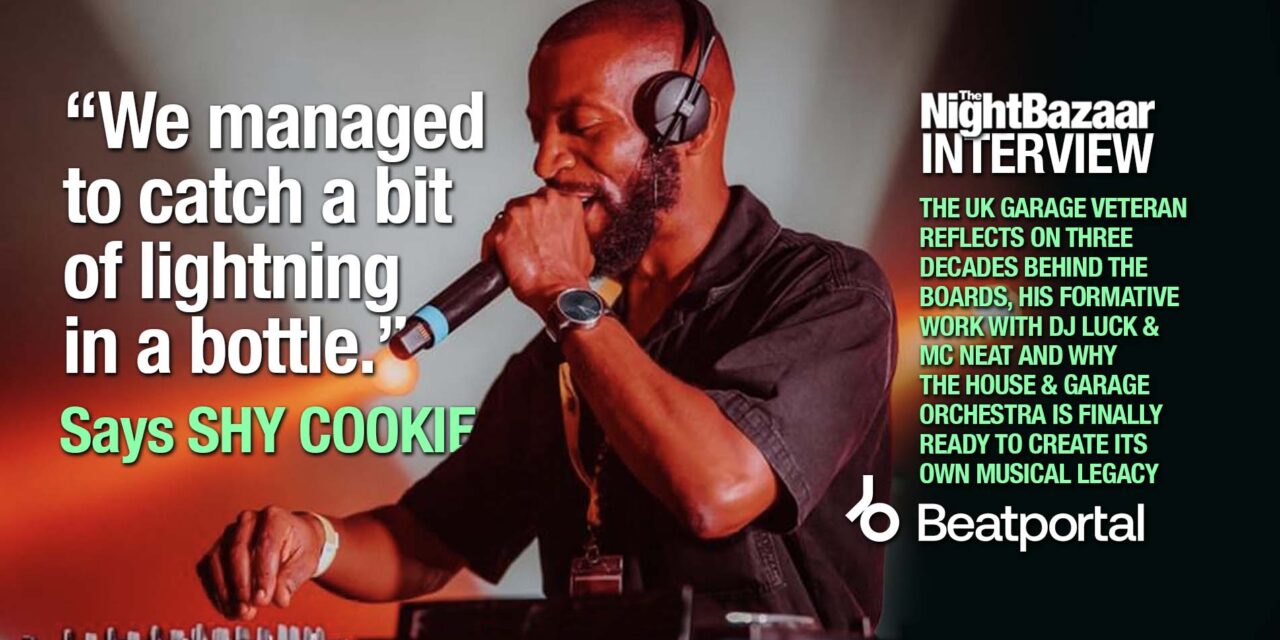
For more than three decades, Shy Cookie has occupied a unique position within UK garage.
From helping shape the sound during its formative years and producing records including Troublesome, Poison and Burning to his longstanding creative relationship with DJ Luck & MC Neat, his career has been driven less by chasing the spotlight than by an enduring fascination with making music.
That same instinct eventually led to The House & Garage Orchestra, the 15-piece live project he has spent more than a decade developing into a major touring proposition. Now THGO is entering perhaps its most significant chapter yet. New single Take Care, featuring Grammy-nominated soul and R&B vocalist Syleena Johnson, marks the beginning of the orchestra’s first original studio material, with further releases and its biggest headline tour to date set to follow in 2027.
For Shy Cookie, the timing feels particularly significant. As UK garage enjoys another resurgence, he believes celebrating its history must go hand-in-hand with creating opportunities for new artists and new music. We caught up with him to discuss three decades in UKG, those early studio sessions with Luck & Neat, building THGO from the ground up, working with Syleena Johnson and why he has no interest in simply recreating 1999.
House and garage is enjoying another huge resurgence, but there is always a danger that scenes become trapped by their own history. How important has it been for you to honour the past while continuing to push the music forwards?
It’s massively important.
You have to acknowledge where the music came from and celebrate the artists, DJs, producers, clubs, promoters, record shops and distributors who built the foundations of the scene. Without them, none of us would have had the opportunities we had.
But I think honouring that history also means making sure the next generation gets their opportunity.
There are some incredible young producers and artists coming through, and we have a responsibility to give them space, support their records and bring them into the scene rather than allowing UK Garage to become purely nostalgic.
I’ve never lost my passion for making beats, and I’ve never lost the excitement of discovering a new artist or hearing a record that makes me think, “What is THAT?”
For me, respecting the past and pushing forward aren’t opposing ideas. You need both.
You’ve been part of the UK underground for more than three decades now. When you look back at the young producer who was making records during the emergence of UK garage, did you have any sense that you were helping to create something that would become so culturally important?
Not at all! I’ve always been very task-focused. Make the record, finish the mix, get onto the next thing. I’ve probably been guilty over the years of not stopping long enough to take in what was actually happening around me.
Looking back now, I can appreciate that some of the things I was doing were significant.
Making what I believe was the first 2-step garage record with full Ragga vocals, producing my records without relying on samples, and eventually helping build an orchestra dedicated to this music , there is a thread running through all of it.
I’ve always been fascinated by creating something from a blank page. At the time, though, you’re not sitting in a studio thinking about cultural impact. You’re trying to make the best record you possibly can.
That’s still pretty much how I operate now.
Records such as Troublesome, Poison and Burning have become part of UK garage folklore. What do you remember most vividly about that period, and why do you think those records continue to resonate so strongly today?
Studio sessions. Lots and lots of studio sessions!
But what I remember most is the energy. We were young, experimenting and making music instinctively. There wasn’t a blueprint telling us what UK Garage was supposed to sound like because the sound itself was still evolving.
Those sessions had a real vibe to them, and I think somehow that got captured in the recordings. When people still react to those records today, I think they’re responding to that feeling as much as the production itself. We managed to catch a bit of lightning in a bottle.
You’ve always occupied an interesting position within the scene, often working behind the scenes rather than standing in the spotlight. Was that a conscious decision or did your career simply evolve that way?
It wasn’t really a conscious decision. It was where the work took me.
I came from a household where money was tight, and at 17 I found myself in the studio making beats for Luck & Neat. Suddenly something I loved doing could also help me contribute at home, so I took the work very seriously.
Production was also incredibly time-consuming then. Something like getting the drums exactly how I wanted them could take weeks. There were no shortcuts, so I naturally became the person who spent most of his life in the studio.
While other people were becoming the faces of records, I was very comfortable being the person behind them.
Looking back, that probably shaped my whole career. I’ve never really chased the spotlight. I’ve chased the next piece of work.
You worked very closely with DJ Luck & MC Neat throughout one of the most explosive periods in UK garage history. What made that creative partnership work so well and what did you learn from one another?
Luck and I had a great chemistry in the studio and we still do.
I came into those sessions having studied production and MIDI at college, so I already had a strong idea of how I wanted to build records. I’d turn up with beats I’d prepared on my Yamaha QY70 and various little drum machines, ready to work. In fact, the first remix we did together started from something I’d built at college on a Korg X5 and an old Mac running Cubasis.
But technical knowledge is only one part of making records. What those sessions reinforced for me was the importance of chemistry. When you’re working with people who understand each other’s instincts, ideas move quickly and you create things none of you would necessarily have arrived at alone.
Luck brought his own musical instincts, Neat brought his energy and personality, and I brought what I did as a producer. That combination just worked. And when it works, you don’t overthink it. You keep making records.

Shy Cookie
UK garage has gone through countless transformations over the years, from pirate radio and underground clubs to chart success, festivals and streaming platforms. How do you view the genre’s evolution and where do you think it stands today?
I’m genuinely excited by some of the new music being made.
I spent a couple of years on Flex FM playing only new House & Garage music, and that completely reignited my passion for discovering new UKG. There are some seriously talented producers coming through.
What I’d love to see now is more connection between the generations. It doesn’t have to be old school or new school. Why can’t a flyer have established DJs, MCs and artists alongside the best of the new generation? Why can’t the classics sit next to brilliant original records being made today?
The people who built this scene should absolutely be celebrated, but the healthiest version of UK Garage is one that keeps creating new stories. I’d like to play whatever is good , whether it was made in 1998 or last Tuesday.
The House & Garage Orchestra has become one of the most ambitious projects the scene has ever produced. Where did the original idea come from and did you ever imagine it would grow to the scale it has?
Interestingly, The House & Garage Orchestra, the label and my own music productions originally existed as one project in a proposal I developed for my Master’s degree.
The live element was slightly different then, more of a band than an orchestra, but the basic idea was there. I introduced the concept to Ishmael at a university student showcase I’d put on at the Jazz Cafe in 2013. We kept talking about it and developing the idea for months until eventually we decided to stop talking and actually build it.
We jumped in feet first. We built a small studio and brought in some of my teaching colleagues and musicians for those first shows. What started as a rhythm section gradually grew into the full orchestra you see today.
As the ambition grew, the team grew, and Ishmael and I had to grow with it. Every stage brought something we’d never done before , producing an orchestral album, touring, marketing shows, building teams, developing the production , so we learned what we needed to learn and kept moving. We didn’t start with a huge pot of funding or an established infrastructure behind us. We built with what we had, reinvested, learned and expanded.
In some ways, I think that’s become part of THGO’s DNA. Eleven years later, we’re still asking the same question:
How do we make the next one better?
One of the most fascinating aspects of the orchestra is that it reveals just how sophisticated and musical so many of these records actually are. Did working with live musicians change the way you thought about the music you grew up making?
I’ve always heard that complexity in the music because I approached it from a producer’s perspective in the first place. But working with live musicians opened up a completely different set of possibilities.
My musical references have never only been House and Garage. I listen deeply to Motown, Soul, Funk, Reggae, Rock and lots of other music, so those influences inevitably find their way into how I arrange and produce.
The orchestra gives us another musical language to work with. And there are still things I want to explore that we haven’t done yet. As the project grows, so does the scope of what we’re able to attempt musically.
That’s probably one of the things that still excites me most about THGO. After eleven years, I don’t feel like we’ve reached the limit of what it can be.
The project has taken you from pirate radio culture to venues such as the Roundhouse, the Palladium and major festival stages. Has there been a particular moment when you stopped and thought, “We’ve really built something special here”?
Honestly, I think Ishmael and I knew from the very first show at Queen of Hoxton that there was something special about it.
But every tour has given me another one of those moments. I’m very music-first in everything I do, so standing on stage and hearing these arrangements performed by incredible musicians while thousands of people are singing records that mean something to them is difficult to describe.
And I’ve been incredibly fortunate that I’ve built it with one of my best friends. Ishmael and I have the same fundamental mindset about THGO , keep pushing it, protect the quality and make the music the priority. Eleven years is a long time to build anything together.
So when I do occasionally stop and look at where it started versus where it is now, I’m very proud of what we’ve created , and of everyone who has become part of it along the way.
Shy Cookie
In 2018, Garage Classics introduced a completely new way of experiencing these songs. Why do you think audiences have connected so strongly with the orchestral interpretation of house and garage music?
I think it’s because we never approached it as simply putting classical instruments over Garage records. That wasn’t interesting enough to us.
What people hear is our interpretation , mine and Ishmael’s vision of what an orchestra playing House & Garage music could actually be. The rhythm still has to feel right. The bass has to feel right. The energy has to feel right. You’re dealing with records people know intimately, so you have to respect what made them special while finding something new inside them.
There’s a lot that goes into making that work. But I’m definitely not giving away all of our secrets!
After years of celebrating classic records, The House & Garage Orchestra is now entering a new phase with the release of original material. Why does this feel like the right moment to take that step?
Because, strangely enough, this isn’t actually a change of direction. It’s a return to the original vision.
When the whole THGO concept was first developed, original music, the live project and the label were all supposed to exist together. The success of performing the classics took us on an incredible journey and gave THGO its own identity, but original music was always somewhere in the plan.
Now we’ve built the audience, developed the orchestra and learned an enormous amount over the last eleven years, it feels like the right moment to complete that circle.
We’re incredibly proud of the history of UK Garage.
But THGO can’t only be about looking backwards. The next chapter has to contribute something new.
The first single, Take Care, features Syleena Johnson, whose voice has become instantly recognisable across soul, R&B and dance music alike. How did that collaboration come together, and what made her the perfect person for the record?
Gemma Fox deserves the credit for making that connection happen. I’d produced the backing track, Gemma wrote the song to it and recorded the guide vocal. She then reached out to Syleena’s team with the demo.
Syleena heard it, loved the record, and things moved from there. When you hear her voice on Take Care, though, it makes complete sense. There’s strength, soul and vulnerability in her voice, and that’s exactly what the song needed. She’s got one of those voices where you immediately know there’s a real person and a real story behind it.
For our first original THGO release of this chapter, having Shy Cookie, The House & Garage Orchestra, Gemma Fox and Syleena Johnson all connected through one record feels like a really strong statement of where we’re heading.
As both the producer and one of the driving forces behind the orchestra, how did you approach writing an original piece of music that still carries the spirit and DNA of the UK garage era?
I didn’t consciously sit down and say, “I’m going to make something that sounds like UK Garage.”
After making this music for so long, some of that DNA is naturally part of the way I hear rhythm. I still start from a completely blank slate. Usually I’ll build the hi-hat and percussion patterns first and let the groove start telling me where the record wants to go.
That’s been my approach for years. I’m a creative. I get an idea, look at the tools and people available to me and start building.
The difference now is that the palette is much bigger. I’ve got everything I’ve learned from producing underground records, everything we’ve learned from eleven years of THGO, incredible live musicians, great writers and vocalists, and decades of other musical influences to draw from.
I’m not particularly interested in trying to recreate 1999. I’m interested in taking everything that period taught me and asking:
What can we make now?
Shy Cookie
Your career has spanned underground clubs, chart records, pirate radio, orchestral performances and major festivals. Have all of those experiences changed your understanding of what dance music can be?
Definitely. Over the years I’ve developed a much greater appreciation for the different forms dance music has taken.
And I don’t just mean electronic dance music. Jazz, Rock in its original form, Be Bop, Soul, Funk , at different points these were the sounds that made young people gather together, challenge convention and, most importantly, dance.
The technology changes. The venues change. The culture changes. But that basic human response to rhythm doesn’t.
That’s something I’ve probably come to appreciate much more as I’ve got older. Although I will maintain one slightly grumpy old-man opinion:
Young people need to dance more. And no, TikTok doesn’t count!
Looking ahead to the forthcoming releases and the 2027 headline tour, what excites you most about this next chapter?
The fact that all the different parts are finally coming together. We’ve got a new THGO show, a major headline tour ahead of us and, importantly, we’re releasing original music.
For me personally, that means I can stand on stage with this orchestra we’ve spent eleven years building, play music we’ve created ourselves, and then later be behind the decks playing everything from the records that built the scene to brilliant new music being made right now.
I’m especially excited about the afterparties for exactly that reason. I want myself and our guest DJs to be able to play classics alongside new records and hopefully introduce people to music or producers they didn’t know before they walked through the door.
That’s what excites me about where we are now. We’ve spent a lot of years celebrating where this music came from. Now we get to help decide where it goes next.
The House & Garage Orchestra – Take Care featuring Syleena Johnson is out now. Grab it on Beatport HERE.
Head to Beatportal to read The Night Bazaar exclusive interviews in partnership with Beatport HERE.