




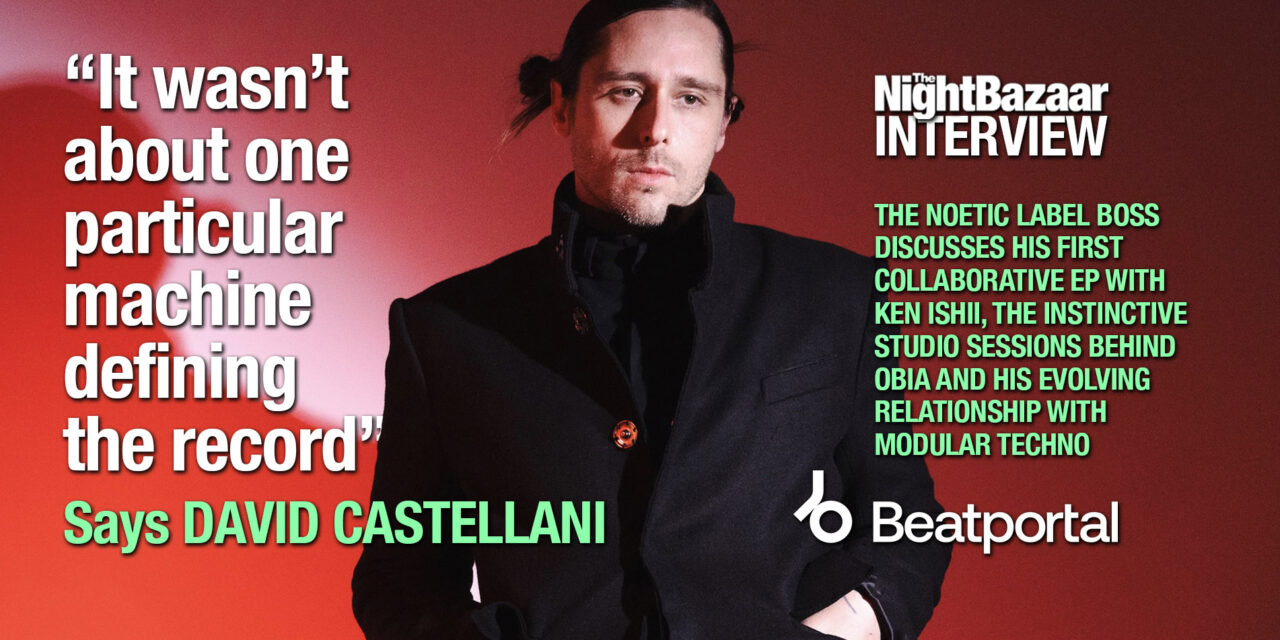
Released through Castellani’s Noetic imprint, the three-track project began during an open-ended studio session in Los Angeles in November 2024, before being shaped over the following year as ideas travelled between Tokyo, LA and Lisbon.
For Castellani, whose work spans modular synthesis, live performance, instrument design, education and running Noetic, the collaboration reflects a wider philosophy built around curiosity, experimentation and allowing music to reveal its own direction.
The Night Bazaar caught up with him to discuss finding an effortless creative flow with Ishii, balancing analogue spontaneity with digital precision, the evolution of Noetic and why, at this stage of his career, he still sees himself as a student of music.
Your relationship with Ken Ishii goes back several years, including his remix of Hyperstop in 2023 and your subsequent meetings whenever he was in LA. How did that relationship evolve from a musical friendship into making an EP together?
It happened pretty naturally over time. Ken remixing Hyperstop was really our first creative link, and after that we stayed in contact. We got together in LA during his visit and just experimented. No big plan, just seeing where it would go. Some of those first ideas really stuck with us. We kept going back to them, and that’s what led us to shaping a full EP.
The initial session that became Obia came out of a free-flowing studio jam during Ken’s extended stay in LA in November 2024. What do you remember about that session and was there a particular moment when you realised you had created the foundations of something special that became this release?
The session started very open-ended, but it became clear pretty quickly that there was potential for a finished release. We were working through different sounds and approaches, modular, hardware, plugins, and recording ideas as they developed. A few felt strong enough to build on. From there, we traded tracks back and forth a lot, refining arrangements and details over time. The foundation came from that first session.
You’ve said that collaborations can sometimes be complicated, but that working with Ken had an unusual sense of ease and fluidity. What do you think allowed the two of you to find that creative flow so naturally?
It flowed because we both listened and left room for the work. Ken’s approach is focused and calm, so nothing felt forced. We tested ideas, responded quickly, and moved on. That kept the process fluid without overthinking it.
The tracks on the new release began spontaneously in the studio but were then refined remotely over the course of roughly a year. How did that transition from instinctive jamming to detailed editing and refinement shape the final EP? Did you have to be careful not to polish away some of the spontaneity of the original session?
The challenge was knowing how far to refine the tracks without losing the instinct of the original session. The first ideas came very naturally, and then we passed them back and forth between Tokyo, LA, and Lisbon, each adding our own perspective. That exchange stayed healthy because it was about strengthening the material. The EP still carries that first energy, but it also reflects the longer process of shaping it together.
Analogue hardware played an important role in the sessions. Were there particular machines or techniques that became central to the sound of the record?
It wasn’t about one particular machine defining the record. We captured a lot during that session, using modular, external hardware, plugins—whatever was useful in the moment. The sound came from collecting those ideas and choosing the moments with the strongest character. The hardware mattered, but mostly because it kept the process physical and reactive. The record was shaped by how that session came together.
Do you see the three tracks as different expressions of one shared idea, or as snapshots of three distinct moments from the collaboration?
We recorded a big pool of material together, and from that selected what felt strongest. Each was then developed into its own piece. They still share the atmosphere of the original session, but each stands on its own with its own focus and identity.
You’re releasing Obia through your own label, Noetic. Did being both artist and label boss affect how you approached the record or were you able to separate those roles until the music itself was finished?
It was never about compromising. In the studio, the focus was simply whether the music was working. Early on, we talked about trying other labels, but as the record took shape, it felt like releasing it on Noetic was actually the strongest move. Having Ken on the label is a very special thing for me. It also marks a strong moment for where Noetic is going.
What does modular synthesis allow you to express that you don’t find as easily working entirely inside a computer or with more conventional studio setups?
For me, it’s about the different ways you can make music across digital and analogue spaces. Inside the computer, you can control every detail. In modular or analogue systems, you’re building a network of interactions that you respond to. I think the sweet spot is moving between those modes—precision in digital and spontaneity in analogue.
Your interest in instruments goes beyond using them, you founded Anti-Kulture and developed the Precision Disrupter, which has found its way into the studios of artists including Richie Hawtin. How has designing an instrument yourself changed the way you think about making music with technology?
Designing instruments has made me more aware of structure. When you build a sequencer, you’re formalizing certain musical behaviours. It forces you to ask what patterns matter and why. But for me it goes deeper than just looping back into how I compose. It’s really part of the foundation of the whole process, finding different pathways toward the most exciting musical ideas I can uncover.
I treat music like a living thing. I’m always trying to dig deeper and find the source of what moves me, and every tool, every system, every structure I build becomes another way of reaching it. The more I do it, the less it feels like I’m the source. I’m more like a facilitator. It’s not about brief flashes. It’s about drowning in it, endless waves you can live inside of. That’s the pull.
You launched Noetic in 2021 with a focus on smart, dynamic techno rooted in synthesis and analogue hardware. Five years on, how has your vision for the label evolved and what have you learned about building a distinct identity in such a crowded electronic music space?
Running the label became a way to clarify my voice by being in dialogue with other artists and the community, and letting that exchange shape me. Now Noetic is starting to stand on its own. It’s bigger than me, a little world where different voices can meet and grow. And that feeds my own work too.
What makes an artist or collaborator feel right for the Noetic world?
For me, it’s about artists who are really inside the music. Not just making tracks but chasing something through sound. There has to be curiosity, and a kind of openness where the music starts revealing its own shape. And that’s the beautiful part, when creativity becomes almost psychedelic and the ideas start fractaling out. That’s what I’m drawn to with Noetic. I’m excited to release a new EP from a talented LA-based producer John Rojas who’ll be sharing an inspiring new work ‘Skin’ on Noetic shortly. He’s the first artist to share an original solo work other than myself, so it’s a key step in the label’s evolution.
The label has also become increasingly connected to live events. How important is it for Noetic to exist as a physical, live community rather than simply as a record label?
Live events matter because that’s where music stops being a product and becomes a shared space. I actively try to remove that hard separation you get at a lot of events, where the artist is up on a stage and everyone else is somewhere below them. With my live modular sets, I want to be in the centre of the dance floor, with people able to come close, get personal with the process and actually participate in what’s happening. And honestly, the more I do it, the more I feel like I’m a spectator too. We’re all inside it together. That closeness and exchange is the point.
Your own journey has taken you from Italy through Chicago and Los Angeles to Lisbon, while maintaining strong connections with the LA techno community. How have those different cities and scenes shaped you creatively, and what has Lisbon brought to your work at this stage of your life?
Chicago gave me a foundation in rhythm and discipline. LA gave me space and scale. A lot of Noetic, the live modular work, and the instruments grew out of that period. Lisbon was intentional. I moved here partly to rebuild with focus, a new studio, a stronger system, but also to be closer to the European community and to share more everyday musical life with friends, collaborators and fellow artists here. I’m not looking to slow down. I’m pushing further, just more connected.
One of your formative musical experiences was studying drums with Juma Santos, who played on Miles Davis’s ‘Bitches Brew’. You’ve described those sessions as helping you understand the value of learning from a proper teacher. What from that experience still surfaces in the way you approach rhythm, improvisation or collaboration today?
Working with Juma taught me that education in music is more than technique. It’s transmission. It’s someone letting you feel the weight, history, discipline and joy behind the music, and it made me hear music as an institution we all participate in.
Even when I touch one knob, I’m immediately connected to an enormous chain of creativity, the person who designed that control, the person who built the interface, the people who organised the sound, built the software, the hardware, the computer, the speakers, and the people who developed the systems of music that came before all of us. So even in one tiny gesture, you’re tapping into thousands of years of creativity, focus and love. That changed the way I think about sound and about being part of that process.
Education has remained a significant thread throughout your career. Does teaching change the way you understand your own creative process?
I don’t really separate teaching from learning. For me, they’re part of the same process. Even when I’m sharing information, I’m still inside that space of discovery. Teaching forces you to organise what you know, question it, and go deeper into it. I don’t see music as just some abstract vibe. It’s a living system. The more you engage with it, the more it gives back. Sharing knowledge has led me to stronger ideas, better results and a deeper excitement about music and its beauty.
Your work regularly crosses disciplines: Hysteria Dichotic brought together techno, contemporary dance, modular synthesis and film, while your graphic-design background has led into fashion through After Infinite. Do you see these as separate creative outlets or as different expressions of the same underlying artistic philosophy?
I’ve always been drawn to deeper creative processes, not just making things, but really following ideas wherever they want to go. Music is the centre of it for me, but creativity doesn’t have to live in only one shape. Instruments, design, fashion, film, visual systems, they’re not the same as music, but they all let me experience art, chase its beauty and share that part of myself. It’s about learning through that process, finding new perspectives, and using whatever medium helps me express something that feels alive.
What feels most important to you creatively at this point in your career?
Creatively, it’s about continuing down the path I’ve been on. Growing, staying curious, and sharing my life with this thing that keeps pushing me: music. Moving forward, that means new projects, new collaborations and building something meaningful around sound. It’s still the same drive, just expanding into new spaces.
David Castellani & Ken Ishii – Obia EP is out now on Noetic. Grab it on Beatport HERE.
Read a previous interview with Ken Ishii by The Night Bazaar on Beatportal HERE.