




Rather than revisiting old formulas, the project finds Deep Dish drawing on the experiences, influences and creative perspectives they’ve developed through successful solo careers, resulting in a collection that feels simultaneously familiar and refreshingly contemporary.
Inspired by a city that has long held a special place in the duo’s story, GU49: Dublin captures a moment of reconnection, not only between Dubfire and Sharam, but also between Deep Dish and the generations of fans who have followed their journey. The mix moves fluidly through melodic house, progressive textures, indie dance influences and darker club sounds, offering a snapshot of where Deep Dish stands today while remaining true to the storytelling ethos that defined their most celebrated work.
We caught up with Deep Dish to discuss their return to Global Underground, rediscovering their creative chemistry, the significance of Dublin and why this reunion is about far more than nostalgia.
After years of pursuing very distinct solo identities, what was the process like finding the Deep Dish sound again in the studio?
Interestingly, we didn’t set out to recreate a “Deep Dish sound.” If we had approached it that way, it probably would have felt forced. The goal was simply to get back into a room together and make music from a place of curiosity. What we quickly realized was that the chemistry never really disappeared. Even after 20 years of following different creative paths, there was still that shared instinct to create something original and timeless. The sound emerged naturally from what we had learned making music on our own individual terms; we just had to find that middle ground rather than trying to revisit the past.
The compilation moves between melodic house, progressive textures, indie dance and darker club material. Did the track selection come naturally or was there a lot of debate between you both?
A bit of both. We agreed very early on that we didn’t want the compilation to sit inside one stylistic lane. Deep Dish has always been about connecting different worlds rather than representing a single genre. There were definitely discussions about certain tracks, but that’s always been part of our process. Those conversations are usually productive because they force us to examine why a piece of music belongs in the story we’re trying to tell. In the end, every track earned its place because it contributed to the overall journey and ultimately we just want the selection to be timeless as we’ve experienced from the previous compilations we’ve done for GU and others.
Dance music culture has changed dramatically since your first Global Underground release in 2002. What excites you most about the current landscape?
The barriers to discovery have never been lower. When we started, access to music was limited by geography, record stores, and distribution. Today, a producer can make a track in a bedroom and have it reach a global audience almost instantly. And because of how far the technology has evolved, the newer producers aren’t afraid to experiment with production styles and sounds which defy the traditional genres; we have a huge selection of music today which actually sits in-between those genres somewhere and that’s exciting. The scene feels more connected and diverse than ever.
You describe the album as “a mix of Deep Dish albums or eras.” How conscious were you of balancing nostalgia with where you both are sonically today?
Very conscious. We weren’t interested in making a museum piece. There are moments on the compilation that longtime listeners will recognize as part of the Deep Dish DNA, but we wanted them to sit alongside music that reflects who we are today. The challenge was finding a balance where the past informs the present without overshadowing it. For us, the most meaningful way to honour our history is to continue evolving rather than repeating ourselves.

Dubfire and Sharam – Deep Dish
Dublin clearly played an important role in shaping the energy of the compilation. What was it about the city and the show that inspired the mood of the project?
We’ve always had a special relationship with Dublin. We’ve come to realize over the years that Persians and the Irish are kindred spirits; we just get on so well with one another. And all our early shows there are the stuff of legend, as we’re constantly reminded by the fans. And now that we are managed by Dublin’s own Donal McCarthy at Purple Wall who has always played a major part in our early shows there it was just too perfect a project to ignore. Ultimately though, we did it for the fans – especially our Irish fans who have never forgotten us. That particular night felt like a perfect intersection of old and new. There were people who had followed our journey for decades standing alongside a younger generation experiencing Deep Dish for the first time. That sense of connection and continuity became a guiding theme for the project.
The original Global Underground mixes were often treated almost like artist manifestos rather than straightforward club compilations. Did you approach GU49 with that same mindset?
Absolutely. The best Global Underground releases were never just collections of tracks. They captured a moment in time and offered insight into how an artist thought about music in that era. We approached GU49 in a similar spirit. Rather than trying to document a club set, we wanted to create a snapshot of where Deep Dish is creatively right now; the music we’re inspired by, the stories we’re interested in telling, and the emotional spaces we want to explore.

Sharam and Dubfire – Deep Dish
There’s a cinematic quality to the flow of the album. Were there particular emotional arcs or narrative moments you wanted listeners to experience from beginning to end?
We always think in terms of flow. It’s very similar to the way we approach a long DJ set. We wanted listeners to feel like they were traveling through different sonic environments rather than simply moving from one track to the next. It’s about weaving together a cluster of music which work well together in a specific format to express what we’re trying to say musically in 2026. And I think we achieved exactly that.
Was there a specific moment during the reunion process where it genuinely clicked and felt like, “Yeah, this still works”?
There wasn’t one dramatic moment; it was more a series of small realizations. Conversation about music we’re currently into, various studio sessions and writing camps, a performance where we instinctively knew where the other person was going musically. Those moments kept reinforcing the feeling that the creative language we’d developed over many years was still there. We did some very long marathon sets again at iconic venues like Stereo in Montreal or Fabric in London to see if we still have that spark, which we did. And once we put the finishing touches on the new music – the first singles we’ve released plus the many which are in the pipeline – we knew that we still had more to say as a duo.
A lot of younger DJs, producers and ravers know Deep Dish through legendary remixes and compilations rather than firsthand club experiences. How do you see your legacy connecting with a new generation?
One of the most rewarding things about this new chapter has been seeing younger listeners discover the music on their own terms. Legacy isn’t something we had dwelled on, but it became something which had been nagging at us to take charge of again so we set out initially to preserve it. And during that process, we also felt we had more to say, and that’s when the conversations with how to express who we are to the younger audiences began and still continue. What matters is whether the new music still resonates emotionally. If someone discovers any of our new works and feels inspired to dig deeper, that’s incredibly meaningful. Ultimately, every generation finds its own entry point.
The release touches on themes of reinvention and evolution. What do you think Deep Dish represents now that it perhaps didn’t in the early 2000s?
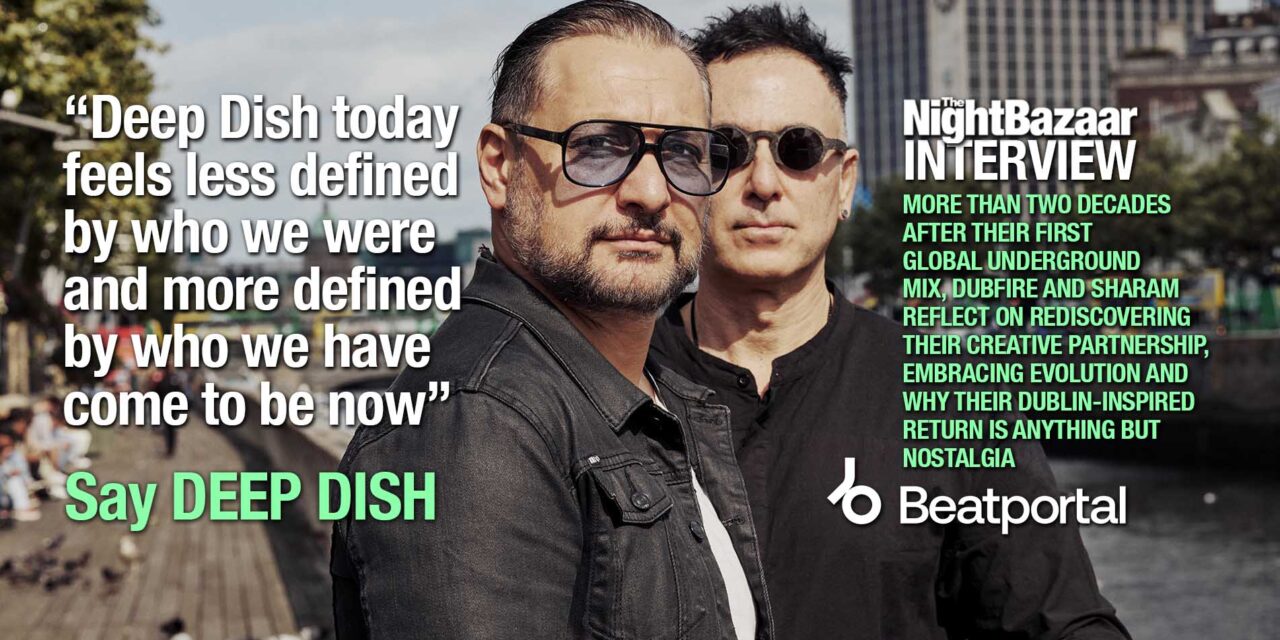
When we started, we were focused on proving ourselves and pushing forward with a unique sound that we tried hard to create over each project. After decades of touring, producing, and exploring individual paths, we have a much broader understanding of what matters to us creatively and obviously we’ve had many different successes and some failures that we’ve learned from. Deep Dish today feels less defined by who we were and more defined by who we have come to be now. We have a renewed curiosity and willingness to keep evolving together in new ways which is exciting to us.
Is this reunion something you see as an ongoing creative chapter or are you intentionally taking things one project at a time?
It’s definitely an ongoing creative chapter. At the same time, we’re approaching it thoughtfully. We don’t feel any pressure to follow a particular schedule or formula. The goal is simply to create the best original music and give our audience – and ourselves – experiences that feel meaningful and authentic. As long as we’re inspired and enjoying the process, we’ll continue exploring where this chapter can take us.
“Eating Hooks” is such a distinctive reinterpretation of Moderat’s original. What drew you specifically to that track?
The emotional core of the song immediately stood out to us. Moderat has always had an incredible ability to combine a certain vulnerability with hypnotic melodies and grooves. They’re masters of electronica, especially in the visual arts medium if anyone has witnessed their incredible live shows. And “Eating Hooks” embodies that beautifully. Rather than simply updating it for the dance floor, we wanted to reimagine it through the Deep Dish lens by stretching it out, creating more space, and allowing the emotional weight of the original to unfold differently over time and with a renewed melodic angle. To have their trust and approval of it has meant the world to us.
Questions for Dubfire
Your solo work often leans toward darker, more stripped-back techno. How did reconnecting with Deep Dish affect your creative instincts?
One of the things I enjoyed most was allowing myself to think more expansively again. My solo work has always been quite eclectic but become more defined by pure techno over recent years. With Deep Dish, there’s more room for melody and I quite like exploring my pop dance sensibilities once again. Revisiting that mindset reminded me how powerful those elements can be when we come together as a creative force.
Having spent years developing the Dubfire identity independently, was it challenging to step back into a collaborative headspace again?
Not really. I was actually looking forward to a change. The biggest adjustment was simply learning to leave more space for dialogue again. When you’re working alone, every decision ultimately belongs to you. In a partnership, the process becomes more conversational and collaborative. What made it easy is that Sharam and I have decades of shared history as well as what we’ve both achieved as solo artists and now, there’s a level of trust that allows us to challenge each other creatively without ego getting in the way.
Questions for Sharam
Deep Dish always felt like a partnership built on contrast as much as chemistry. What do you think you and Dubfire each brought to the project that wouldn’t have existed without the other?
One of the things that always made Deep Dish special was the fact that we didn’t think exactly alike. We shared the same passion for music, but we often approached it from different angles. Ali has always had an incredible ability to focus on the details in a very deliberate way. I’ve tended to be drawn toward the bigger emotional picture; the melody, the “hook”, and the human connection in a track. When those perspectives came together, they often pushed the music somewhere neither of us would have gone on our own. I think the project has always lived in that space between our individual instincts.
After spending so many years developing independent artistic identities, what was the most surprising part about reconnecting creatively with Dubfire?
Honestly, how natural it felt. When you’ve spent years pursuing your own path, you assume there’s going to be an adjustment period. But once we started exchanging ideas again, it felt surprisingly familiar. What was most surprising wasn’t how much had changed, it was how much of that creative language was still there. We could still challenge each other, debate ideas endlessly, and ultimately arrive at something stronger because of the collaboration. That dynamic returned much faster than I expected. I mean we still argue but are far more diplomatic – and democratic – than before.
Sharam and Dubfire – Deep Dish
Do you think time apart gave both of you a greater appreciation for what made the Deep Dish chemistry unique in the first place?
Absolutely. Sometimes you need distance to fully understand what made a partnership special. During the years we spent developing our own careers, we both learned a lot about ourselves creatively and as individuals. Coming back together, there was a greater appreciation for the things we each contribute and for the fact that Deep Dish was never simply about a particular sound. It was about a creative dialogue that constantly pushed both of us outside our comfort zones. Looking back, I think the years apart ultimately strengthened the partnership because they allowed us to return with fresh perspectives and a deeper respect for what we built together.
#GU49 Dublin – Deep Dish is out now. Grab it on Beatport HERE.