




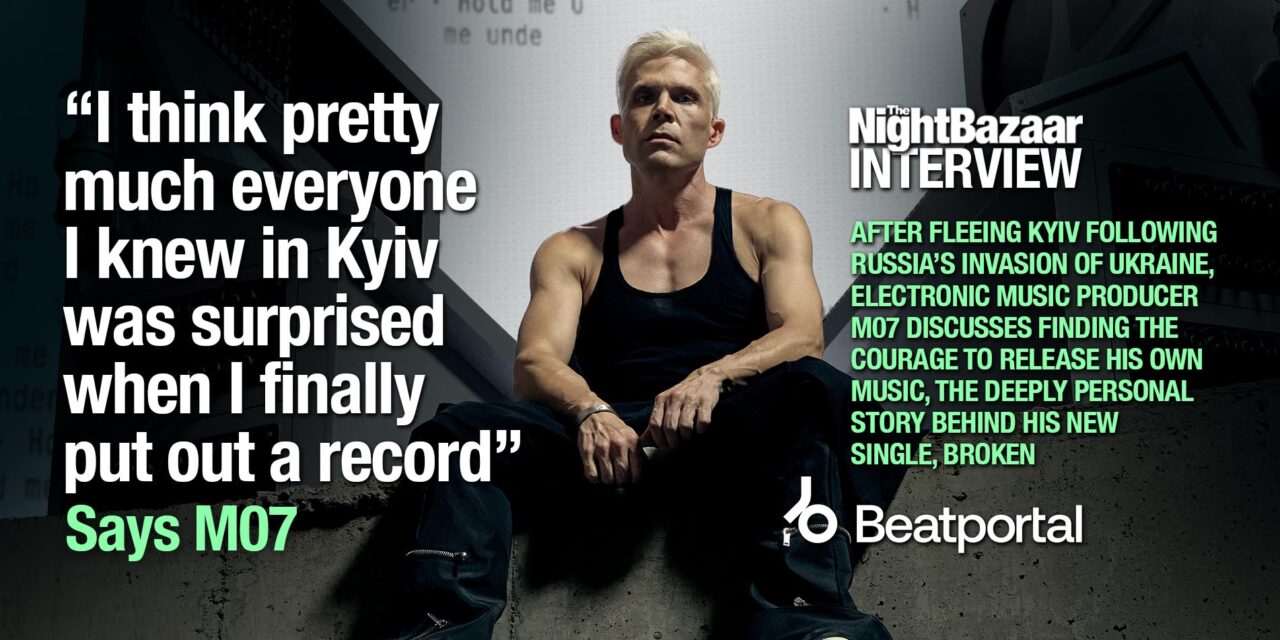
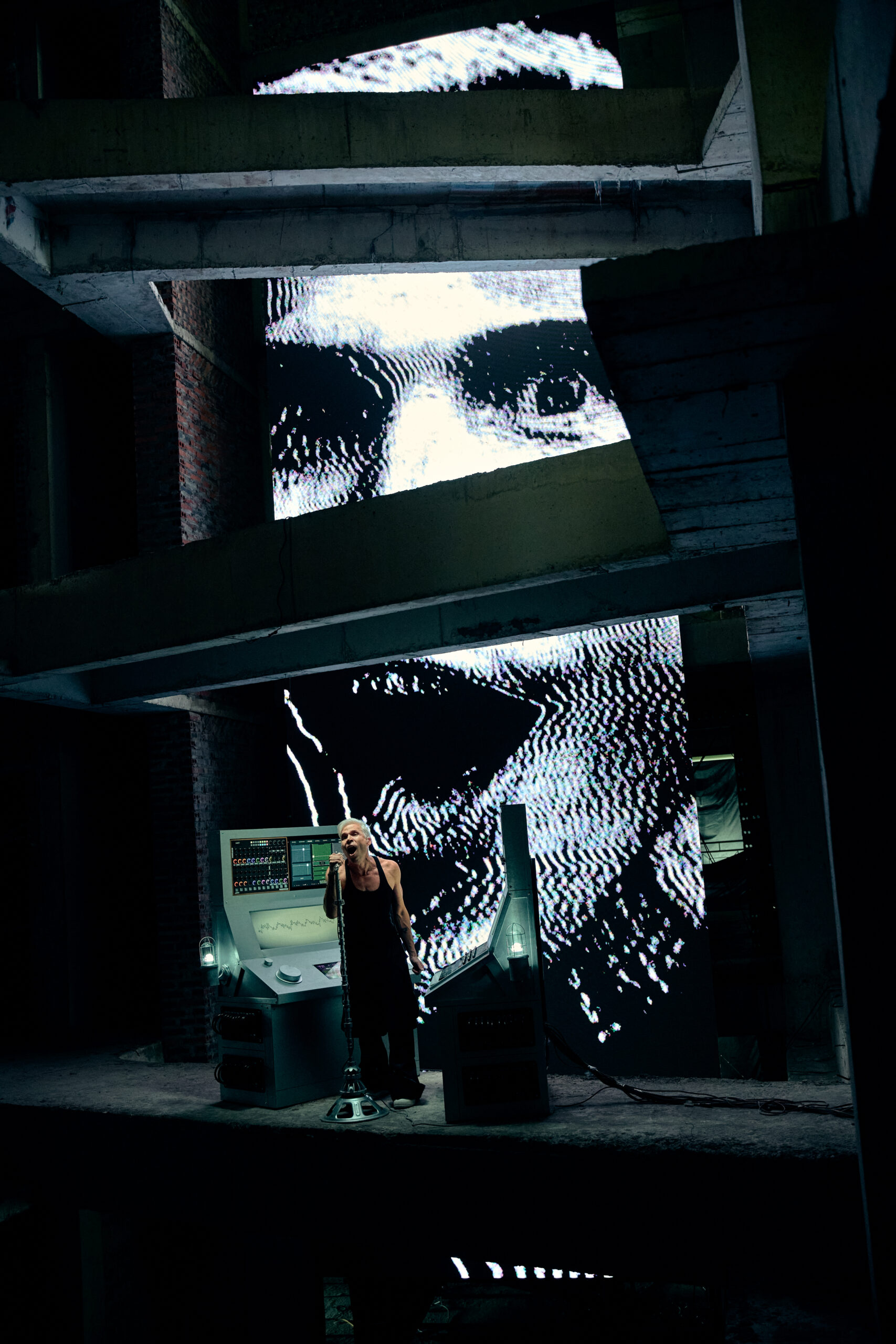
His latest single, ‘Broken’, is a deeply personal collaboration with Ukrainian vocalist Alona Chernenko of Nesamovyta, written remotely during the devastating electricity blackouts in Kyiv earlier this year. The track also features in SIGNAL, an extraordinary 30-minute live performance film shot in Vietnam, where abandoned architecture, monumental LED installations, bespoke electronic instruments and choreography combine to create an immersive audiovisual experience.
Produced in collaboration with acclaimed creative studio AntiAntiArt, SIGNAL premieres at Amsterdam’s historic Koninklijk Theater Tuschinski on October 22 as part of Amsterdam Dance Event’s official Arts & Culture programme, ahead of further releases and plans to develop the project into a full-length touring show.
In this exclusive interview with Beatportal and The Night Bazaar, M07 reflects on the life he left behind in Kyiv, overcoming his reluctance to release his own music, the extraordinary circumstances surrounding Broken, and the creative ambition driving SIGNAL as he prepares to take his music from the studio to the stage.
You’ve spent more than two decades involved in music behind the scenes, but M07 represents you stepping forward as an artist in your own right. Why is the time right for you to step out from behind the scenes?
I’m not sure the time ever felt right. I’d been making music since I was a teenager, and I’d spent years finding ways to stay in music without really putting my own work out there. Booking other people was much less frightening than asking anyone to listen to me.
Then I left Kyiv after the invasion. I’d thought I was settled, started building a family, and suddenly we were rebuilding our lives somewhere else. Fear of rejection didn’t go away, but it looked rather different after that. Becoming a father changed things too.
I had about three hundred tracks by then. At some point I had to stop sending selections to friends and actually release something.
The name M07 comes from the Kyiv-Warsaw highway out of Ukraine. Given everything that road and that journey now represent to you personally, why did you choose to make it the name of your artistic identity?
Because I knew it before it became the way out. I’d driven it for years, seen the same stretches in different seasons, passed those bus stops that seem to be in the middle of nowhere. It was a road in my life before it had this other significance.
I wanted the name to hold those years as well. When I say Kyiv, I’m thinking about a place I lived for almost a decade, not only the day I left it.
You lived in Kyiv from 2013 until the full-scale Russian invasion in February 2022 forced you to leave. How profoundly did that experience alter your relationship with music and your understanding of why you make it?
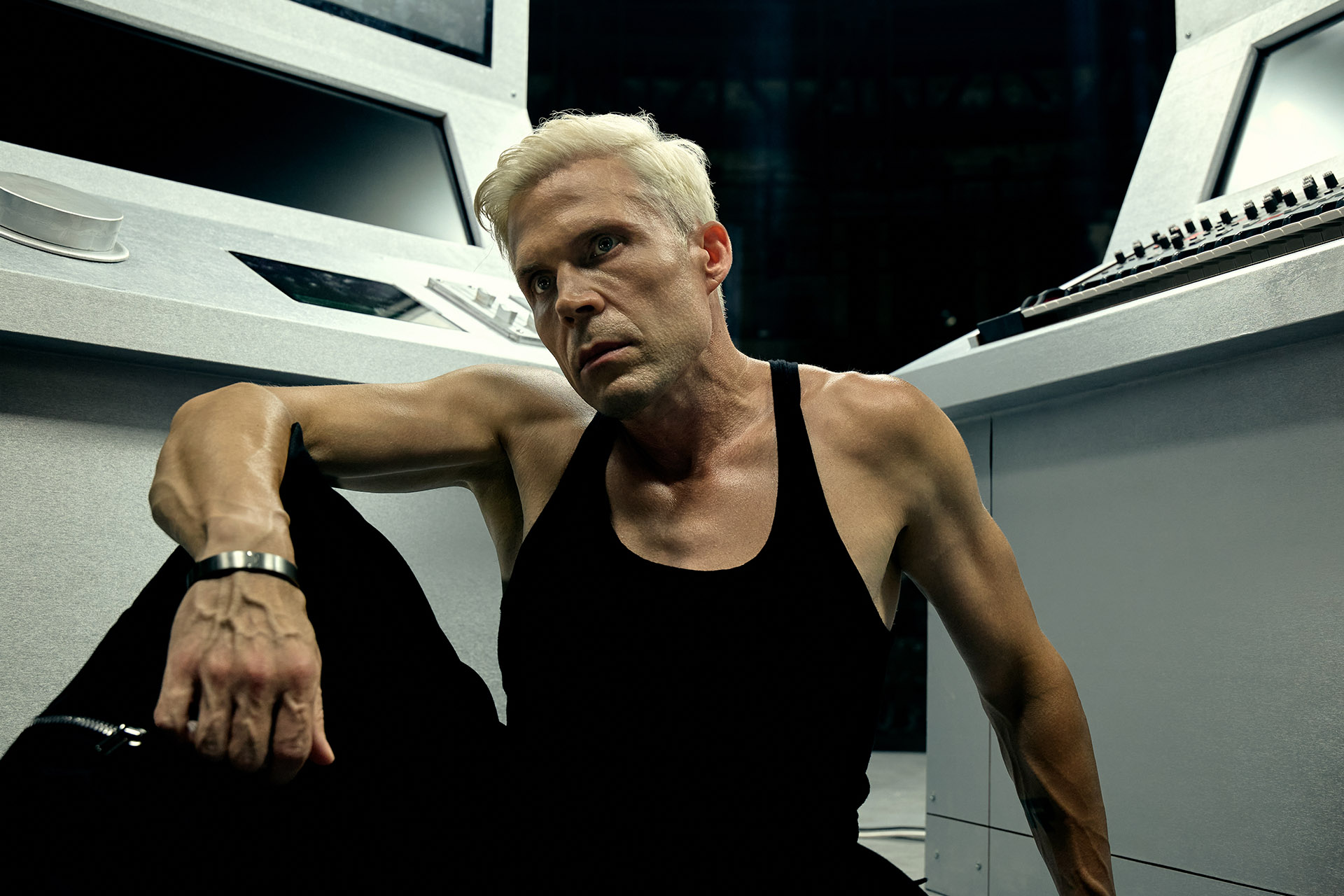
I didn’t move to Kyiv for music, and I wasn’t part of the music industry there. I was just someone buying a ticket, going out and being in the room. When you’ve worked in clubs and concerts, going to one can feel a bit like being back at the office: you’re listening, but you’re also noticing the production and thinking about how the night is being run. In Kyiv I could go to Closer without any of that being my responsibility. I could just enjoy being part of it. It was a wonderful feeling, and it had changed my relationship with music long before the invasion.
M07
Making music wasn’t part of who people knew me as there, either. I had a modest studio at home, but it wasn’t somewhere I’d invite people in to hear what I was working on. I think pretty much everyone I knew in Kyiv was surprised when I finally put out a record.
Leaving changed something else. I grew up in LA with earthquakes, fires, floods and riots, and I thought I’d seen quite a lot. I hadn’t expected to have to leave a home I’d spent years building because of a war. We were fortunate as a family, but the life I thought I was settling into had changed completely. After that I stopped giving quite so much of a fuck about being rejected. I still cared about the music. I just didn’t want to keep hiding it. The first EP has songs that deal with the war directly, but there’s nearly a decade of living and listening in Kyiv behind the music too.
Your music sits in this dark, melodic and atmospheric space within techno. Did the sound of M07 emerge organically from everything you had experienced, or did you begin the project with a clear idea of the musical world you wanted to build?
It took making the first record to hear what I was doing. On ‘KM0’ I was trying quite hard to get everything right. I can hear myself being careful, and there are places where I polished away things I should have kept.
SIGNAL is closer to some of the music I was making when it was only going to be heard by friends. It’s darker and rougher. There’s more post-punk and acid in it, more breaks, and it moves between about 128 and 140. The Prophet-6 has become a big part of the sound.
So there was an idea of the world from the beginning, but I had to loosen up a bit inside it. I don’t want to tidy away everything that made me like a track in the first place.
Broken feels particularly significant because of the circumstances surrounding its creation. You were in Spain while Alona Chernenko of Nesamovyta was in Kyiv during the January 2026 blackouts, and you were essentially writing together over Telegram. Can you take us inside that process and the conversations that became the record?
Alona sent over a vocal melody and some lyrics. I liked the melody straight away, but I’d also been listening to Nesamovyta, her Ukrainian-language project, and I wanted more of that person in this record. Her writing there is fire.
The conversation was less about changing individual lines and more about where the emotion was coming from. I wanted it to go further inside: the pressure, the memories, what happens in your head when everything around you is moving. Darker and more personal.
‘Nobody wanna be broken’ was the line I wanted to keep. Beyond that, I didn’t want her to feel trapped by the first topline. We went back and forth, she sent little videos, and we worked on getting more dynamics and contrast before the chorus. The song needed somewhere to go when that line arrived.
M07
Alona was creating while strikes on Ukraine’s energy infrastructure meant millions of people were living with only a few hours of electricity each day. How did knowing what was happening around her affect you while you were working on the track from somewhere comparatively safe?
I was in Spain for much of the writing, but when she delivered the vocals I was actually in Iceland, on a glacier, without a laptop. We couldn’t have been in more different worlds.
In Kyiv she was losing electricity for up to sixteen hours a day. There were points where she was close to finishing and her laptop ran out of battery, and then the work had to wait for the power to come back. So alongside all our conversations about the song, there was this very basic question of whether she could even turn her computer on. That was the difference between where we were working.
There’s obviously a temptation for listeners to interpret a title like “Broken” through the lens of war and displacement. What does the word mean to you within the song and how much of yourself is contained within it?
The bit that mattered to me was what happens inside you while everything around you is changing. That’s what I was asking Alona to go towards in the writing: pressure, memory, fracture, survival. Something darker and more personal, rather than describing a scene or a journey.
There’s plenty of me in that direction, given what we’ve been talking about. But it’s also a song we’re making together. Nobody wanna be broken was there in her sketch, and it was the line I wanted us to keep as the rest developed. It gives you a lot to work with without needing to explain everything.
What did Alona’s voice bring to Broken that you felt the music needed and how important was it that another Ukrainian artist became part of this particular piece of the M07 story?
What I liked in Nesamovyta was how much of herself I could hear in it. That’s what I wanted in this too. She already had a great melody, and I wanted the writing to have that same darkness and personality I heard in her Ukrainian songs.
The fact that she’s Ukrainian is part of the connection, and Kyiv is part of both our lives. But I’d like people to go and listen to her work as well. She’s bringing her own writing and voice into this, and that’s what made the collaboration interesting to me.
SIGNAL is much more ambitious than a conventional filmed live session, bringing together cinema, choreography, instrument design, architecture and club culture. Where did the original idea come from, and at what point did you realise it needed to become something on this scale?
I started with wanting to build a live show. Orbital and Underworld were in my head when I first imagined performing this music. Then the questions got quite physical: where am I standing, what am I playing, what does someone at the back of the room see? I wanted a show where you could see what I was doing, and where the sound and picture belonged together. That meant building it first: the set, the consoles, the screens, and working out how I was going to play it. I couldn’t describe it properly with a few drawings and some tracks.
The awkward bit is that I’m introducing myself. A promoter needs to see what they’re booking, and someone buying a ticket needs a reason to come. But the show has to exist before either of them can see it. Making the film gave us a way through that.
So we built the show, took it to Vietnam and worked with AntiAntiArt to make SIGNAL. The cinema screenings let people see and hear it properly before deciding whether they want to come when we bring the live show to their city.
Why did the project become known as SIGNAL?
It comes from a line in ‘Hold Me Under’, a new M07 track featured in the film. It’s one of two moments where I step out from behind the console and bring my own voice into the performance. You can’t hear it anywhere yet. It’ll lead the SIGNAL EP. It’s the most exposed track on the release, and the most physical moment in the film. The line is: and I can’t tell if I’m falling, or if I already hit the ground. Every signal turns to static, every colour drains away.
It also fits the whole CRT, lo-fi, glitched world we’d been building around M07. The old screens, the distortion, something real that doesn’t quite come through cleanly. And then you’ve got the actual signals from the instruments on the consoles. There were a few things meeting in that word, but the lyric is where it came from.
You worked with Antiantiart, whose previous work includes Apple’s 360-degree “Shot on iPhone” campaign. What did they understand about your vision that made you feel they were the right collaborators to translate the M07 world to film?
There was a lot we already liked in each other’s work. With M07 we’d been talking about things that feel real but slightly distorted, actual places with some roughness in the image, and Phuong’s team understood that without us having to explain every decision.
There’s a warmth to them too. That matters when you’re a long way from home trying something you haven’t done before. They’d made plenty of music videos, but this was their first live performance project. We were bringing different things to it, and there was room to try things together. By the end I think the producers knew more about live sound than they’d ever wanted to.
M07
There’s something interesting about performing electronic music inside abandoned or unfinished architecture: spaces that once had a purpose. Given your own experience of displacement and rebuilding, did those environments acquire a deeper meaning while you were filming?
I can see that connection, but I wasn’t standing there thinking of the buildings as a metaphor for leaving Kyiv. On the day there are plenty of less profound things to think about, like where the power is coming from and whether a cable will reach.
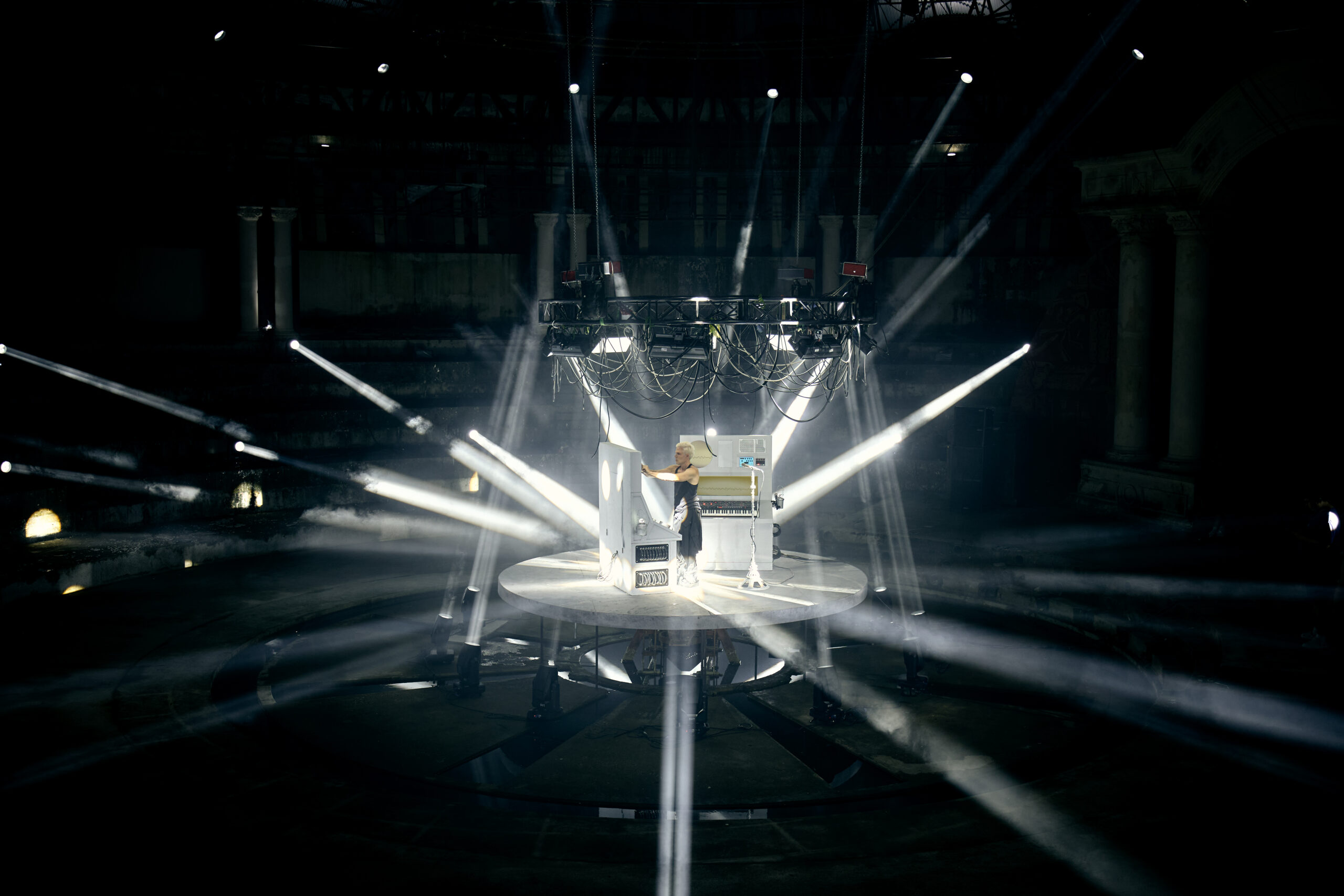
What struck me was how they changed the feeling of performing. The circus is enormous, but I’m alone on a circular stage in the middle of it, and yet it feels oddly intimate. We used white light and strobe. There’s no big video behind me to carry the performance. Something I’d made in a small room is suddenly coming through a concert PA in this huge space, and I’m right in the middle of it.
The concrete building gives you something quite different. There’s a four-storey LED, but my setup is on a narrow concrete beam inside a confined space. The screen adds texture to the architecture. Those are very different places to put the same music and the same person.
And then people from the crew start dancing while I play. Officially there’s no audience, but there are people responding to it. That was the part that brought it back to something familiar.
Electronic music has always had a complicated relationship with the idea of the live artist. How much did you want SIGNAL to challenge the familiar image of a DJ or producer standing behind equipment?
A lot. Even watching live electronic shows I love, I’ve sometimes wanted a better view of what the person is actually doing. I don’t need to follow every knob turn, but that curiosity fed into how we built SIGNAL.
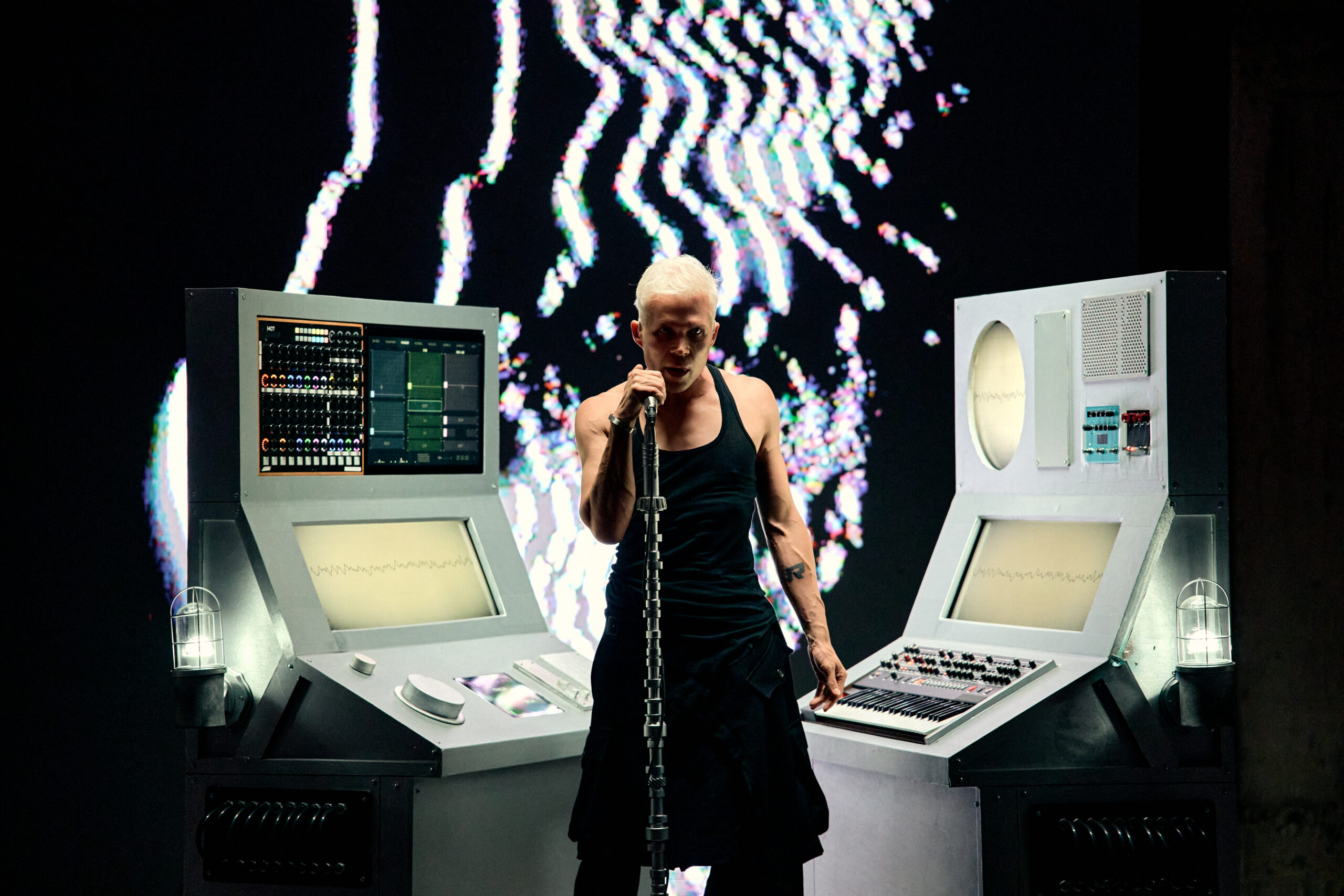
So, one of the first things we changed was the table between me and the audience. We built two consoles that face out into the room, with the controls mounted vertically and my hands lit. The whole setup opens towards you. The screens show the signal coming from the instruments as I play, so what you see relates to what you hear.
We also consciously worked on how the movements read from the audience. Something that makes sense when you’re standing next to me can disappear from further back. Some gestures need to be bigger and more physical for you to understand what I’m doing.
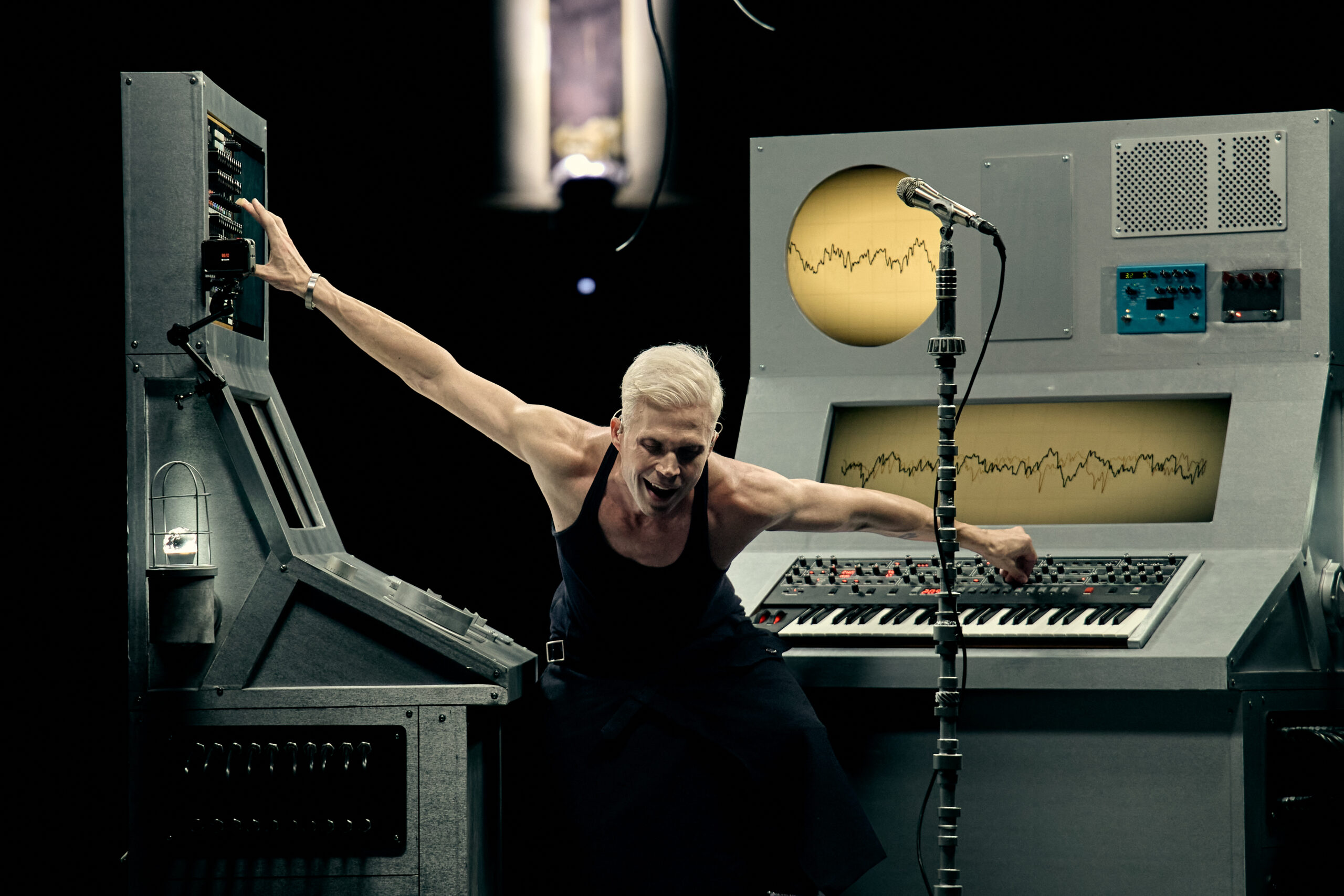
That’s where the choreographed movement comes in. Early in the production I said M07 needed a language of movement. I didn’t know what a movement choreographer was before this. I’m not a dancer, but we could work on how I reach for something, how I move between the consoles, and what happens when I step away from them to sing. I wanted to think about my whole body in the performance. You shouldn’t have to spend thirty minutes watching my fingers.
M07
With SIGNAL are you deliberately trying to build an artistic language that can exist beyond the traditional boundaries of electronic music?
I’m trying to make something I’d want to go and see. I love club music, and there’s plenty of it in this, but I also want people to have a clear view and hear the whole thing properly. Sometimes that means finding a different kind of room.
I’ve got two young kids. Despite my best intentions, a disco nap can turn into just going to bed. I don’t think I’m the only person who loves this music and would sometimes like to see something without being out until six in the morning.
The music can still be loud and physical. I’m interested in the different ways people might come to it.
You recorded the 30-minute performance at the abandoned circus rather than constructing everything retrospectively in the studio. What was it actually like performing the material in that environment and did the atmosphere or acoustics of the location change the way you played?
We did one take all the way through in the circus, and then the section in the apartment building. The thing that took longest wasn’t the playing. It was learning not to worry about making a mistake, and getting the system to feel like an extension of me. It’s built entirely around this project, but it still took time to get used to, like learning to drive.
I’m sending vocals through guitar pedals, playing instruments, and working with a system built around these songs. We send sixteen channels out of the laptop, separating things like kick, bass, drums, played instruments, clean vocals and processed vocals. We thought we’d done a good job of keeping things separated, and then the Atmos mixer on the film said, this is great, but next time please record more channels so we have more to work with. I had to laugh.
Playing in the circus still felt very different. There was a concert PA in this enormous concrete space, and it was loud. Then people from the crew started dancing. They were there to make a film, and we ended up putting on a show for them as well.
SIGNAL premieres at Koninklijk Theater Tuschinski during Amsterdam Dance Event’s Arts & Culture programme, which puts the project inside a cinema rather than a nightclub. How do you think experiencing this music seated in a historic theatre changes the relationship between you and the audience?
Cinemas are brilliant for this. Proper sound, a huge screen, everyone can see, and for the most part people aren’t on their phones. You’ve all come into a room to watch the same thing. I want people to get the sound and the picture we put so much work into.
As for what it changes between me and the audience, I’ll find out on the 22nd. I’ve never watched myself with strangers before. I’ll be in the room. Ask me on the 23rd.
M07
There is more M07 music arriving from the end of October onwards, starting with ‘Sugar Rush’ on October 23rd. Does “Broken” give us a clear indication of where the project is heading musically or are the forthcoming releases going to reveal very different sides of the world you’ve created?
BROKEN sits between KM0 and where SIGNAL is going, so it’s a bridge into the world rather than the whole picture. There are three singles between now and February. SIGNAL gets up to 140bpm, there are straight instrumental tracks, and the tracks with my own vocals lean more alt-electronic but are still club tracks. One is a breakbeat track mixed by Mark Yardley of Stanton Warriors. Sugar Rush lives in the same world but has some of the pop sensibility of the first EP, darker and with more developed songwriting. There’s a lot more saturation and distortion across all of it. It sounds real.
The Prophet is a big part of it, and I’ve left more of the roughness in. That’s probably the clearest change from the first record. I’m less inclined to smooth something out just because I can.
Having had your life geographically and creatively reshaped since leaving Kyiv, what does moving forward mean to you now and what would you like M07 to become over the next few years?
We’re building the full-length show now. SIGNAL is thirty minutes, and it’s a very high-energy thirty minutes. I trained for it like a race, and performing it still reminded me that I’m a human. I need to breathe and so does everyone watching. Extending it means more material, but also more room for contrast, for something to settle before we push again.
I’m working with a musical director on how the whole show moves. Where do you push, where do you give people a moment, what makes you want the next track to come in? It turns out that’s quite hard to hear with your own music. You’re so close to each track that having someone else help you hear the whole thing makes a difference.
I look at the artist team on the Kissing You video, me, Dmytro and JT Roach, who co-wrote and sang on the track, and then at SIGNAL, where we’re at something like fourteen people orbiting around the project. I feel fortunate that people get what I’m trying to make and want to be part of it. I couldn’t bring it to life by myself. Now I want to get the full show in a room with people who’ve chosen to come.
Moving forward mostly means not going back to sending tracks to friends.
M07 – Broken is out now on Key Factory Music. Grab it on Beatport HERE.
SIGNAL premieres at Koninklijk Theater Tuschinski during Amsterdam Dance Event on October 22, with Sugar Rush following on October 23.
Read The Night Bazaar interview archive on Beatportal HERE.