




Live electronic music pioneer Saytek returns to Carl Cox and Christopher Coe’s Awesome Soundwave imprint with Live At Sisyphos, a three-track EP capturing the raw energy and spontaneity of two improvised performances at Berlin’s legendary Sisyphos club.
Recorded across the club’s Hammerhalle and Tunnel floors, the release brings together Saytek’s enduring influences from Detroit techno and ’90s house with his constantly evolving approach to hardware-driven live performance.
With more than two decades of live shows behind him and a 12-year relationship with Sisyphos, Saytek remains committed to pushing electronic music beyond conventional boundaries. He speaks to The Night Bazaar and Beatportal about the stories behind the new EP, his creative relationship with Awesome Soundwave, Berlin’s unique techno culture and why the human connection between artist and dancefloor matters more than ever.
Your new EP Live At Sisyphos brings together two longstanding relationships in your career, with the club itself and Coxy’s Awesome Soundwave. What makes this release so special and what inspired you to capture these performances as a dedicated EP?
It’s amazing to bring together two relationships that I value so much. Awesome Soundwave is a label dedicated to live electronic music, which is exactly what I’m all about. Everything I’m releasing at the moment is recorded live, and most of it nowadays is captured while I’m on tour. My relationship with Sisyphos goes back 12 years and it’s genuinely one of my favourite clubs in the world.
This EP was recorded across two incredible gigs. The first was on January 2nd, during their massive New Year celebrations, in the Hammerhalle. The second was on a Sunday afternoon in the Tunnel, the day after Rave The Planet. Both were amazing experiences, and it’s brilliant to have captured those moments as a release.
My journey with Awesome Soundwave has been incredible too. I’ve released three albums with them, alongside a number of EPs and remixes. Carl Cox has been a massive supporter of my music, and Christopher Coe has been fantastic as well. So bringing these two relationships together on one EP feels really special.
You’ve been playing at Sisyphos for 12 years now, and it’s clearly somewhere you have a deep connection with. Can you take us back to your first experience of the club and explain what makes it such a unique environment for electronic music, particularly for someone performing completely live?
Sisyphos was always something of a hidden gem. For years, Berliners considered it one of their favourite clubs, but it was relatively unknown to the outside world. Recently, it was named Europe’s best club by Time Out, which was lovely to see. Although I’m in two minds about that kind of recognition. It’s fantastic that the club gets the appreciation it deserves, but at the same time, it inevitably brings more tourists, and part ofwhat makes Sisyphos special is its underground character.
About 12 years ago, I was regularly playing at Golden Gate, a club called Chapel, and various other underground parties around Berlin. I was introduced to Julian, the booker at Sisyphos, and that’s where the relationship began.
My first performance was in the Hammerhalle, and it was an absolutely amazing experience. For me, Sisyphos captures the Berlin clubbing spirit perfectly. Every time I play there, it’s absolutely packed with people who genuinely love techno. There’s an incredible energy and connection with the crowd, which makes it a fantastic environment for live performance. It’s probably my favourite club in the world and certainly one of my absolute favourite places to perform.
How do the different spaces at Sisyphos influence your approach to performing and can you hear those differences reflected in the finished tracks?
The Hammerhalle and the Tunnel are both essentially techno floors, but they offer two very different experiences. It’s a big industrial space with an incredible sound system. It’s got that proper dark, gritty Berlin atmosphere, and I’ve been playing there at least once a year for many years now. It’s an amazing room for techno.
One of the really fascinating things about Sisyphos is that the Hammerhalle and the Tunnel actually share the same DJ booth! It’s mounted on a hydraulic system that moves it along rails between the two spaces which is pretty incredible.
The Tunnel is a very different environment. It’s a long, narrow space, partly open-air, with decorations that give it an almost Chinatown-like appearance. It’s predominantly a summer floor, with more of a daytime techno atmosphere. There’s something really special about playing there in the sunshine, although it still retains that gritty, dark Berlin club feeling. It’s a strange but wonderful juxtaposition.
I’d been playing the Hammerhalle for years before I started getting bookings on the Tunnel floor following Rave The Planet. Those daytime performances were a completely different experience, with a real summer energy to them.
Both spaces are incredible in their own way, and that contrast in atmosphere is part of what makes recording live music at Sisyphos so interesting.

Saytek
The opening track, Sisy Love, was born during Sisyphos’s extended New Year’s celebrations on January 2nd, in the Hammerhalle. What do you remember about that particular performance?
I’d actually spent New Year’s Eve headlining another one of my favourite clubs, Tanzhaus West in Frankfurt, which was an incredible experience. From there, I caught the train to Berlin to play Sisyphos on January 2nd.
One of the amazing things about Sisyphos is that there doesn’t really seem to be a peak time. Every time I’ve played there, regardless of the day or hour, it’s been absolutely packed and going off. And January 2nd was no exception! The Hammerhalle was absolutely rammed, the atmosphere was incredible, and the DJs playing around me were fantastic.
I remember staying in the Hammerhalle for hours after my set, just dancing and soaking up the atmosphere. That’s one of the things I love about Sisyphos. It’s somewhere I genuinely want to spend time as a clubber, not just turn up, perform and leave.
What’s interesting is that those performances have become part of a wider series of live recordings I’ve been releasing. Four tracks came out on vinyl through Dexter Records, and another three were released through Resilient Records. Both releases have done really well.
The Awesome Soundwave EP brings together music from the Hammerhalle and the Tunnel, with the latter recordings capturing a completely different side of Sisyphos. It’s been amazing to see music created spontaneously during these incredible nights find a life beyond the dancefloor.
North And South was created on the Tunnel floor the day after your performance at Rave The Planet. That’s a big contrast, moving from the enormous spectacle of Berlin’s techno parade into the more intimate surroundings of Sisyphos. Did the energy and emotions of the previous day influence what you created and how did that transition affect your performance?
It’s incredible. There’s nowhere quite like Berlin, is there? You can perform at Rave The Planet with hundreds of thousands of people filling the streets, then head to a techno club on Sunday afternoon and find it absolutely rammed with people who love the music.
I’ve even played Sisyphos while Rave The Planet was happening, and it was still packed! You’ve got something like 400,000 people out on the streets of Berlin, and the clubs are still full of techno lovers. It’s pretty insane when you think about it, especially coming from the UK, where techno is still relatively niche. I was definitely still buzzing from my performance at Rave The Planet the previous day, and that energy naturally carried over into my set at Sisyphos. The Tunnel was absolutely vibing that Sunday afternoon, and I was feeding off that atmosphere throughout the performance.
That’s what makes Berlin so special. You can go from this enormous celebration of electronic music to a more intimate underground club experience, and both have this incredible energy. A packed Tunnel floor on a Sunday afternoon, full of people who genuinely love techno. What’s better than that?
When we spoke previously for The Night Bazaar, you explained that preparation is the key to allowing instinct to take over during a live performance. With Live At Sisyphos, how much of the music existed in some form before the performance and how much was genuinely created in response to the atmosphere and the crowd?
I’m not naturally the most organised person, but when it comes to my live performances, I have to be incredibly organised! Preparation is absolutely essential because it’s what gives me the freedom to improvise.
All the music already exists in some form as patterns, loops and ideas I’ve created on various machines and in Ableton. These are essentially the raw components of the music, but how I bring them together is decided entirely in the moment.
I have a huge amount of control over those patterns. I can manipulate sounds, introduce effects, trigger synth patterns and perform live sound design. I can take a single sound and transform it into something completely different, depending on how I’m feeling and how the crowd is responding.
I’d describe what I do as arrangement-based improvisation. Some live artists create everything completely from scratch, but that’s not my approach. I’m taking musical ideas I’ve already developed and spontaneously arranging, manipulating and combining them into something new. I’ve always been fascinated by artists like Lee Scratch Perry, jamming on a mixing desk and bringing different elements together in real time. There’s something of that philosophy in what I do, except I’m also triggering and arranging all the musical elements as I go.
The result is that every performance is different. The preparation gives me the tools, but the atmosphere, the audience and my instincts determine what actually happens.
Your relationship with hardware has always been central to your identity as an artist and your setup continues to evolve. What were the essential pieces of equipment behind these recordings and have you introduced any new machines or techniques that have significantly changed what you’re capable of doing live since we last chatted?
At the moment, I’m absolutely in love with my Korg MultiPoly. It’s an incredibly powerful four-part multitimbral synthesiser with some fantastic analogue modelling capabilities. It’s an absolute beast! I can create tracks where all the synth parts are coming from the MultiPoly, and I’ve assigned MIDI CC controls to manipulate different parts in real time. There’s an enormous amount of scope for live sound design. I can completely transform sounds during a performance, and although it has a beautifully analogue character, it’s capable of going far beyond traditional subtractive synthesis. I’m also using the Roland SH-4d, another fantastic multitimbral synth, alongside my Kaoss Replay and the Donner B1, which is a great little analogue acid machine. It’s not strictly a 303 clone, but it’s brilliant for those classic acid sounds.
The Roland MC-707 is still part of my setup, although I’m planning to phase that out. I’ve recently picked up an Akai MPC One, which I’m currently exploring, so that will potentially become part of the rig as it evolves.
Ableton remains central to everything, and I’m using an Arturia MiniLab controller to trigger samples andmanipulate parameters both within Ableton and on the MultiPoly.
What excites me most about this setup is the amount of hands-on control I have. I’m constantly looking for ways to make the machines more expressive, giving me greater freedom to manipulate and reshape the music spontaneously during a performance.
There’s something exciting about the idea that a track which might eventually be played by DJs around the world first existed as a fleeting moment on a Berlin dancefloor.
When you’re performing, do you ever recognise that you’ve created something particularly special or is it only when you listen back to the recordings that you discover those moments?
I think I’ve developed quite a non-sentimental attitude towards my music nowadays. For me, performing is about enjoying the moment, the atmosphere and the connection with the crowd, rather than becoming overly attached to any particular piece of music.
I used to get much more attached to individual tracks, but over the years I’ve learned that the music I thought would do really well sometimes didn’t, while tracks I wasn’t quite as excited about would end up being incredibly successful. So, I’ve learned to separate myself from those expectations.
Nowadays, I just immerse myself in the performance, enjoy what happens, and then listen back to the recordings, extract the tracks and release them into the world to see what happens.
What’s been particularly incredible recently is the amount of support my music is getting from DJs. Obviously, having some of the biggest names in electronic music playing my tracks is fantastic, but it’s equally rewarding to see everyday DJs incorporating them into their sets, radio shows and SoundCloud mixes.
I’ve had thousands of radio plays over the years, and every year there are hundreds of new DJ mixes uploaded to SoundCloud featuring my tracks. I often listen to those mixes myself, and some of them are genuinely inspirational. There’s something really special about hearing music that originated as part of one of my improvised live performances being reinterpreted by another artist and woven into their own musical journey. Hearing my tracks alongside other music that I absolutely love, and realising they fit naturally into those incredible sets, is a real honour.
That’s probably more meaningful to me now than trying to predict which particular track might become successful. The music has a life beyond my performances, and I love seeing where other people take it.

Saytek
Your live performances are built around an ongoing conversation between you, the machines and the audience. Can you describe a moment during either of these Sisyphos performances when something unexpected happened musically and you followed it somewhere you hadn’t anticipated?
This happens all the time! It’s one of the most exciting things about performing live.
Before I take new material on the road, I’ll usually make a rough recording of the ideas, sometimes filming them for Instagram. But those recordings are really just a starting point. It’s often when I’m performing in front of a crowd that I’ll suddenly do something completely unexpected and think, wow, that sounds amazing! And then I’ll remember it and start incorporating it into future performances.
I genuinely think I’ve learned most of my live performance techniques right there in front of an audience. It’s a completely different experience from standing in the studio staring at a wall. You can put together a perfectly good live set in the studio, but when you’re in a club and the crowd is responding to what you’re doing, you discover possibilities you might never have considered otherwise.
The raw musical ideas almost take on a mind of their own. They develop and evolve through repeated performances, and I learn more about how to manipulate and arrange them every time I play.
Because I’m touring so regularly, I also have a fairly strict rule about keeping the music fresh. I generally don’t want anything staying in my live set for much longer than a year before it’s replaced. When you’re performing two-hour live sets, that’s an enormous amount of new music to create every year! But that’s part of what keeps it exciting. The original ideas are there, but the actual performances continue to evolve, and the audience plays a huge part in that process. It’s an incredible way to develop music, and I feel very fortunate to be able to work like that.
You’ve been part of the Awesome Soundwave family for almost a decade, releasing albums including Improvisations, Motifs From The New World and Twenty. How has your relationship with Carl Cox, Christopher Coe and the label developed over that time, and where do you feel Live At Sisyphos sits within that body of work?
It’s been an incredible journey. Carl Cox was already a huge supporter of my music long before Awesome Soundwave existed and he was really keen to get me involved with the label.
I actually bumped into Christopher Coe at IMS in Shanghai, and we started chatting. He said, “Oh, you’re Saytek! Carl’s been talking about you.” That was a pretty amazing moment and it was really the beginning of my relationship with Awesome Soundwave.
Carl went on to book me for Creamfields and Awakenings in 2019 and in 2022 I spent a lot of time touring with him and the Awesome Soundwave crew. There’s a fantastic community of live electronic artists around the label and being part of that has been a really important part of my journey.
They’ve released three of my albums, Improvisations, Motifs From The New World and Twenty, and they’ve genuinely got behind my music and worked hard to support those releases. That kind of belief in what you’re doing means an enormous amount as an artist.
Live At Sisyphos is my first release on the label for quite a while, so it feels really good to be back. It’s particularly special because it captures what I’m doing now: creating music spontaneously on stage, recording those performances and turning them into releases.
I’ve got enormous respect and gratitude for Carl, Chris and everyone at Awesome Soundwave. They’ve been a huge part of my journey, and it’s fantastic to be continuing that relationship.

Saytek
Awesome Soundwave has consistently championed live electronic performance. How important has having a label that genuinely understands your creative philosophy been to your development as an artist?
It’s been incredibly important, and the timing of Awesome Soundwave coming along was quite remarkable. I’d already been releasing music recorded live for many years, but I think the wider understanding of what live electronic performance actually involves has changed enormously in recent times. Awesome Soundwave has played a significant part in that.
Having someone with Carl Cox’s profile championing live electronic music and actively explaining and promoting it to a wider audience has been hugely valuable. Alongside the growth of social media platforms like Instagram, it’s helped people understand the difference between performing electronic music live and DJing.
When I first started performing live 23 years ago, there were relatively few of us doing it, and not many people really understood what it was. Now there’s an entire culture developing around live electronic music. You’ve got EMOM (Electronic Music Open Mic) nights happening everywhere, and a growing community of artists exploring hardware, improvisation and live performance.
Having a label that genuinely understands and supports my creative philosophy has obviously been fantastic for me personally. But I also think Awesome Soundwave’s commitment to championing live electronic music has been incredibly positive for the wider scene. It’s helped bring greater recognition to something I’ve dedicated most of my musical life to, and that’s a wonderful thing to see.
Your previous releases on Kevin Saunderson’s KMS have highlighted your longstanding connection to Detroit techno, while Live At Sisyphos also draws heavily on ’90s house influences. What is it about those formative sounds that continues to inspire you and how do you balance that respect for electronic music’s heritage with your determination to keep pushing forward?
I’ve been releasing on Kevin Saunderson’s KMS for over ten years now and it’s a relationship I’m incredibly proud of. I released another EP with them this year, which reached number one in the Beatport release chart, with two tracks making the Top 10. I also remixed E-Dancer and DJ Minx, which was particularly special because E-Dancer is absolutely legendary to me.
The classic techno and house sounds of the ’90s are still hugely inspirational to me. And if I’m honest, I sometimes feel that techno has lost its way musically in recent years. There’s some amazing raw, minimal techno being made, but a lot of it can sound quite similar, with these very strict rules about what the music should be. To me, that almost goes against the original spirit of techno, which was about experimentation and breaking boundaries. Meanwhile, other areas of techno have become increasingly commercial.
What’s interesting is that genres like jungle, drum and bass and house have managed to retain a strong connection to their ’90s roots while continuing to evolve musically. And I sometimes think that’s what I’m trying to do with techno.
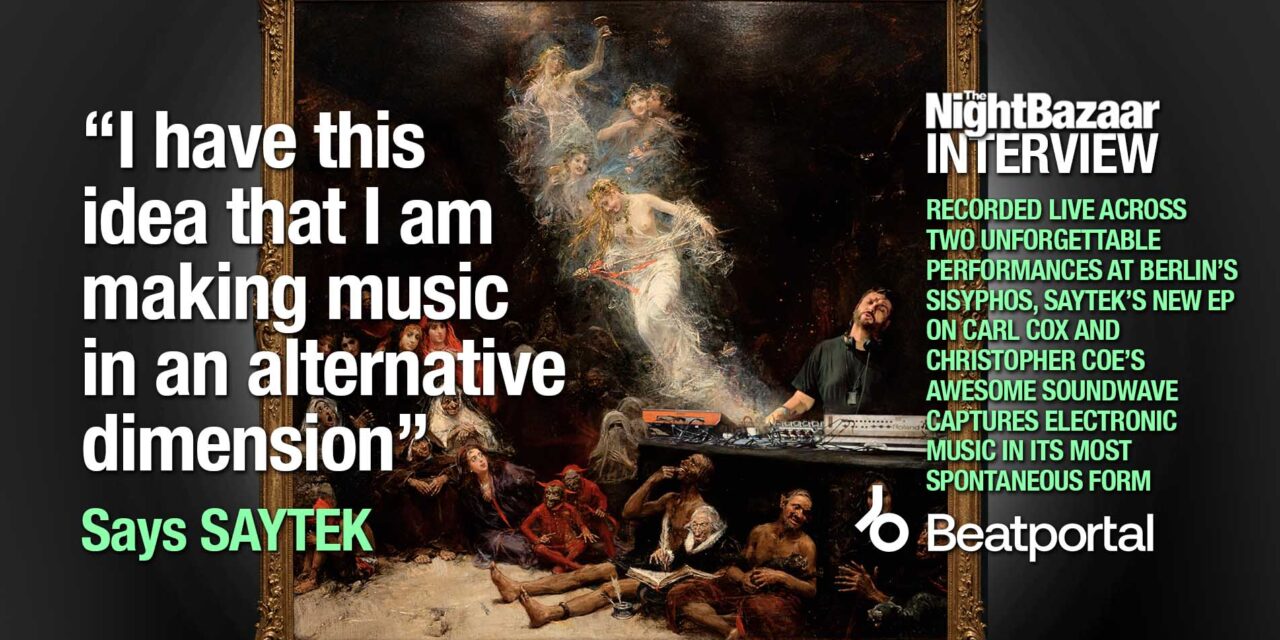
I have this idea that I’m making music in an alternative dimension, where everything that happened to techno after about 2002 or 2003 took a different direction. What if techno had continued evolving from its ’90s foundations in the same way that drum and bass or house music did?
One of the best compliments I’ve ever received was from someone who told me, “I’ve heard all those sounds before, but I’ve never heard them performed like that.” That really sums up what I’m trying to achieve. With the power of modern hardware in 2026, I can manipulate, arrange and perform electronic music in ways that simply weren’t possible when those sounds first emerged.
So, I’m not interested in nostalgia. I’m not trying to recreate the past. I’m using those classic sounds as a framework to explore completely new possibilities and push the music forward. For me, that’s much closer to the original spirit of techno.

Saytek – Live From Sisyphos
When we last spoke, you described Berlin as the epicentre of techno culture, while also acknowledging the pressures facing its club scene. Having spent so much time performing at Sisyphos and other Berlin institutions, what do you think makes the city’s underground culture so special and how important are places like Sisyphos to the continued evolution of electronic music?
I genuinely think techno is deeply embedded in German culture. Someone once said to me that techno is almost like folk music in Germany, and I think there’s a lot of truth in that.
Obviously, techno originated in Detroit, but Germany embraced the sound in an extraordinary way, particularly after the fall of the Berlin Wall. It became part of the country’s cultural identity, and you can still feel that today.
In the UK, we have a huge drum and bass culture, but techno is still relatively niche. In many parts of the world, I think techno is quite misunderstood. In Germany, people really understand it. It’s not just a particular underground scene; it’s something that’s woven into the wider culture.
That’s what makes Berlin so extraordinary. You have this enormous community of people who genuinely love and understand the music, and clubs like Sisyphos are an expression of that culture. It’s almost like the writing running through a stick of rock. Techno runs right through Berlin’s identity, and that’s something you don’t experience in quite the same way anywhere else.
Places like Sisyphos are incredibly important because they give that culture somewhere to live and evolve. They’re not just venues for electronic music; they’re part of what keeps the whole scene alive.
You previously told The Night Bazaar that you no longer worry whether people understand the technical complexities of what you’re doing on stage, as long as they feel the music. Has that philosophy changed the way you approach your performances, particularly in a club like Sisyphos where the connection between artist and dancefloor can be so intense?
I think, ultimately, the technical complexities don’t matter. Music is about feeling and that’s something I believe very strongly. Think about a singer. Someone with an incredible voice can stand in a room without a microphone, without any technology whatsoever and move people emotionally in the most extraordinary way.
Unfortunately, I can’t sing! So my way of expressing myself and sharing my feelings through music involves a much more complicated process. There’s an enormous amount of work that goes on behind the scenes and sometimes translating that initial spark of musical inspiration into something I can actually perform live can be quite a convoluted process.
But all of that is simply a means to an end. Fundamentally, I’m trying to communicate something emotionally through music. When I’m performing, what matters is seeing people dancing, connecting with the music and genuinely feeling something. I’ve had people come up to me after performances and tell me that my music gave them goosebumps, and honestly, that’s one of the greatest compliments I could ever receive as an artist. Because that’s exactly what music does to me. When I hear something that really moves me, I get goosebumps too. It’s a visceral, emotional experience.
So, when I’m playing somewhere like Sisyphos and the dancefloor is completely connected with what I’m doing, none of the technical complexity matters in that moment. It’s about that shared feeling between me and the audience. That’s what makes it all worthwhile.

Saytek – Rave The Planet, Berlin
You’ve always championed the spontaneity and unpredictability of live electronic music. With technology advancing so rapidly, particularly the emergence of AI-assisted production and increasingly sophisticated performance tools, do you think the human element of improvisation is becoming more valuable than ever?
I absolutely do. And at the risk of sounding controversial, I think quite a lot of DJs could potentially be replaced by AI. If what you’re doing is simply selecting pre-made tracks from the Beatport Top 10 and putting them together in a fairly predictable way, there’s not necessarily a huge amount of creativity involved in that process.
I think we’re entering a time when doing something genuinely human is becoming more important than ever. AI can replicate an enormous amount of what we do technically, but it doesn’t experience human emotions. It doesn’t feel the music, and it doesn’t have that emotional connection to what it’s creating.
For me, making music from the heart and putting everything you have into it emotionally is incredibly important. That’s something I believe people can recognise and connect with. And it’s why I think live performance will always matter. Whether it’s a rock concert, a techno rave or someone playing an acoustic guitar, there’s something incredibly powerful about people coming together to experience music.
It’s not just about what happens inside each individual listener. There’s also this collective emotional experience happening across the entire crowd. Everyone is sharing something in that moment and that connection can be incredibly powerful.
Technology will continue to evolve, and I’m excited about what new tools can offer artists. But fundamentally, I believe very strongly in the human element of art. The emotion, spontaneity and connection are what make music meaningful to me, and I think those things are becoming more valuable than ever.
Finally, there are indications that your Cubism label is preparing a slew of new releases. Can we expect any new material from you on the label?
Absolutely! I’ve been involved with Cubism for many years now, and although my own musical direction has evolved slightly differently from the label’s, I’m definitely planning to release at least another single on Cubism in the near future.
My last release on the label was Parade 24, which is actually one of my favourite tracks I’ve made. It was recorded live at Rave The Planet and was quite different from much of my other material. It’s a really emotional track, with chopped-up, gated vocals, a rave-inspired piano and heavily glitched breakbeats, which eventually develop into a powerful four-to-the-floor techno rhythm. It’s a track that really connected with people. Whenever I’ve performed it live, I’ve had people coming up to me afterwards asking what it was, which is always a wonderful feeling. So it was particularly nice to release that one on Cubism.
I think whatever I release next on the label needs to be something equally special. I want it to be a track that feels a little different and genuinely warrants returning to a label that means so much to me.
Mark and I have been running Cubism together for many years, and we’ve built up an incredible history and catalogue of music. It’s something I’m very proud of, and I’d love to continue contributing to that history with something really special.
Saytek – Live From Sisyphos is out on 20th November. Pre-order it now on Beatport HERE.
Read more interviews on The Night Bazaar’s Beatportal archive HERE.