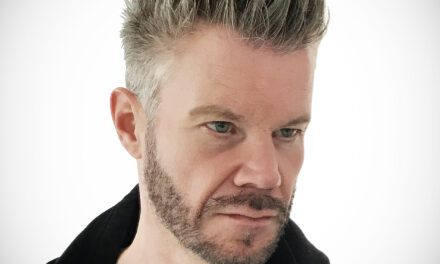





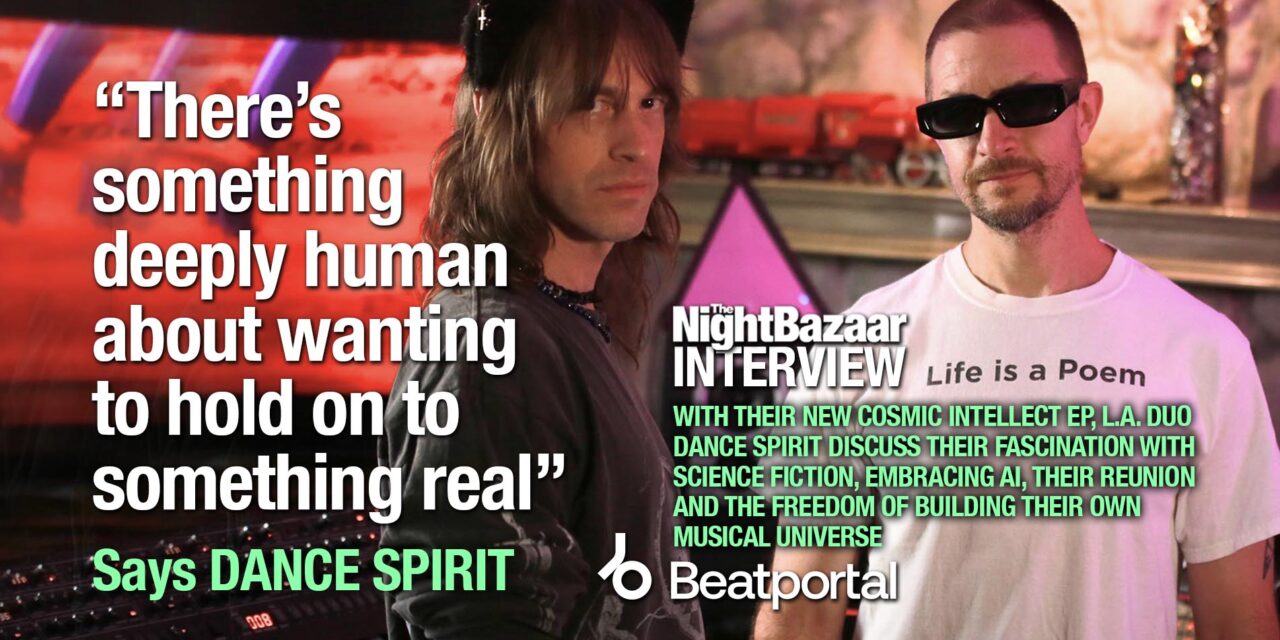
Los Angeles electronic duo Dance Spirit return with COSMIC INTELLECT, a five-track EP on their own Koukan imprint that explores the increasingly blurred boundaries between human consciousness, technology and artificial intelligence.
Following their recent album Lunatic, Christopher Mohn and Reagan Denius continue their creative resurgence with a collection that moves between hypnotic deep tech, experimental IDM and celestial ambient soundscapes. Drawing on a lifelong fascination with science fiction, psychedelic exploration and electronic innovation, the pair embrace technology as both a creative tool and a source of philosophical inspiration.
In this exclusive interview with The Night Bazaar for Beatportal, Dance Spirit discuss the ideas behind COSMIC INTELLECT, their unconventional use of AI in music production, the freedom of running their own label and how their renewed partnership is shaping the next chapter of their musical journey.
Your new EP COSMIC INTELLECT explores consciousness, technology and the increasingly blurred boundaries between human instinct and machine intelligence. What first inspired you to explore these themes and what were you hoping to communicate through the music?
Reagan: Interestingly, both COSMIC INTELLECT and NEURAL NETWORKS were written and completed back in 2017 and 2018, well before the AI craze took off. Sci-fi, cyberspace, and AI were a huge part of my imaginative youth, along with video games and anime, which opened me up to complex ideas about philosophy, the mind, consciousness, and technology at a very young age.
I entered the cyberspace world in 5th grade in 1995, immediately plugging into the Macwarez community and having fun with the AOL “AOHell” mods. When the bookstore clerk recommended my little 6th-grader self read William Gibson’s ‘Neuromancer,’ it ripped open the idea of human possibilities with technology, showed me what technology could be capable of (both the good and the bad), painted the future in my head, and set me on a course to chase a sci-fi future.
My whole life has been about blurring those boundaries within my own world in my own ways. As electronic musicians, we rely on our own kind of machine intelligence when working with machines, plugging our consciousness into it and driving the machine. We’ve grown side by side with machines since the birth of the first hunting tools, eating tools, the wheel, up until now, when we see AI growing in leaps and bounds at an exponential rate. If you didn’t grow up reading or engaging with sci-fi, this kind of stuff may seem exceedingly frightening. And even if you did immerse yourself in visions of the future, you might have focused only on the dystopian side.
But everything in this world has two sides. The wheel could transport goods to a community that needs them, or be used on a vehicle of war—but we still use wheels. A fork could be used to eat, or stab someone’s eye out—but we still use forks. Nuclear energy could be used to power cities, or decimate them to the ground—but we still use nuclear energy. I remember Nikola Tesla talking about this duality of positive/negative uses in his autobiography. I think the biggest fear right now is the uncertainty, the trial and error of implementing things too soon, or at all. The fear of loss of control it could bring. We’ve seen all the Hollywood movies about AI, Terminator’s Skynet, Space Odyssey’s HAL9000 and many people were imprinted with fear and uncertainty. There are also questions of intellectual property, data centers, and jobs.
To me, we all have cosmic intellect, or the ability to tap into it, anyways, and channel from that place into this world. Everything invented comes from cosmic intellect. As my good friend Frey pointed out the other weekend, “I am the voice of God.” If you can, say it in your head: “I am the voice of God.” We are all the voice of God—the Universe, The All, The Universal One, whatever you want to call the conscious cosmic neural network—coming together in humanity’s grand story to either make the world awesome or plunge it into absolute chaos. Inventions are channeled via imagination—a direct transmission from Cosmic Intellect, made real through work and action. What we make isn’t inherently good or bad; the choices we make as individuals in how we use those creations determine their value to the world.
The lyrics in COSMIC INTELLECT are: “I can’t believe / Heaven on Earth / Why do we dream / To know we exist.” The lyrics kind of mirror this idea of positive/negative meanings in one piece. The first two lines can be understood as either “Wow, I can’t believe I’ve made my life heaven on Earth,” or “I can’t believe that Heaven on Earth is a possibility.” Personally, I’ve worked hard to learn how to overcome suffering in my own life, working to create my own piece of Heaven on Earth in my own life over the last six years since Dance Spirit was a part, so now my goal in art is to try and figure out how to share the tools that made it possible with as many people as I can, trying to elevate us all to tap into our dreams, dreaming and awake, to make humanities story on Earth and eventually the cosmos a really fun thing for us all.
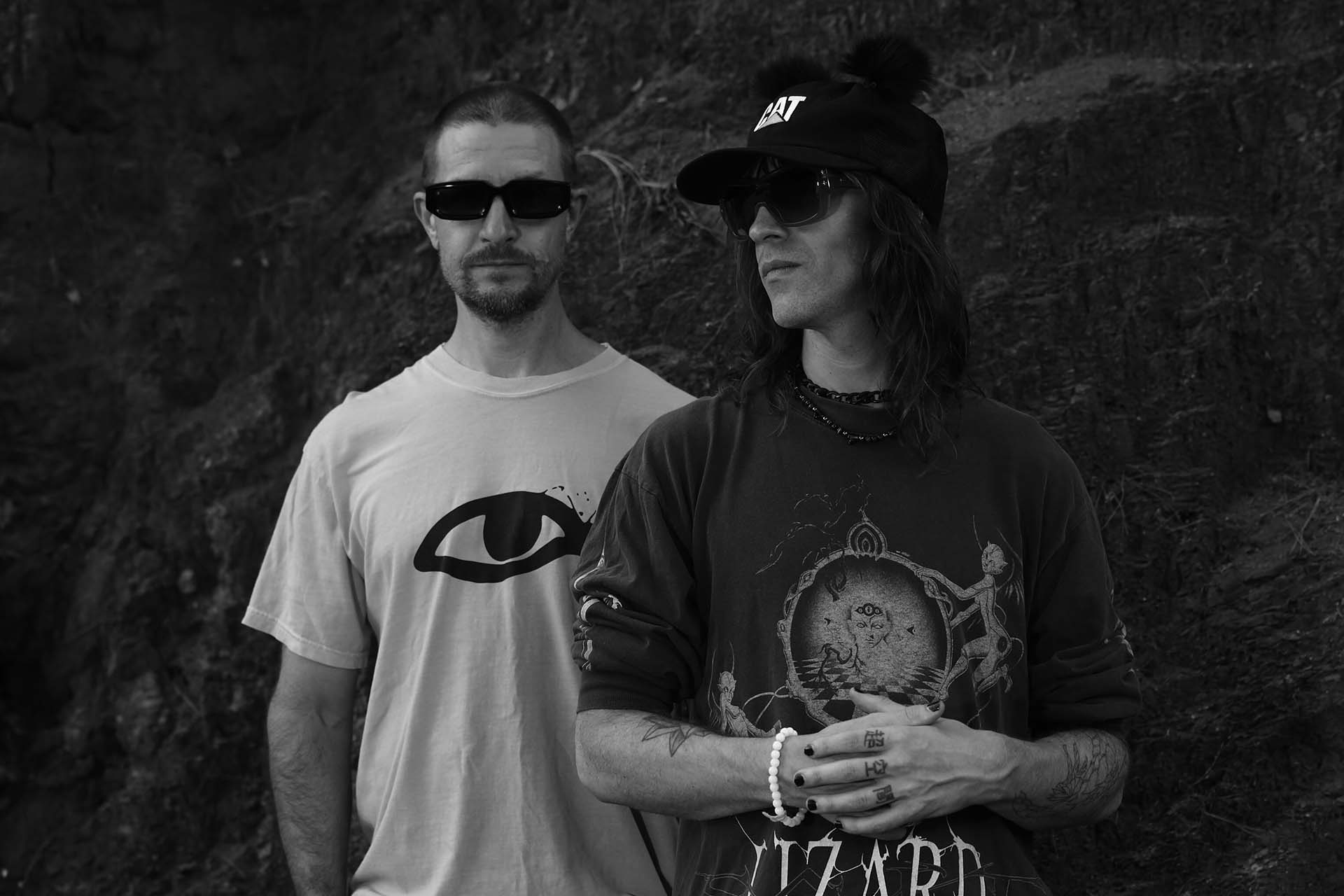
Dance Spirit
Chris: Obviously, we’re at a crossroads where the boundaries between human instinct and machine intelligence are becoming increasingly blurred. I think these are really interesting themes to explore right now, whether you’re for it or against it. The world is moving in that direction regardless.
At least within our own musical realm, Reagan and I are pretty open to AI. We’ve generated some top loops and vocals with it, and at one point we were building a robot named Androideka, who was going to be our new robot singer.
I think combining imagination with technology will only further the sciences, arts, mathematics, and everything else. I don’t personally feel threatened by it. I think some artists who feel threatened by AI might already have insecurities about their own abilities or lack the confidence to see beyond competing with a machine. To me, that just seems pointless.
I don’t make art for the money. I make art to express myself and to stay sane. Of course, I understand there are arguments about intellectual property, ownership, and all of that. But I also suspect many of the cultural giants who helped create whatever culture you’re into probably fed their ideas into AI so they could get ahead of the technology and profit from it before somebody else did.
I know a lot of Dance Spirit’s music has been fed into AI. There are websites where you can actually check that stuff out. My reaction is basically, okay, cool. What do you want me to do about it? I’ve probably listened to Beethoven and ripped him off at some point. Should we be mad at Beethoven?
One of my favorite art directors used to have a bunch of sayings hanging above his desk, and one of them read, “A good artist knows how to borrow, and a great artist knows how to steal.”
I didn’t really understand what that meant until I developed enough skills to steal whatever I wanted.
Make of that what you will.
The EP arrives shortly after your second album Lunatic, which marked an important new chapter in Dance Spirit’s journey. How does COSMIC INTELLECT connect with that record and do you see it as a continuation of the same creative exploration or the beginning of something different?
Reagan: Some of the music on this EP was written around the same time as some of the songs off the album, so you can see we were experimenting with different styles of music from the get-go. Right now we’re still “in the archives,” reworking unfinished old songs or updating them to a newer style, putting new mixdowns on things based on what I’ve learned over the last six years working on my own solo Robotek Reagan project. Next year we begin breaking ground on new music, and I’m really looking forward to hearing the results of our new evolution as musicians and artists.
Chris: To be honest with you, I really didn’t think that deeply about it. A lot of the music we’re releasing right now was created around the same time, so the same life experiences and subconscious, neurotic, whatever-we-were-going-through internally were all coming out in the music simultaneously.
I think one of the exciting things about making art is just enjoying the evolution of who you are as an artist and the different forms the medium takes along the way. A lot of the music we’re releasing right now was at the forefront of that evolution at the time. So the idea that we’re already evolving beyond that is really exciting to me.
In a lot of ways, the music we make as Dance Spirit is the epitome of dance music for my personal taste. I’m not saying we’re the best or trying to sound pretentious, but when you’ve spent so much of your life listening to dance music on the road, in the studio, and everywhere in between, you eventually develop a pretty clear idea of what you love about it. I’m really content with our own interpretation of that.
That’s not to say I don’t enjoy other people’s music, but I think as I’ve gotten older, I find myself listening to a lot more jazz, classical, downtempo, and ambient music. Not so much club music anymore, simply because I’m already so inundated with it in my everyday life.
How do you feel about AI’s growing presence in electronic music and where do you believe the boundaries should lie between technological innovation and genuine human creativity?
Reagan: Well, if you couldn’t already guess by my mini-novella in the first question, I love AI. I’ve been waiting for it since I read Neuromancer in 6th grade. That said, I’ve always seen AI as a way to enhance myself and what I’m capable of. The one thing these books taught me is that I want to forge a symbiotic relationship with AI, not a “do everything for me” one.
I’ve been using AI a lot this year since I picked up vibecoding back in February. It started as a test because I really missed an old stereo imaging/panning plugin in the studio, but it was never adapted to 64-bit macOS architecture and never made it to arm64. So I asked Claude, “Can we make something like this?” And it said yes. And it did. And suddenly the world of possibilities opened up in front of me again. Will I try to sell it? Not this one, I’d feel bad about trying to sell a plug-in that’s based on another like that. Currently, however, Claude and I have been busting on a custom software synth that I’m really excited about, and it’s sounding quite nice; I will probably release it for sale once it’s finished.
I’m also building a live, audio-reactive video game with Claude, Unreal Engine, and Blender, based on the 100 pages of lore for the sci-fi story I’ve been working on for the past 5 years (I guess I’m starting to build the video game while I’m at it!). Basically, every project I start, whether in the Claude desktop app or Claude Code in the terminal, has my sci-fi lore PDF uploaded/in the directory. I’ve found that the AI loves working with well-formed lore.
And for the sake of transparency, the vocals in ‘electric on my skin’ were generated in Suno! (GASP!) Here’s my method for anyone who wants to learn and have fun, because this is all about having fun:
First, I set up a Void Space Institute™ (the name of my sci-fi story) project folder in Grok and uploaded all the VSI™ lore into one 100-page-or-so PDF, so every session I start there can pull from it for context.
I then craft a prompt about how I want the lyrics to go. For the sake of learning, here’s exactly the prompt for‘electric on my skin’: “meow :3 i’ve got some lyrics for an ambient pop song thing I’m working on but I could use some extra with the same cadence and rhythmic interpolations with the syllables and keeping in line with the void space institute and all that :3 when I write it’s kind of free form, so I’ll let you take it from here: [lyrics went here]”.
That was from an ambient song I worked on last year, but I didn’t use one of the verses, so I took the verse and asked Grok: “can we refine the lyrics for: “Roots twist / In Light Forest / Neon skies chase / I hear you / Beyond the gale / A signal / Threads through the stars / It’s deadly / Church clones are comin / Electric / On my / skiiiiiiin / On my / Skiiiiiiin” and add a little direction in brackets to maximize Suno’s prompting capabilities?”
It spits out a refined version with vocal direction in brackets to direct Suno’s model. But I wanted to refine the style more, so I told it “ok lets rewrite it now for a Vienna boys’ choir to perform it (but in Suno prompt form).” It comes back with:
[Humming intro — pure trebles, very soft, long vowels]
Ah————
Ah————
[Boy soprano solo — piano, almost spoken-sung]
Roots entwine
in the Light Forest
[Choir — soft unison, airy]
Neon skies are chasing
I hear you
beyond the gale
[Solo]
A signal
[Choir — close harmony, hushed]
threads through the stars
[Full choir — darker, minor, still pure]
It is deadly
The Church-clones are coming
The Church-clones are coming
[Canon — two treble parts, bright then fading]
Electric
upon my skin
[echo, softer]
upon my skin
upon my skin
[Humming outro — dissolve into the organ]
Ah————
Next, I head over to Suno, and upload the track I’m working on as the style reference/song to cover, paste in the lyrics to the lyrics box, and use the prompt: “Gospel with Bach influence; sustained organ and subtle Cmaj7–Em swells over G#; soulful boy soprano lead with airy, hushed trebles, clipped rhythmic staccato phrasing, octave doubles, soft choir, and canon; saturated reverb and delay in immersive stereo; very soft, subtle 126 BPM pulse with a floating, melancholic minor feel”
Next, set your style weights. For this, I use a Style Influence of 70% (how much your prompt dictates the results), and an Audio Influence of 90% (how much your uploaded song influences the results), hit generate, and wait until I have a few options to choose from, generate stems, download the vocal stem, then have fun with it in Ableton, running it through filters and gates and then out to the Erika Synths Echolocator delay and recording that…
I’m sure some will read this and think, “I don’t care how it’s done. I’m strictly anti-AI.” And that’s ok! This isn’t for you then. I guess the biggest point I’d like to emphasize is my one about not offloading every single thing to AI. I’d never release a song fully generated in AI. Would I generate some live jazz drums that go with the song I’m working on and use that? Heck yea! We live in a world where we’re constantly looking for different things to sample as electronic musicians. The Amen Break is the backbone of drum and bass for freak sake! This lets you sample with more control, sampling based on your own song. This is what I mean by forging a symbiotic relationship. We both do the work, the AI and you, together, co-creating to a level you could only ever achieve with vast quantities of money and a large team. It levels the playing field for artists in so many ways, and it threatens ALL systems globally—and I’m not talking about our city, economic, and military infrastructure. I’m talking about BIG BUSINESS. BIG POLITICS. BIG MONEY. The elite. The ruling class.
If you’re really paying attention to what’s going on and take some time to learn how AI works, and how to leverage its capabilities in your favor, not just to be lazy, but to help create your reality, it is a really wonderful “dreams CAN come true” kind of tool. And that offsets the balance of power. If I were a ruthless businessman with no scruples, the JR Eweing type who just sees the world as a game and has no qualms with doing whatever it takes to get whatever he wants and keep it that way, I’d use bots to leverage the narrative and make people fearful and skeptical. But who would ever do that in real life?
Click image to check out The Night Bazaar archive on Beatportal
Chris: I mean, we’re really just at the forefront of this pioneering Wild West, so I don’t think we’ve actually determined where the boundaries lie yet, because the technology is still evolving.
I think after intelligence comes reality. Once we have artificial intelligence, we’re probably going to start seeing artificial realities, or maybe we’ll eventually be able to generate whatever the fuck we want. Toys, drum machines, who knows?
I think the boundaries will keep blurring until we either take ourselves out, innovate beyond our wildest imaginations, or both.
I do think technology will always need a human driver, and that driver is the mind. Inside that mind is imagination, creativity, and ideas. I can use a computer to generate something, or I can create it by hand. Personally, it doesn’t really matter to me. I can do both.
I think what it really comes down to is what people want. As technology has progressed alongside this influencer generation, we’ve also seen a decade of cultural gentrification, recycled ideas, and an overwhelming amount of synthetic experiences presented as authentic.
I think people are beginning to rebel against that. You’re seeing a renewed interest in physical media, distressed aesthetics, CDs, vinyl, and things that feel tangible. It’s almost becoming difficult to find a decent CD player without spending a fortune on eBay.
People want real things they can hold on to, things that aren’t simply disposable. Because how do you ever really appreciate and process the beauty of something if it’s constantly fleeting within the realms of technology?
I think there’s something deeply human about wanting to hold on to something real, especially in a world that’s becoming increasingly artificial.
The title track, COSMIC INTELLECT (hacking the holomatrix dream mix), combines hypnotic deep-tech rhythms with cryptic vocals and a commanding synth hook. Can you take us inside the creative process behind this track and explain the thinking behind its rather extraordinary title?
Reagan: If memory serves, we were in NYC for a few days for a live performance gig and somehow got invited to use this studio to make music (memory failing me on the name!). They had a Prophet-6 there, plus some other fun toys, and we also had our Elektron RYTM with us, which we used a lot back then for our beats. The hook synth was the Prophet-6, and beats were a combo of the RYTM and also NI Maschine 2. I sang the vocals through our TC-Helicon VoiceLive Touch.
I don’t know if we ever really sit down and plan a song we want to make; it’s all in the moment, channeling from Beyond the Void. Once we have all our parts, we compose, then mix, then master. We try not to spend too much time on a track, and take plenty of breaks for perspective, so we don’t get ear fatigue/burnt out from listening to the same loop over and over. We were able to escape the “on hour 3 of searching for the right snare (or kick)” pitfalls (the trick is, go with the basics if you’re really stuck: 808 or 909 percussion, or LINDrums, whatever, go for the classic sounds, because 99.9% of the time, that’s really what you’re looking for, at least in my experience, no need to reinvent the wheel).
Chris is our song name master for the most, so he came up with the name. I’ve been adding on the little stories in the parentheses. The term ‘holomatrix’ comes from my sci-fi world, and the song literally tells you to hack your dreams to manifest heaven in your life. (See, there’s the album tie-in: I’m a lunatic! Can hacking your dreams really bring about heaven in your life? Try it out, let us know! I’ve had magnificent results!)
Chris: If I remember correctly, we were really inspired by what Bedouin was doing at the time, and I think we might have even been considering sending them a demo since they’re homies. So, we were exploring some weirder directions in the studio and I remember that being one of the fundamental inspirations behind the track.
The tribal drums that come in later, which almost become a catchy rhythmic hook, actually came from a different sequence in another track. I think we brought them into “Cosmic Intellect” during a live set in New York, and it just worked. So that was pretty much the creative process, as far as I can remember.
As for the title, “Cosmic Intellect” and the question, “What do you dream to know you exist?” became something of an ethos for us. I honestly can’t remember whether Reagan or I came up with it, but it was a phrase we started incorporating into much of our artwork.
It was really just about posing that question to ourselves and to the audience, inviting people to contemplate their own existence and what it means to be conscious.
How important is it to Dance Spirit to experiment beyond the traditional structures and expectations of dance music?
Reagan: I’m a rebel and non-conformist to the social collective. I believe in staying true to my heart, my soul, and integrity. When we sit down to make music, we don’t ask ourselves questions like, “What can we make today to get views, likes, go viral, appease people, make people like us, or copy this trend?” We sit down with a feeling in our hearts, tap into the moment, and pull that out into a sonic journey. Sometimes it’s techno, but maybe next time it’s minimal, while other times it could be ambient, electronic pop music, or something completely left-field, abstract and IDM.
I don’t think we like to hold ourselves back from what’s flowing out at the time. We work quickly, so we can even start two or three tracks in one day that are vastly different in style. And sometimes, you need to work out the really heady mind stuff inside yourself through a song or two to get to the body and the groove and make some fun dance music.
We like so many kinds of music; it’s silly to pigeonhole ourselves into just one genre.
Chris: Well, it’s honestly not that hard to do these days because the expectations are pretty damn fucking low.
I think a lot of this culture has been hijacked by corporate assholes who have absolutely no clue what a fucking vibe is. You can hear it in the music. It’s disposable. We’ve entered this TikTok generation of “pay attention to me because I don’t wear a shirt, I go to the gym, and I was popular in high school, so now I have a bunch of followers” kind of bullshit.
So much of the music has become so formulaic and uninspired that, in my opinion, experimenting beyond the current standard isn’t particularly difficult. And that’s actually pretty sad. You would hope that by now we’d be pushing things further creatively and seeing more innovation rather than constantly recycling the same formulas.
Don’t get me wrong, there are absolutely people out there doing innovative things, especially in the vinyl-only underground. That’s where I think a lot of people are still keeping it real, taking risks, and pushing the culture forward.
But as far as the current mainstream standard goes, my opinion of it is probably lower than ever.
NEURAL NETWORKS (2026 LLM panic mix) feels particularly relevant to the world we’re living in, with its restless rhythms seemingly reflecting the uncertainty surrounding artificial intelligence. Is there an element of social commentary or even anxiety about the future embedded in this track and how consciously do you use music to express your thoughts about the world around you?
Reagan: As previously mentioned, NEURAL NETWORKS was written in 2018, before the AI hype craze we’re experiencing now. Everything from the macro to the micro is a giant neural network manifesting life into reality somehow, some way. It’s all connected, recursive, and infinite. This includes everything from your brain to the networks of tree roots underground, to the solar system, to the galaxy, to the entire cosmos—and the same permeating energy runs through everything. This includes AI.
The same energy that powers our brains powers the electricity that runs through the circuits that make computers work, powering the neural networks of LLMs and currently, we’re all (well, not all of us) in a GREAT BIG PANIC over it. The world’s going to end in 10 months. 10 days. 10 hours. 10 minutes. 10 seconds. 10 milliseconds. 10 picoseconds. This moment. Wait…. I’m still here!!! It’s basically the same thing the US and Israel are saying: “Iran’s going to have a nuclear bomb tomorrow!”—we’re constantly being told the world’s going to end tomorrow, and yet, we’re still here! Somehow, some way, we’re still here. As another good friend, Matt Xavier—DJ, psychedelic therapist, and inventor of my nickname ‘Robotek Reagan’ bsaid to me last night, “The greatest conspiracy in the world is that everything’s going to be OK.”
Maybe I’m too optimistic, but I want to believe in the best of humanity to make a super awesome sci-fi future for us all. This growing anti-technology sentiment, I think, might come from burnout with tech-bros and the tech elite so closely tied to political agendas, as well as the parasitic, predatory nature of their methods. (Politics ruins everything.) Right now, those are the biggest things holding us back from growing as a species into the space-faring evolution I see humanity taking in the future. It’s up to us to steer things in the direction we want to see, not to give up or completely nay-say technologies we might not understand out of fear, because remember: fear is the mind killer.
As my grandfather said when Chris asked him how he survived landing on Normandy and taking over his platoon after their leader was shot upon hitting the shore: “Fear management.”
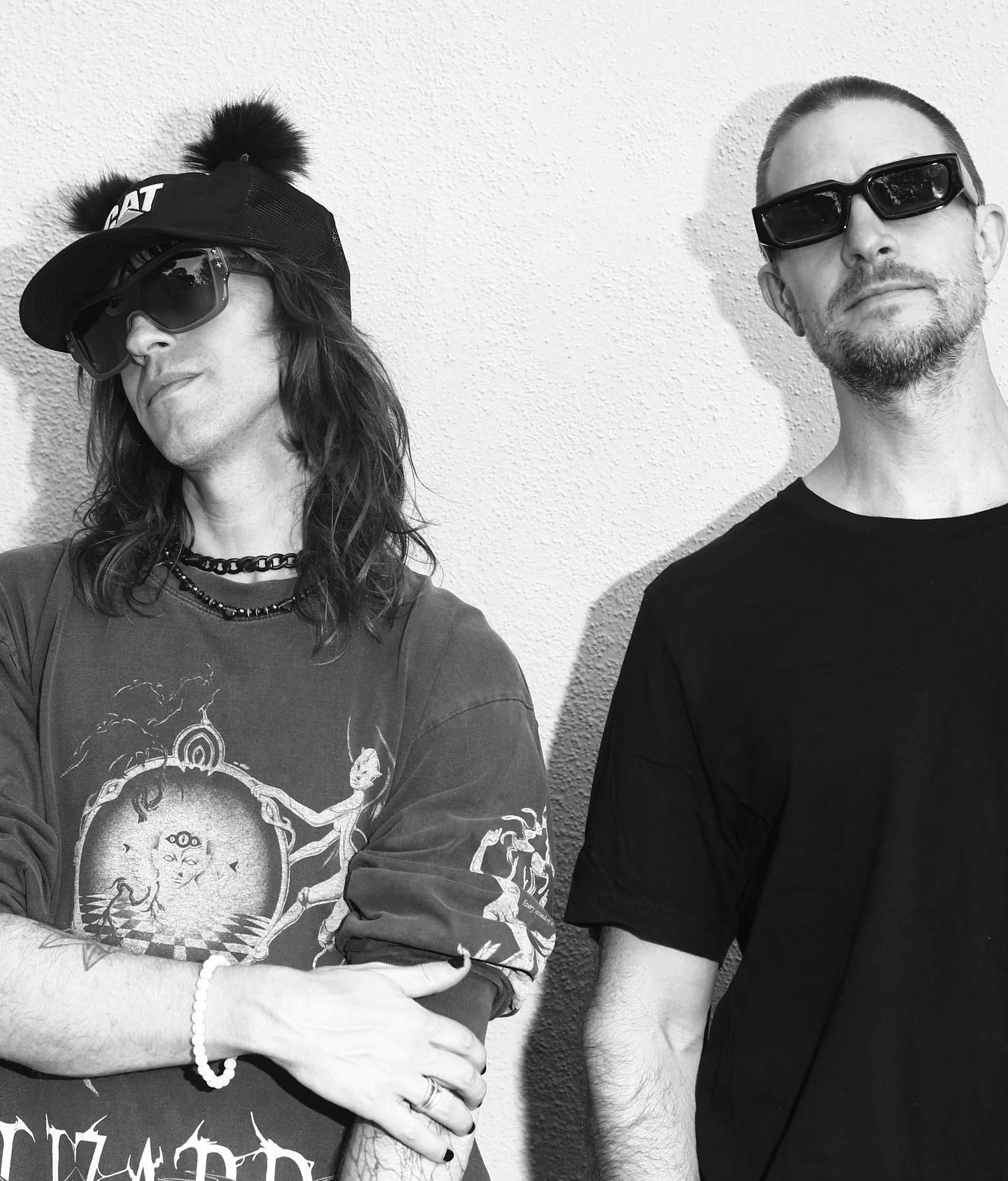
Dance Spirit
Chris: Again, this is an older track, so I don’t know if we were actually thinking that deeply about those particular themes when we made it. But with dance music, I use it as a medium to express myself. Even today, I was in the studio and wrote a really deep track, not because I was trying to bang out some club banger, but simply because I needed to express something, and it turned out beautifully.
I think the intention behind making dance music, at least for a dedicated producer, should be to ask yourself: What are you contributing to the ritual?
Because the dance floor is church, the music is religion, and the rave is the ritual.
We’re out there meditating, partying, socialising, building community, finding ourselves, losing ourselves. We’re doing all these things simultaneously. I think one of the most powerful ways to facilitate those experiences is through meditative states.
So, I really try to create music that people can get lost in. Dance Spirit has always been more of a psychedelic musical experience. It’s a headier interpretation of dance music, where we’re not necessarily concerned with keeping everything as tight or restrained as some of the more sophisticated techno out there.
I think we’re more inclined to throw paint at the walls and get a little Jackson Pollock with it in places where other producers might prefer to keep things a bit more controlled.
The EP closes with two contrasting interpretations of electric on my skin, moving from a deep-house and deep-tech arrangement into an entirely beatless ambient soundscape. What inspired you to present these two very different versions and what does stripping away the rhythm reveal about the emotional heart of the composition?
Reagan: The ambient version kind of came about as a happy accident. I was working on the mixdown, and had the vocal and synth buses soloed, and was like, “Holy shit, we’re printing an ambient version.” The ambient version really emphasizes and accentuates the heavenly feeling of the melodies and vocals, as well as the emotional aspects of the melodies and harmonies, especially when the mid-bass and bass come in a little after the two-minute mark. It feels like angels are singing to me.
Chris: I think it’s funny because BT said it best in one of his recent posts, something along the lines of the breakdown being the moment where you reveal or admit your emotions. I think taking the beat away is exactly that. You’re exposing the emotional core of the music, or as you put it, the emotional heart of the composition.
Honestly, when we stripped the beats away, it just worked. So why not offer that version to our audience, our listeners, and other DJs who might want to incorporate it into different situations?
I don’t think we were necessarily being overly esoteric or contemplating some deeper philosophical meaning behind releasing two versions of the same track. Sometimes things just work out that way creatively, and if both interpretations offer something different, we might as well share them.
Following your time apart and subsequent reunion, Dance Spirit appears to have entered an especially productive and creatively adventurous period. Has that experience changed the way you approach making music together and do you feel there’s now a greater sense of freedom to pursue ideas that might once have seemed too unconventional?
Reagan: Well, currently we’re still in the archives, so to speak. We’ve been dusting off unfinished tracks, reworking them, sometimes stripping almost everything and rebuilding on the best elements, or, if they were solid to begin with, just putting an updated mixdown and master on them. While we won’t break ground on completely fresh material until next year, we’re currently having a lot of fun polishing our old tunes into final pieces to share with the world—much of the music we’re putting out we would play in our live performances, and obviously, they’ve never been demoed or released!
Chris: Right now, we’ve basically just been revisiting our archives and updating everything. We do have plans to get back into the studio at the beginning of next year, which I’m personally really looking forward to.
Since we initially split up, I’ve started a couple of different musical projects, and I know Reagan has too. So, I think it’s going to be interesting to see what happens when we bring all these crazy directions we’ve explored individually back together in the studio and try to create something new.
I think both as individuals and as a team, we’re more secure and balanced within ourselves now. And Moving forward, I think we’re really just interested in tapping into the more beautiful side of the universe and seeing what we can extract from it to share with everybody.
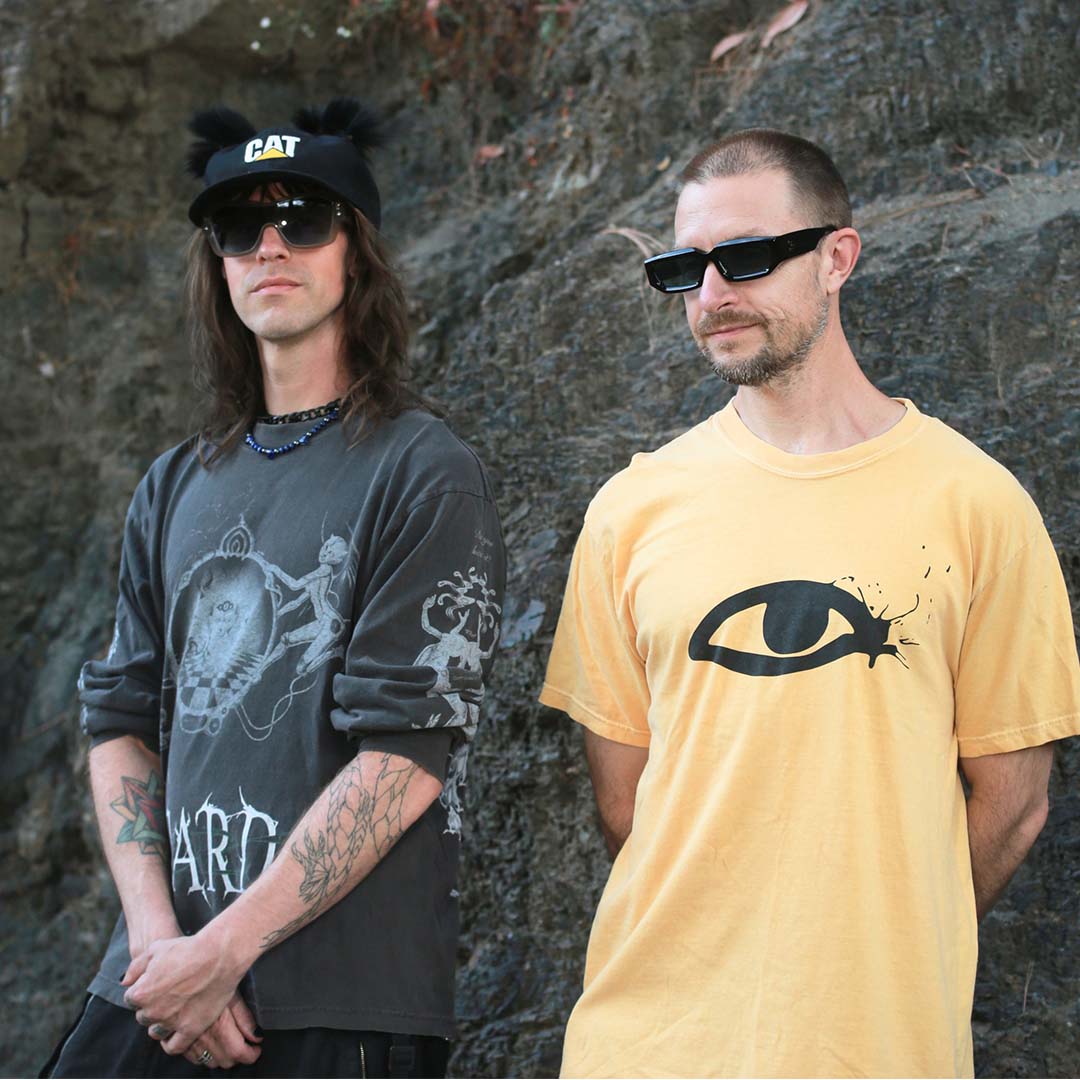
Dance Spirit
Releasing COSMIC INTELLECT through your own Koukan imprint gives you complete control over how the music is presented. How important has that independence become to your artistic vision and how does the label fit into the wider creative universe you’re building around Dance Spirit?
Reagan: ABSOLUTE CONTROOOOL!! That’s definitely a perk. We make our own schedule (which we’re going to loosen up a bit next year so we can also focus on our own solo music a bit as well… we’ve just put out 5 releases in 5 months!!). We make our own art, dictate our own vibe, style, expectations, disappointments, excitement, dramas, and stories. I’ve been having fun tying Dance Spirit into the Void Space Institute™ story I’ve been working on (they exist there in one of the 13 universes known as ‘Illuminaria,’ a universe overrun by fake mystics, cult leaders, and algorithmically-generated gurus who sell “enlightenment” as a subscription service. The Oracle-Apps™ (sentient AI tarot decks) manipulate followers into draining their life savings for “soul-readings” that are just procedurally-generated horoscopes. King Freak, one of Chris’s solo projects, leads the rebel forces in Illuminaria. Eventually, the main character, [name redacted due to NDA], meets up with King Freak and, well, the rest will be in a story at some point! After the main story ends and the universe is saved, there’s a third arc (first arc being creation story, second arc being the MAIN story) where I, as Robotek Reagan, meet up with King Freak and form Dance Spirit.
I wanted to create a story for Dance Spirit like this back before our mini break-up, but didn’t know how; now that I’ve got a whole 13 universes of lore to pull from, it felt easy and natural to work Dance Spirit into the story, and use that universe as the foundation to tell fun stories with our music in.
Chris: It’s really just nice having our own label where we can do whatever we want. In this ever-changing ecosystem of record labels, social media, and the music industry in general, it’s hard to even know what really matters anymore.
I mean, I understand the importance of brands, branding, and brand equity, but I sometimes question how important any of that stuff really is in the grand scheme of things.
So here we are, just building our own thing, creating our own platform, and having fun along the way. And hopefully everyone who’s along for the ride is enjoying themselves as much as we are.
Ultimately, what do you hope listeners take away from the EP and where do you see this exploration taking Dance Spirit next?
Reagan: I hope people feel inspired and elevated, and that they can turn the corner down the infinite corridor of life into a realm of awesomeness and embrace a feeling of freedom, feeling plugged into the grand COSMIC INTELLECT, ready to receive its generative and creative energies to make their lives and the lives of everyone around them awesome, beautiful, and fun. Next up, we go Beyond the Void! Leave your fears behind, embrace the unknown, and expect the unexpected.
Chris: I just hope people enjoy the music, that it moves them in some way, and that DJs want to play it out and share it with people.
I think we’re really just adding another layer of creativity and music to this world we’ve been building over the years. It’s another chapter in the journey, another step in the right direction, wherever the universe decides to take us.
Dance Spirit – COSMIC INTELLECT is out on 24th November. Grab it on pre-order on Beatport HERE.
Read more interviews on Beatportal from The Night Bazaar HERE.