




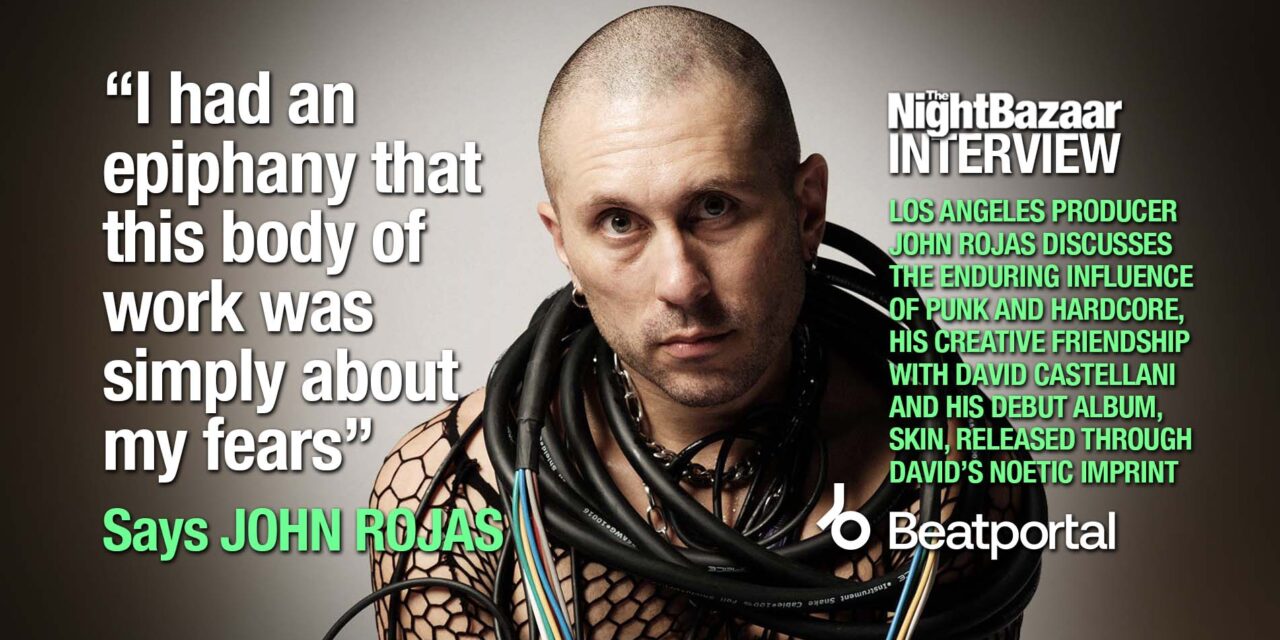
Built around five original compositions inspired by different parts of the human body, SKIN is an intensely personal exploration of vulnerability, instinct and the relationship between human emotion and electronic machinery. Drawing on his punk roots, unconventional rhythmic structures and a fascination with modular synthesis, Rojas has created a record that is as introspective as it is physically compelling.
Following his recent appearance alongside Castellani and techno pioneer Chris Liebing at Amsterdam Dance Event, Rojas speaks to The Night Bazaar for Beatportal about the fears that inspired SKIN, the enduring influence of punk, his friendship with Castellani and why finding his own voice has opened an exciting new chapter in his musical journey.
Your debut album SKIN is a very personal piece of work. What was happening in your life creatively and personally when you began the project in summer 2025 and what made you want to explore these feelings through electronic music?
I had been itching to dive into my solo project for a long time but always felt ambivalent or pulled away because of other projects. Last year, I just realized that I was putting it off because of fear. I stopped making excuses and began to look inward for my own voice. There was fear and self-doubt that I was facing, but those complex feelings were also giving me excitement. And as I began to paint with my audio canvas, I had another epiphany: that this body of work was simply about my fears. Although the music has energy, it still showcases my vulnerability through the decisions I was making and what I felt at the time. There is a sense of volatility that the music carries, depicting personal frustration.
You’ve described the album as an opportunity to confront your anxieties and insecurities, choosing to look for yourself within the electronics rather than seeking validation. That’s a fascinating statement. Can you expand on what you meant and whether making SKIN changed the way you see yourself as an artist?
Thank you.
First off, I come from the band world, where I have always had a team to make these big decisions with. Those parameters make seeking or feeling validation more digestible because there’s a collective decision rather than a personal one.
Secondly, I think when you’re expanding your horizons, going solo, or pushing musical boundaries, I believe every artist at times, subconsciously or consciously, makes decisions to get props or praise from their peers and audience. This isn’t a question of what is right or wrong, but rather an honest element that perpetuates itself when making art. The real question to ask yourself is whether you’re brave enough to face it.
With these questions in mind, I decided to be incredibly honest with myself by asking very hard questions. The truth is, I was thinking about validation and wanting people I respect to like my work. That simple idea influenced the decisions I was making, so I pushed against it and decided to be unforgiving with myself whenever I knew there was some sort of element percolating in the back of my head that suggested I was making decisions for public appeal rather than for myself. It was really fuckin’ hard at times because it required true discipline and transparency. I’m sure not every decision was made without seeking validation, but I do know that I tried my best to exercise this idea to the best of my abilities.
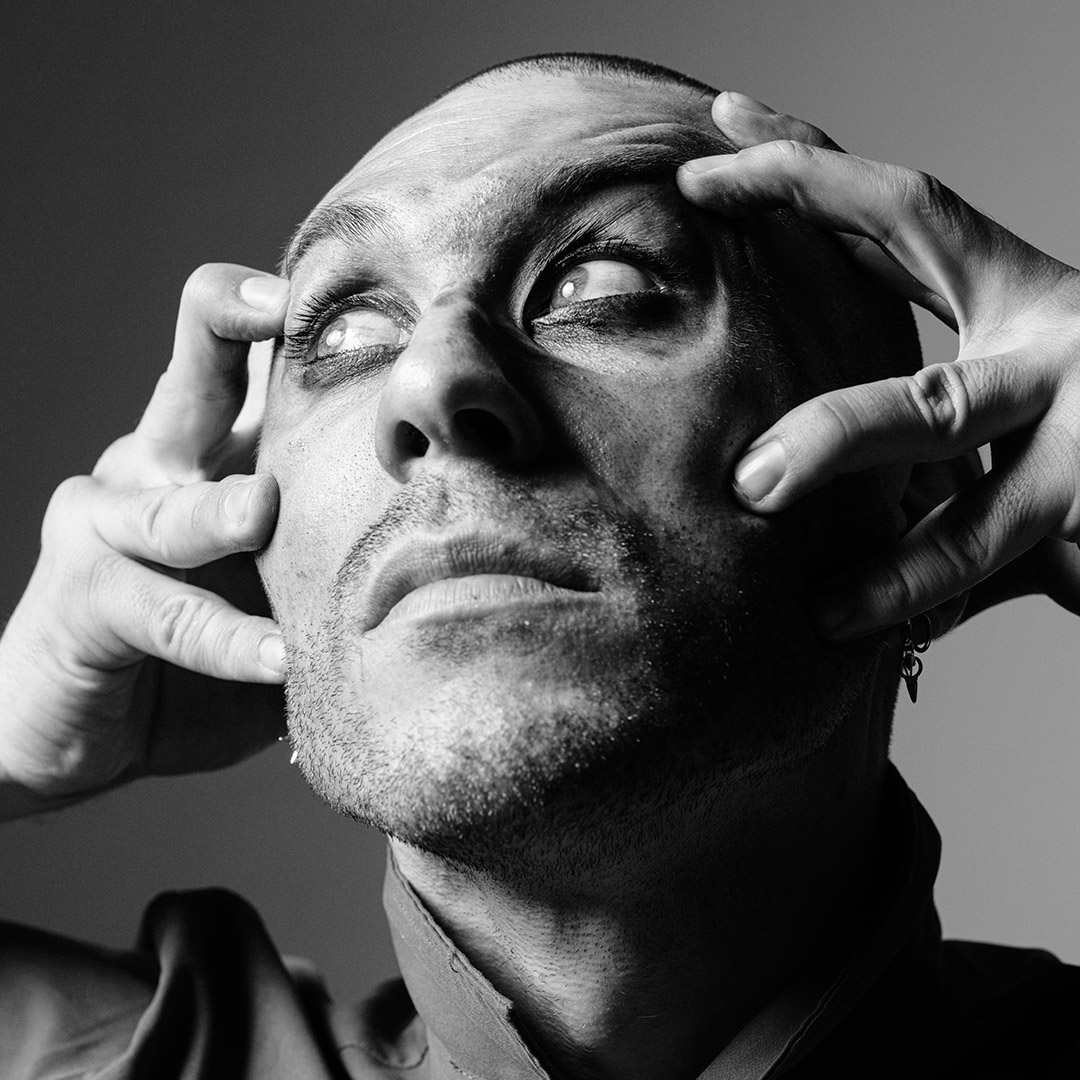
John Rojas
The concept of using different body parts as starting points for each composition is particularly interesting. You’d choose a body part before entering the studio and let that guide the creative process. Where did this idea originate, and how did something as physical as human anatomy translate into the sounds and structures of the music?
I didn’t necessarily choose a body part before entering the studio; however, that did happen a couple of times. What typically happened was that I would sit in silence before making anything and think about the “what” and the “why” of a specific body part. This moment of reflection would then become an anatomical image. I was using instinct and intuition to determine how I wanted to make sound around a specific body part.
The idea originated from thinking about my personal vulnerability. In my opinion, there’s nothing more vulnerable than the human body, and I used that idea to illustrate my emotional vulnerabilities. The concept felt straightforward and honest, and it also connected directly to the music itself.
Using the music to illustrate a body part was probably the easiest part. Electronic music is all about movement and dynamics; therefore, pinpointing how a specific body part moves was indicative of how I would make the track move. For example, “Oblique” is about the way I move when I perform with my band MACHINEKIT. I am the frontman and singer, and I toss myself onto the crowd and contort my body through movement. “Oblique” is a sonic reflection of that same contortion. Additionally, the dynamics exemplify my energy within that space and how my body flips around everywhere.
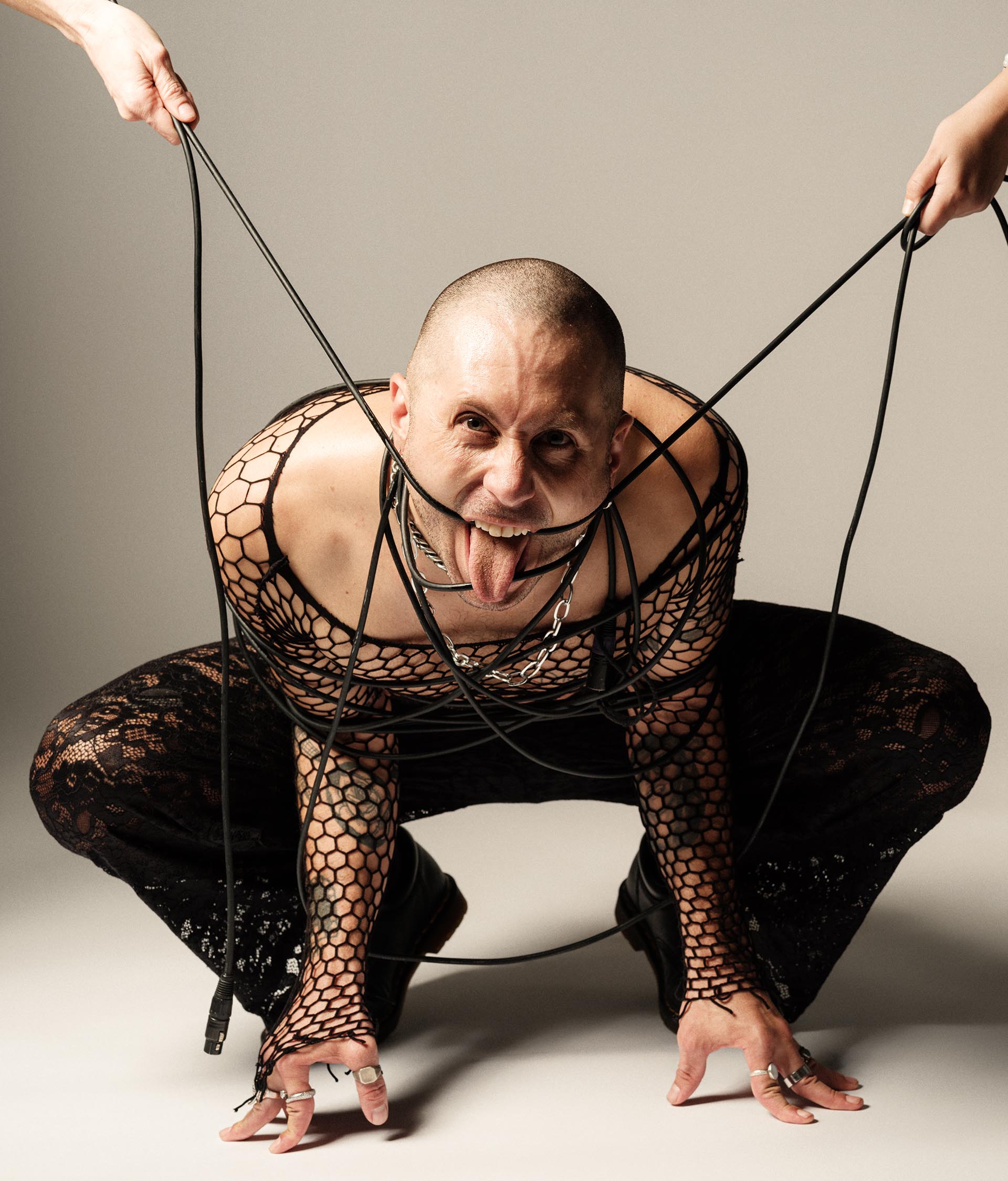
John Rojas
You initially created more than a dozen pieces before narrowing the album down to five original compositions. How did you determine which tracks made the final cut?
I used my instincts to determine what continued to feel exciting. I would write compositions, sit on them, and then decide if I still felt the same. If my mind changed about them and I thought they sucked, I would throw them away and wouldn’t look back. There were a couple of tracks: “Fingernails,” “Hand,” and “Cortex” that almost made the cut, but after a while, I wasn’t connected to the music anymore, so I tossed them.
Maybe I’ll feel differently later on and release them.
Your musical journey began in punk and hardcore bands and you’ve spent two decades working as a musician, producer and engineer. Take us back to those early years. What drew you into that world, and how did the experience of playing in bands shape your attitude towards music, performance and creativity?
Punk is and will always be a big part of me. I grew up in the DIY community, where we played in basements and bookstores all across America.
The early years were chaotically innocent. I was a kid who loved alternative culture, whether it was punk or raves, and enjoyed being out late and hanging with a bunch of weirdos like myself.
As I became a musician, then a working producer and engineer, I realized that I’m a “lifer.” It doesn’t matter what music scene I participate in; what matters is simply wanting to be around it. Having the privilege of creating a working recording studio, MACHINEHOUSE AUDIO, made my music life more real. It also gave me more purpose because I began to feel an enormous sense of responsibility to the music community. Whether anyone is watching or caring, I feel like it’s my duty to serve music in whatever way I can. Sometimes it’s putting out music, and other times it’s helping others bring their vision to life.
Speaking about recording bands for a living, the great Steve Albini once said, “My name is Steve Albini, and I get to work with the most interesting people in the world.” That quote deeply resonates with me because I feel the same way. Musicians are very interesting individuals, and being able to grow up and work alongside them within a special subculture is a complete privilege. It’s very special, so we must respect it.
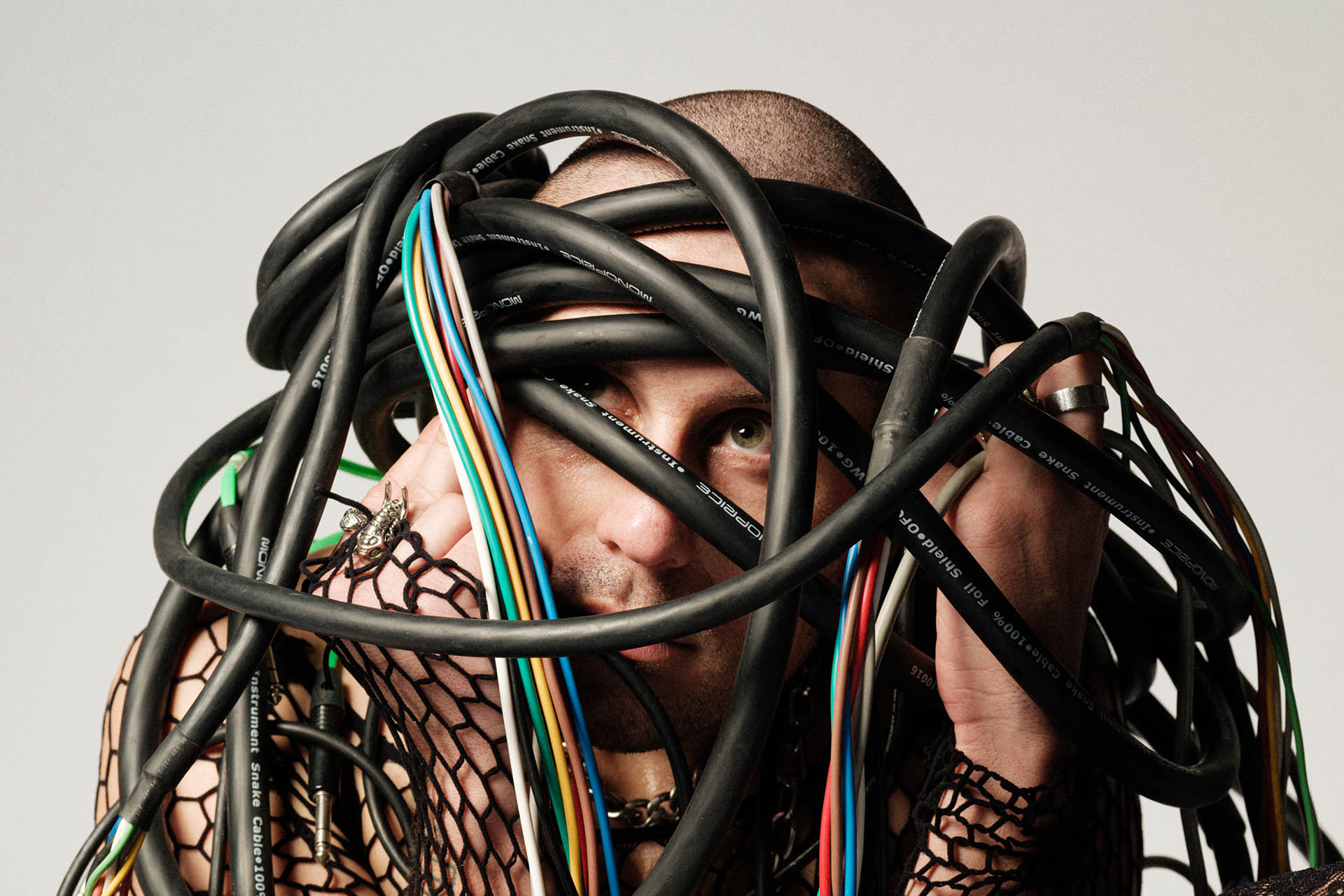
John Rojas
Punk and techno might seem like very different musical worlds, but they share a rebellious spirit and a fascination with raw energy. What connections do you see between those cultures and how much of your punk and hardcore background still informs the music you’re making today?
The style and genre might be different, but they both carry a deep DIY ethos. Underground parties are cultivated by people trying to do their part for the techno community. That is relevant to DIY punk spaces that do the same thing to keep the culture going.
15 years ago, my friends and I created a DIY space called Bridgetown DIY in my hometown of La Puente, CA. No one knew what they were doing, but the spirit of creating and contributing was a part of it. I saw the same thing manifest with my friends in the LA techno space who have cultivated parties. Most of these individuals took the DIY approach of creating something out of nothing by using their ambition. That, to me, is punk as fuck.
Anything that I do musically will always carry an essence of punk and hardcore. It’s in my blood, and I deeply love and respect the music. To me, Fugazi is just as important as Jeff Mills.
Techno doesn’t have a distorted guitar, but it does have fast dynamics, moody changes, and a rebellious spirit. Therefore, I tap into those elements when making music, and that also feels punk as fuck.
You went on to establish the industrial punk project MACHINEKIT and your Orange County studio, Machinehouse Audio. How important were those experiences in developing your understanding of sound design, recording and experimentation and what eventually drew you towards modular synthesis and electronic music?
Both of these projects have shaped every part of me as an artist.
MACHINEKIT is my brainchild. This project is a canvas where I get to intertwine my love for both punk and electronic music. It’s also what introduced me to production, synthesis, and engineering. I owe everything to this project.
MACHINEKIT is a very difficult project. From learning what it means to be a frontman and writing difficult riffs to understanding the quality of the production, each element has taught me the craft inside and out. I learned how to mix and produce electronic music through this band, but more importantly, it taught me how to create a business model that eventually led to MACHINEHOUSE AUDIO.
THERE WOULD BE NO MACHINEHOUSE AUDIO WITHOUT MACHINEKIT.
MACHINEHOUSE AUDIO is another special brainchild that has become my livelihood. I have been blessed with being able to make a living recording bands and helping artists bring their projects to life. It is a very special and rewarding job. The studio gave me a sense of purpose, but it has also shown me what true responsibility means inside of the music community.
I get asked a lot about what it takes to run a recording studio, and my first answer is always the same: “First and foremost, you have to be into gear.” I say this because, as a collector, it is what eventually led me to modular synthesis. For me, it is the most addicting gear habit there is – more than amps, guitars, and recording equipment. There is so much to understand that if it piques your interest, it will grab hold of you and send you into a spending frenzy. Real nerd shit, to be honest, but it’s awesome.
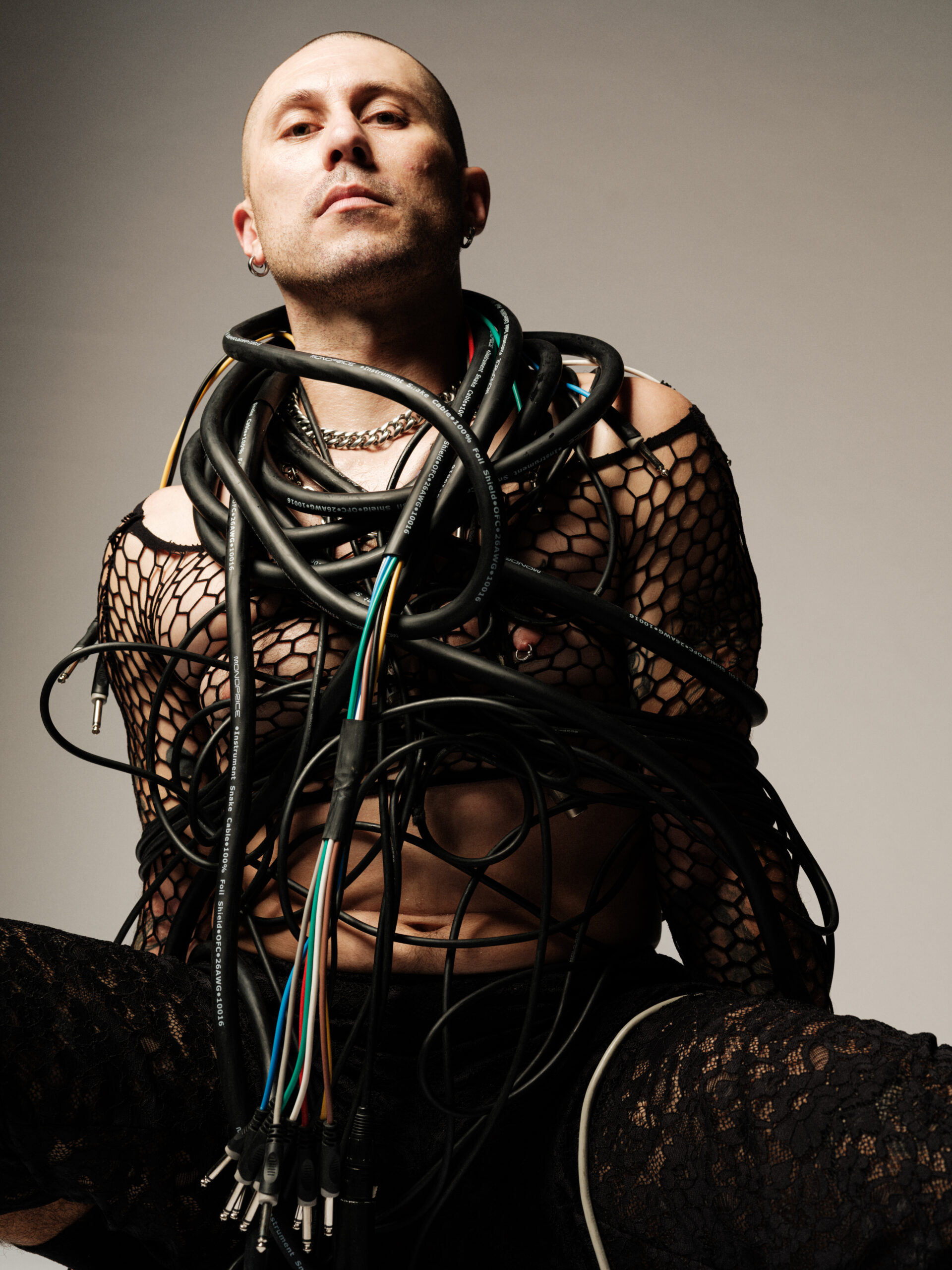
John Rojas
Your productions move between hypnotic techno and more fractured, broken-beat arrangements. How much of that rhythmic experimentation comes from your background as a multi-instrumentalist and do you approach electronic composition differently from writing music with a conventional band?
A lot of it comes from my background as a multi-instrumentalist. I’m primarily a guitar player, and I have this obsession with creating riffs with odd time signatures. I’m always writing something in 3, 5, or 7. When I write with my drummer, we tend to explore polyrhythms, and the challenge is very exciting.
This made it easy to enter the electronic production space with a mindset of broken-beat and polyrhythms. It’s odd and weird, and I really like that shit. The idea of having to think about the math and the placement can be excruciating, but genuinely rewarding once you figure it out. It also provides a lot of movement because everything behaves in a strange, angular way.
Inevitably, I do approach electronic music differently than a conventional band. Writing music with a band is raw and not based on definitions. For example, if I’m teaching a bandmate a riff, I am physically showing him finger placements or anything that requires physical movement. Electronic music is more contingent on definitions, meaning that in order to achieve an intentional sound, learning about the definitions around synthesis helps navigate and accomplish what you want.
One is more mental, and the other is more physical. Yes, you need to use your mind for both, but I never break a sweat turning knobs while sitting in front of a computer.
Modular synthesis is central to your creative identity, as it is for David Castellani. What is it about working with hardware that inspires you?
I don’t think it’s central to my creative identity, but rather an extension of one of the many elements that I practice and perform. However, I thoroughly enjoy working with modular synthesis. It’s exciting and feels very raw. There is so much room for error, and that alone excites me.
What inspires me is the endless possibilities and how much you can really learn from these weird machines. Learning how to patch has allowed me to deconstruct music and experiment with things I never thought I would. Those subtle gifts feel infinitely rewarding.
You first met David Castellani in 2023 and quickly connected through a shared enthusiasm for music and equipment. How did that friendship develop into a creative relationship and what was it about David’s approach to music that particularly resonated with you and how does it feel being part of the Noetic family?
My creative relationship with David developed through the simple act of always being in the studio together. Before writing ‘SKIN’, we spent a lot of time fiddling around with equipment, hanging out, and making random tracks. We learned a lot from one another. Throughout those hangs, I learned a lot about his methodology and noticed we had a lot of things in common. We both have strong work ethics and live and breathe music, so the connection was genuinely easy because we speak the same language.
There are many things about David’s approach to music that resonated with me. A lot of it has to do with his philosophy and the systems that he has developed inside and outside of the box. I genuinely embraced his methodology and began using some of his systems because they are very efficient and practical ways to immediately get going.
Being a part of the Noetic family feels right. When I finished ‘SKIN’, Dave was one of the first people with whom I shared it. When he offered the opportunity to release through Noetic, it was a no-brainer for me. It’s in the family, and it all made sense – a full-circle moment that helped us expand on our personal and creative relationship.
Noetic has developed a distinctive identity through David’s work and collaborations with artists including Ken Ishii, while drawing remix contributions from figures such as Redshape, Matrixxman and Truncate. What do you think defines the label’s musical philosophy and where do you see your own artistic identity fitting into that vision?
I believe the label’s philosophy aligns with keeping the techno tradition alive by paying respect to those who came before us and offering an opportunity to the next generation – a value that I personally believe to be an enormous fundamental.
Having artists like Ken Ishii, Matrixxman, and Truncate, then adding me to the roster, feels like the techno tradition, and that felt very special.
This feels artistically fitting because I get to share a space with artists who have inspired me while showcasing my own voice. My objective is to always pay tribute and respect to the people who have pushed me to evolve (whether they know me or not), and I believe Noetic has that fundamental philosophy.
You made your Noetic showcase debut at Amsterdam Dance Event on October 23, performing back-to-back with David Castellani at the Noetic x KEYI Magazine event. How did you approach that performance?
Going into that moment, I worked on a hybrid set with Dave at his studio in Lisbon. We workshopped sounds and crafted a system that would allow us to focus solely on the performance.
Chris Liebing also joined the event as a special guest and you and David ended up playing with him spontaneously. What does sharing a lineup with someone of his stature mean to you?
Being a part of that lineup was something very special to me. The experience was amazing, to say the least. It is ineffable to describe how beautiful that moment was because I got to play alongside one of my great friends (Dave) and an individual (Chris) who is important to our history and has made an impact on me personally. Truly magical.
Having spent so much of your career working collaboratively, SKIN feels like a defining moment in establishing John Rojas as an individual electronic artist. Has completing the album changed your ambitions or your sense of where you want to take your music next?
Of course. I have made many records before, and each one plays an integral role in my development. ‘SKIN’ is no different in that capacity. However, it is different in the context that it is pushing me to embrace my individualism.
SKIN has also allowed me to see where I want to take my version of electronic music. This body of work gave me a new system, new vision, and new ambition. I’m just excited to get back to the drawing board. I already started writing new material, and I’m excited to see where it takes me.
Also, I think doing SKIN has inspired my band life as well. Making electronic music deconstructs habits, and I want to see what it does to my guitar and bass playing.
All in all, SKIN gave me inspiration, and now I just want to apply it in every venue of my creative endeavours.
John Rojas – SKIN is out now on Noetic. Grab it on Beatport HERE.
Read The Night Bazaar archive of interviews on Beatportal HERE.