




Iranian artist Ayk has never been particularly interested in neat definitions. The 22-year-old prefers to think of himself simply as “an artist,” a creator working across disciplines and borders, and his latest release Demon In The Mirror reflects that expansive mindset.
Landing on Belgium’s boundary-pushing R&S Records with remixes from Som.1 and Trash Cells, the track marks a significant moment for a musician who has spent the last five years crafting a sound that fuses psychedelic textures, hip-hop structures and electronic experimentation.
Raised in Iran’s Guilan province, Ayk draws heavily on his surroundings, from local folk music and cityscapes to the realities of making art under restriction, while remaining deeply collaborative and outward-looking. Demon In The Mirror is both a personal statement and a step onto a wider stage, a track he describes as rooted in chaos, symbolism and self-awareness. In the conversation below, Ayk discusses growing up in Guilan, resisting labels, embracing genre-blending, and what it means to release such a deeply autobiographical record on an international imprint.
How has growing up in Guilan in Iran while engaging with a global online music culture helped shape your sound?
Well, Guilan itself has always been one of the biggest sources of inspiration when it comes to me and the music. Aside from sampling the local folk music, which is either super energetic and flamboyant or massively minimalistic and vocal- based, l’ve also drawn inspiration from the cityscape itself. My release Demon In The Mirror was also part of a tape called All Quiet O n The Northside, with Northside being where Guilan is located. The music itself doesn’t have much to do with the global online music culture, aside from the excessive use o f vocals in the local music that sometimes becomes mantra-like due to the repetitive nature of its lyrics. I’ve always tried to include where I’m from in the music, whether it’s direct sampling or references within the lyrics.
You’re studying English Literature while pursuing music and theatre. Do you see yourself as a multidisciplinary artist rather than just a rapper or producer?
I’m glad you asked me this because it has always been a prominent part of every creative conversation I’ve had with other artists and music aficionados. I detest the idea of being called a “rapper” or “producer” because I think the sole act of creating a piece of art is far more precious than these labels and titles. I’d rather call myself an artist and leave it open to interpretation, whether it’s the theatrical things I’m doing or the music itself.
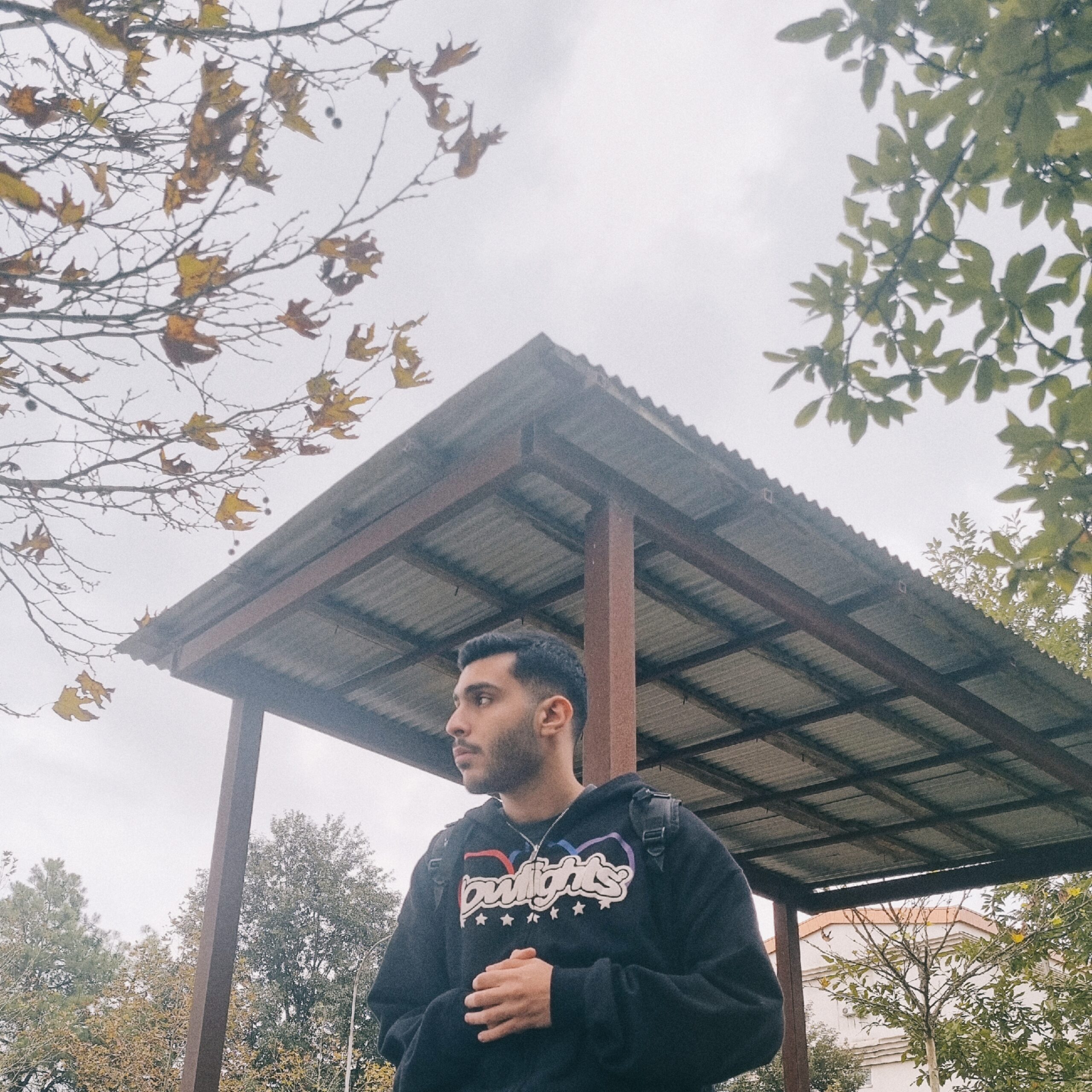
Ayk
Your earliest work involved meme tracks and voice messages with internet friends, how did that playful experimentation evolve into the psychedelic, boundary-pushing sound people hear now?
Experimentation is key to everything. I’ve always been obsessed with the idea of doing stuff with music that doesn’t seem doable. When we started our journey with meme tracks, we weren’t thinking about anything serious, but it slowly turned into a desperate effort toward a professional music career. Producing those tracks needed excessive creativity, even if it didn’t seem like it, because there was no structure and no pattern. We had to produce songs that were listenable and humorous using voice messages from Telegram, and the combination just didn’t seem to work. But we had to try, and all those hours we spent on meme tracks resulted in a broader view and artistic vision.
What technical or creative skills from those FL Studio Mobile days still carry into your current production process?
Lots of them, in fact. I still use FL Studio Mobile occasionally, especially t o chop samples. It doesn’t seem like it, but to me it’s much easier and there are more things you can do with samples. When I recorded my first tracks, I was totally unfamiliar with the mixing and mastering process, and I didn’t bother learning about it at all. Whatever I know comes from hours of being entangled with vocals that weren’t recorded properly and needed meticulous mixing to sound decent. I still find the app very useful and convenient.
When did you first feel that your music had moved from “internet hobby” to “serious artistic pursuit”?
Well, to put it frankly, I never did. Doing what I’m doing in such a country under terrible circumstances just seemed impossible, and not too many people have created English-based music that has gone global. But if I were to talk about a significant point in my career that opened my eyes toward a better musical approach, I’d say my collaborative efforts with two of my old buddies. We formed a trio and decided it was time we turned from fully comedic verses into semi-comedic ones that also contained serious material. Shortly after, I produced a couple of solo tapes and things got more serious over time.
The press release describes your music as “underground psychedelic hip-hop.” What does “psychedelic” mean to you in a hip-hop context?
To me, psychedelic means a combination of genres. It means experimental music that rekindles the lunatic in you and gives it the steering wheel. Music that drives you t o insanity, whether it’s the instrumentation or the lyrics that touch the deepest parts of you. Demon In The Mirror did that to me through both. Where I come from, hip-hop is tied to its original form and there isn’t much risk-taking done by producers. I believe it must change.

Ayk
You’ve cited electronic music influences; how do you balance electronic textures with traditional rap structures?
Electronic music, to me, is the foundation of every genre there has ever been. I grew up listening to Kanye West, and his album “Yeezus” is what really shook me the first time I heard it, as it contained electronic elements I hadn’t even heard of at the time. It was like an epiphany. My love for electronic music grew as I became older, and artists like Aphex Twin, Autechre, Squarepusher, and DJ Shadow became my inspirations, especially DJ Shadow, since we share a more similar approach when it comes to production.
Do you approach genre blending intentionally, or does it happen naturally as you produce?
I’d say it’s a deliberate act, but then I’d be lying. It just comes naturally, since all l’ve ever listened to and stuck with are works that are fusions of various distinct styles. I find it extremely intriguing to blend genres that weren’t meant to be blended. I think sampling plays a massive role in the process. Demon I n The Mirror itself samples a psychedelic rock track that I had found earlier on.
Demon In The Mirror is becoming a central track in your story. What personal or emotional themes were you confronting when you created it?
Most of what I create is personal, because otherwise I feel no need to create. Every story told is a precious gift, and I’d like to think that whoever listens to my music thinks the same way. Someone once told me that music must be therapeutic to the artist, and that’s what I’ve been holding on to since the beginning. Demon In The Mirror was meant to portray the chaotic nature of my life and how bizarre things were at the time. It depicts an all-over-the- place mess that became my day-to-day life. Unhappiness veiled by madness.
Demon In The Mirror is becoming a central track in your story. What personal or emotional themes were you confronting when you created it?
I think it has unlimited production potential. It could be turned into a hundred songs and still sound fresh. The energy that its instrumental brings is impeccable. I’m glad others could see the potential too, and I very much like both remixes. As I previously mentioned, that’s the nature of a genre- blending approach to music. It involves more people and more artists and gives you opportunities t o collaborate with people who had nothing to do with hip-hop to begin with.
Why do you think this track resonated enough to receive multiple remixes?
I think you described it best. It’s both, maybe more autobiographical if you pay close attention to the lyrics. But when I wrote the hook, I was thinking of symbolism and how seeing a demon in the mirror could be interpreted. The demon hasn’t taken control yet, but he’s visible and powerful. Not giving in to the demon but being aware of its existence is what I wanted the imagery to convey. The self- awareness concept has always been one that deeply influences me. I’ve also got a tattoo on my arm that says, “the giant looks i n the mirror and sees nothing. ” Donda West, Kanye’s mother, said that in a clip that ended up in his documentary too.
 Ayk
Ayk
Hearing other producers reinterpret your work can be a vulnerable experience, what was your reaction to the Som.1 and Trash Cells remixes?
Well, to me, it has never been anything even close to a vulnerable experience. In fact, I find collaborations extremely fun and fruitful. I’ve got a long history of letting people work on rough demos I’ve produced and sometimes even giving up creative control for the greater good, so it was a smooth and enjoyable experience to work with artists from different countries and communities. I enjoy both remixes and appreciate the effort both groups put into the process.
Did their breakbeat and deconstructed approaches reveal anything new about your original composition?
They certainly revived an inner ambition. The som. 1 remix is something I’d listen to every day myself if it were by another artist, just to show how big of a fan I am when it comes to breakbeat. The Trash Cells remix is also in tune with the original sample and the drums, which we had also used in the original track, so it’s much closer to the earliest version of Demon In The Mirror, and therefore there wasn’t much confusion as to how different it would become.
How open are you generally to collaborators reshaping your sound?
Well, as I mentioned before, I’m extremely fond of collaborations, especially ones that don’t seem doable, or at least seem strange. I must thank Renaat for making the remixes happen, due to his peculiar understanding of how things can work. His vision changed mine too.
The Twilight Marauders collective seems like an important creative circle for you, what role does collaboration play in your process today compared to your early internet groups?
Today, it’s much more limited compared to what it used to be. Twilight Marauders consisted of three rappers and three producers, with me being both when it came to crew work. Now it’s just me and Katana, my close friend and collaborator with whom I’ve made numerous tracks and albums. Being next to such a creative and excellent producer makes it easy to do things the way you want in the most perfect manner possible. He’s originally an electronic producer, and his interest in experimenting has fostered our musical chemistry beyond perfection. We work tirelessly and plan on releasing another EP before the end of the year, a successor to our previous project “Don’t Worry How I Grieve.”
How does being part of a collective influence your individuality as an artist?
I always try to bring the best out of the people I work with, and I’d like to think that I’ve accomplished that. My individuality lies within cooperative approaches, whether it’s music or theater, especially the latter. I’ve always wanted t o be in control of things when it comes to group work, to put it frankly, but working as a director in theatre helped me understand that the true value of group work lies in flexibility and acceptance of ideas that aren’t your own. Working with Katana also helped me understand how powerful like-minded people can be when they find common ground.
R&S Records has a strong legacy in electronic music. How did it feel to have your hip-hop project embraced by a label known for breaking genre boundaries?
Words can’t describe how proud I was when I first got in touch with them. Following the path o f artists like Aphex Twin, James Blake, and Nicolas Jaar was something I never deemed possible. I recall listening to “Drukqs” for the first time and wondering how a piece of work could be so mind- blowing and unique, and then suddenly, I was following in the footsteps of its creator. I want this opportunity for every single artist in my country and other countries that deprive their artists of opportunities and confine them by limiting their creativity. Where I come from, this is a once-in-a- lifetime opportunity that can’t be described b y words. I thank Renaat every day for believing in me and in people who can’t find their place in the world because of where they were born.
 Ayk – Demon In The Mirror – Release on R&S Records on 20th February 2026
Do you see this release as validation, opportunity or both?
I don’t see it as validation. Not yet. I believe there’s more work to be done and more chances to be taken. I do see it as a massive opportunity t o achieve that validation. Validation comes after release, and to me it’s not as precious as the opportunity. I think praiseworthy art proves itself in the long run, and right now, this is only the beginning of my journey.
Has working with an established imprint changed how you view your long-term career path?
How can the answer be no? Of course it has. It has altered the way I look at life too. Nobody believed me when I first announced my connection to such a renowned label far from the Middle East and its calamities. It made me believe that no matter the circumstances, it’s possible to reach certain heights that once seemed far away and unattainable. It made me realize that potential and effort are rewarded, whether it’s simple recognition or the provision of opportunities. As I previously mentioned, this is only the beginning of the journey, and I’m starting to realize how far I can go.
You’ve directed plays and acted on stage, does theatrical training influence your delivery or visual presentation in music?
There’s a plethora of intertwined moments when it comes to music and theater. As I said, directing plays gave me the confidence to lead a group and simultaneously step aside and listen to what others have to say. It made me much more patient and understanding. The creative part has also been interconnected since the start. In theater, every moment must be meticulously observed, and I think the same goes for music. Both are rhythmic, personal experiences that can touch the human soul beyond anything else.
Do you think audiences experience your music differently when you perform live because of that background?
I haven’t had the pleasure o f performing live yet, since we live in a restricted environment that doesn’t allow people like m e t o take their music t o the stage. Believe it or not, permits are given to artists if they are to perform, and only legalized pop music enters that list. But I’ve always thought about how energetic and brilliant it must be to involve your audience and bring them as close as possible to the music itself.
You’ve mentioned a new album with production already completed, is it a continuation of the psychedelic hip-hop direction or a departure?
There has been a hiatus in my work, and I wasn’t able to do anything in particular regarding my musical career for the past few months, but I managed to produce lots of material that remained unreleased. It is indeed a continuation o f the experimental approach I picked earlier, and there are psychedelic elements present too, but the most prominent sounds are those created with synthesizers. The drums are, at times, weird and noisy, and I’d say there’s too much going on. Contrary to my previous releases, I’ve decided to focus more on the production part rather than the lyrics. I’ve also had the chance t o work with lots of different producers, notably one of my guitarist buddies who brings electronic guitar sounds into multiple moments on the album. I think it’s a psychedelic experience rather than a musical approach.
At 22, you’ve already crossed several artistic disciplines. What creative frontier are you most excited to explore next?
The music. I’ve been gripped by its potential, and I’m beginning t o think there’s much more to it than I’ve ever thought. The theatrical stuff too, but since there have been more accomplishments in that field, I’m more curious about what music can be to me and the people who work with me. I want to explore more genres and create things that exceed my current abilities.
If listeners discover you through this R&S release, what do you hope they understand about Ayk beyond the genre label?
I hope they grasp the difficult situation artists like me are in. Aside from the current tribulations in my country, the usual hardships and restrictions against artists like me are greater than people think. To be able to do this is a blessing I wish for everyone who thinks their situation is the biggest obstacle on their way to success. It isn’t. We can’t be silenced, and we will never be. I want people to see the music as it is, not something our circumstances shape us to be. To be able to touch souls far from where you live is the greatest achievement ever.
Demon In The Mirror by Ayk is available on R&S Records from 20th February 2026.